Astrophotography diagnosis of M31: Backfocus error, clipped stars and 1 other
ProcessedAntlia triband
The Doc examined this image of M31 (processed, Antlia triband). Estimated overall technical quality: 6/10. 3 defects found: Backfocus error (severity 2/5), Clipped stars (severity 2/5), Oversaturation (severity 2/5).
&w=1920&q=75)
Info
- Cible
- M31
- Position
- 0h42m43s · +41°16'12"
The 76 percent waxing gibbous Moon is unfavorable for a broadband galaxy like M31: its continuum flux (stars, bulge) is swamped by the lit sky background, which crushes the contrast of the arms and dust lanes. The triband filter cuts some of this moonlight but it also blocks most of the galaxy's stellar light, hence the reddish rendering. The measured background stays clean (no gradient detected), a sign the calibration handled illumination well, but for M31 it is better to target a moonless night or far from the Moon.
Setup
- Type d'image
- Traitée
- Télescope
- sky-télescope 150 Quattro
- Caméra
- ASI26000MC Duo Air
- Filtre
- Antlia triband
- Monture
- EQ6-R pro
- Phase de lune
- Waxing gibbous (76 %)
- FOV
- 3.00°
The 150 Quattro Newtonian (600 mm) with the ASI2600 gives about 1.3 arcsec/px, comfortable sampling, and the 3 deg field frames M31 with M32 and M110 perfectly: a very coherent setup geometrically for this target. The weak point is the Antlia triband filter on a galaxy: M31 is a broadband object (stellar continuum), and a tri-band filter only passes Ha/OIII, hence the red-brown tint and loss of natural color. For M31 prefer a UV/IR cut or a mild light-pollution filter. Also check the coma corrector backfocus to tighten the edges.
The diagnosis in detail
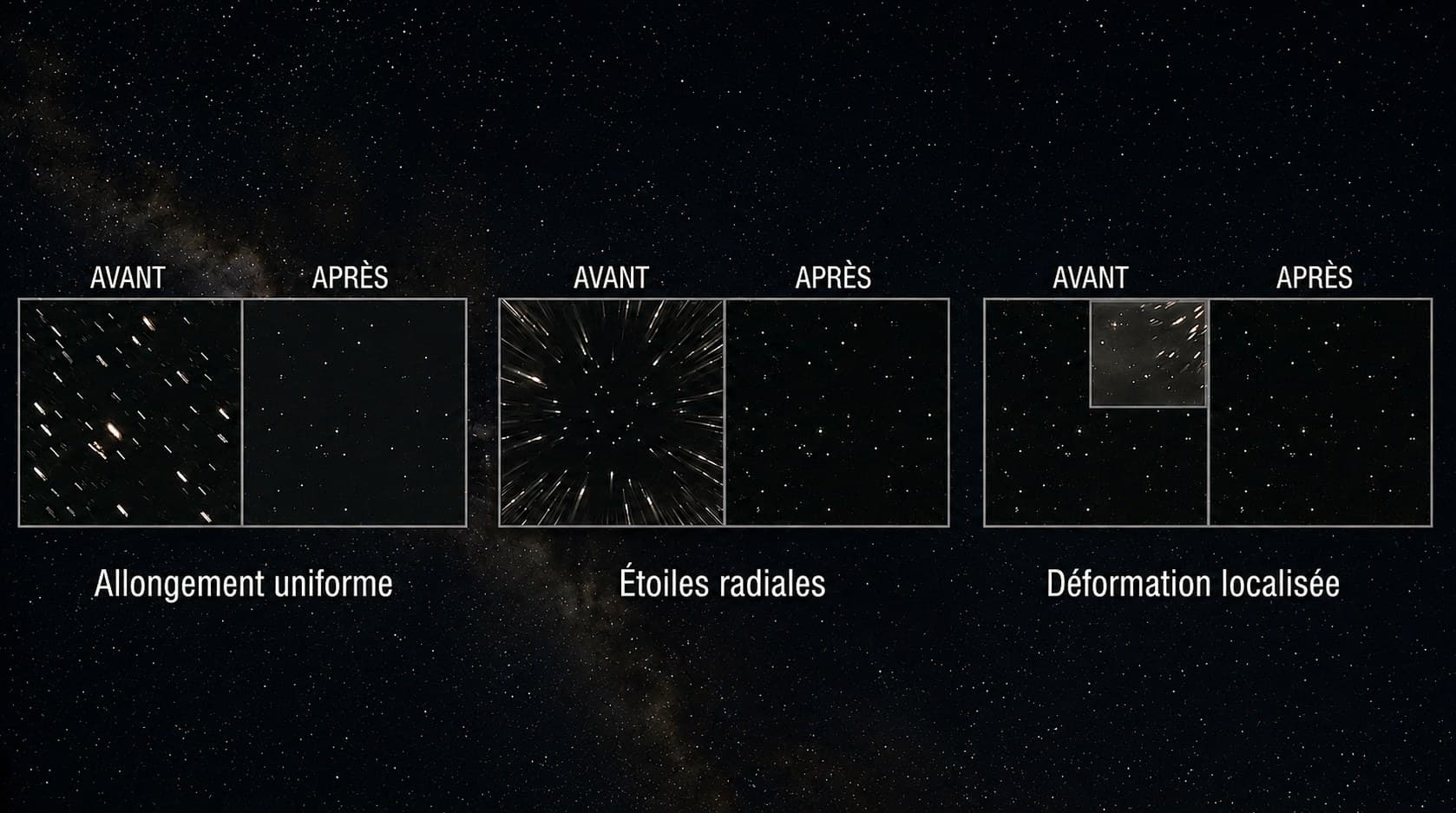
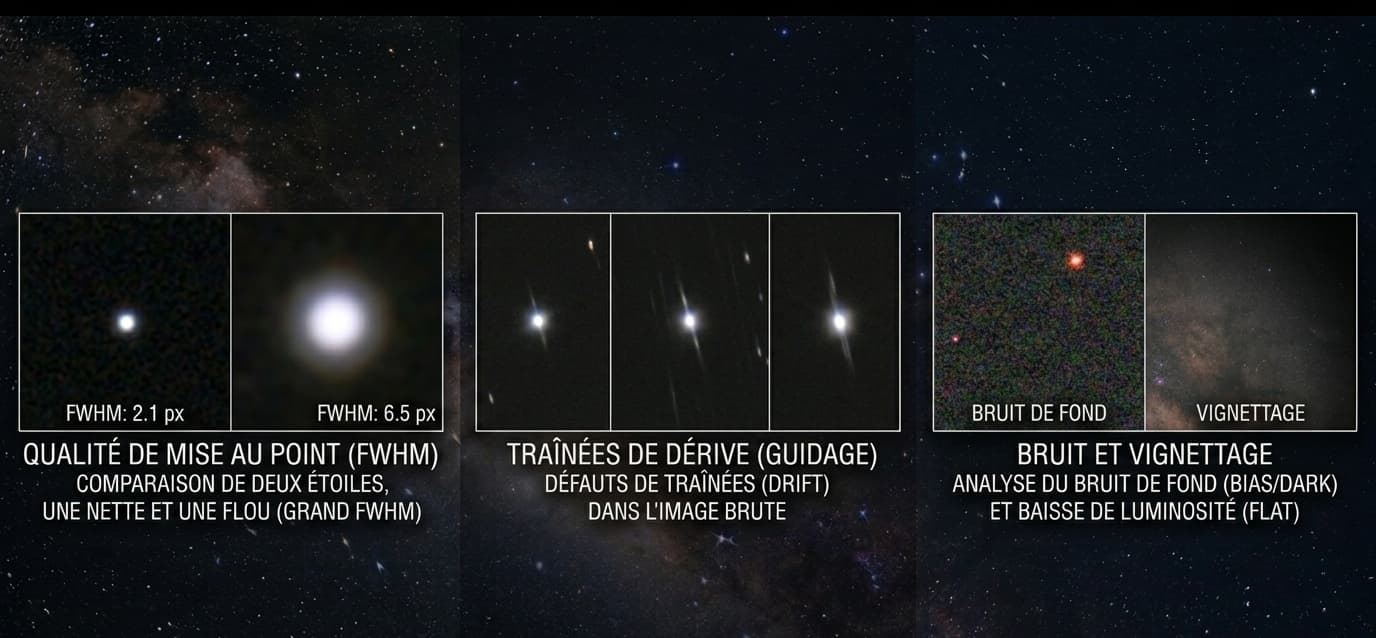
The PSF inspection is reassuring on tracking and guiding: the center is the sharpest point (FWHM 4.1, elong 1.09 at the field floor) and PA dispersion is low, with no uniform directional elongation. The degradation happens at the edges with a symmetric FWHM rise in all four corners (corner/center ratio 1.24) and slightly oval stars without radial coma tail or diagonal asymmetry: this is field curvature / backfocus to adjust, not tilt or true coma, on this demanding f/4 Newtonian.
Most of the diagnosis is color- and processing-related. The strong red-brown cast and the loss of bulge hue come mainly from using a triband filter on a broadband target: M31's stellar continuum is filtered out, which desaturates the galaxy and brings out Ha from the HII regions. Add to this clipped bright star cores and a bulge drifting toward a white plateau, signs of a stretch pushed a bit hard on the highlights.
The measured sky background is flat (no gradient), a good point despite the 76 percent Moon and confirming effective calibration and background removal. The priority is therefore color rendering and highlight management, then refining the backfocus for sharper edges.
Priority actions
- Redo the color calibration (SPCC/PCC) or switch filters: a UV/IR cut suits broadband M31 better than the triband
- Protect the highlights: short subs for star cores and the bulge, gentler highlight stretch
- Fine-tune the coma corrector backfocus (0.5-1 mm spacer rings) to tighten edge stars
- Favor a moonless night to gain contrast on the arms and dust lanes