Astrophotography diagnosis of IC1396_0724: Tracking drift, backfocus error and 1 other
Raw300s26 juil. 2026
The Doc examined this image of IC1396_0724 (raw, 300s). Estimated overall technical quality: 6/10. 3 defects found: Tracking drift (severity 3/5), Backfocus error (severity 2/5), Satellite trail (severity 1/5).
&w=1920&q=75)
Info
- Cible
- IC1396_0724
- Date
- 26 juil. 2026, 01:56
- Lune
- Croissant décroissant 11.6% (sous l'horizon)
- Site
- Bortle 2 · rural typique (VIIRS)
- Position
- 21h40m36s · +58°16'59"
Excellent conditions: Bortle 2 gives a very dark background and high SNR even at 300s, confirmed by a deep black background with no light-pollution gradient. The Moon is at 11.6% and below the horizon, 101 degrees from the target: no lunar contribution, moon gradient excluded. Nothing limits the shot on the sky side; on a region like IC1396, rich in Ha and dark dust, this sky lets you reach the IFN and faint structures. The only limit is mechanical (tracking), not the sky.
Setup
- Type d'image
- Brut
- Télescope
- EQMod Mount
- Caméra
- ZWO ASI585MM Pro
- Exposition
- 300s
- Phase de lune
- Gibbeuse croissante (87 %)
- FOV
- 1.70°
Consistent for the target. At 375mm and 1.595"/px on a 3840x2160 sensor, the 1.70 degree field frames the IC1396 complex well with margin, comfortable sampling for current seeing (center FWHM ~2.4px, neither over- nor under-sampled). The ASI585MM at gain 252 is high, but the histogram shows no clipping (dark 0%, saturated 0%): offset 15 is sufficient, cooling at -17.5C is healthy. The background/black-point margin e_margin=1.93 is low, which is NORMAL here (very dark sky under Bortle 2 with moderate exposure), not a sign of underexposure. The weak link is tracking, to secure before lengthening exposures.
The diagnosis in detail
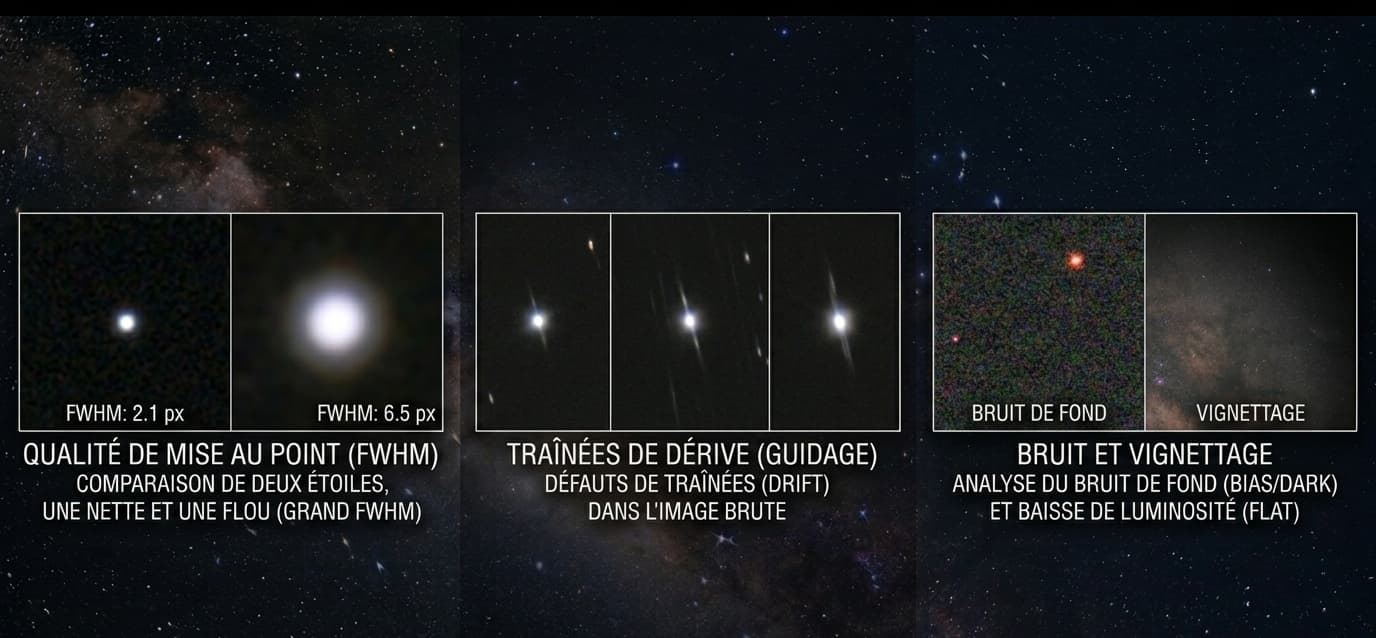
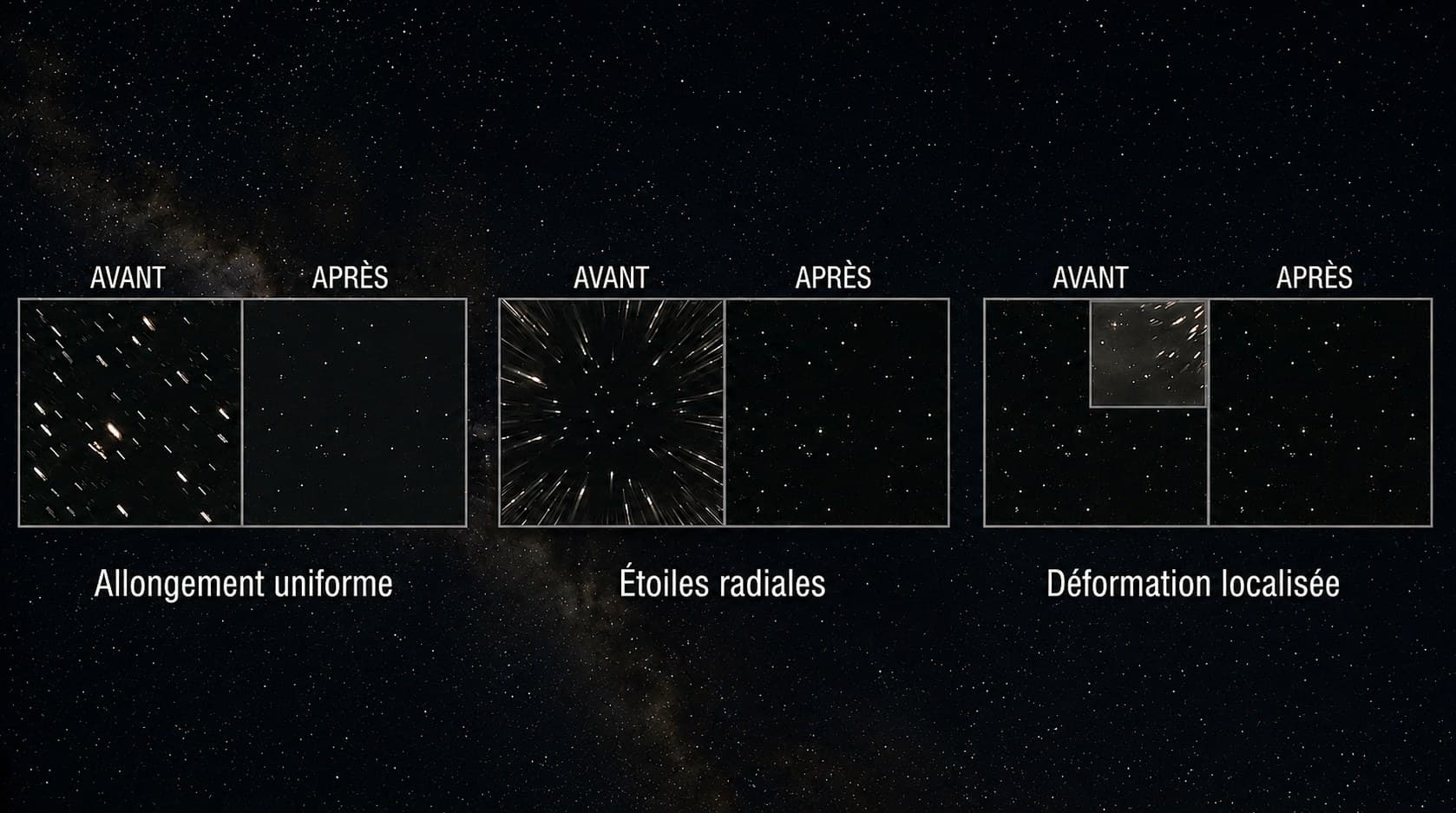
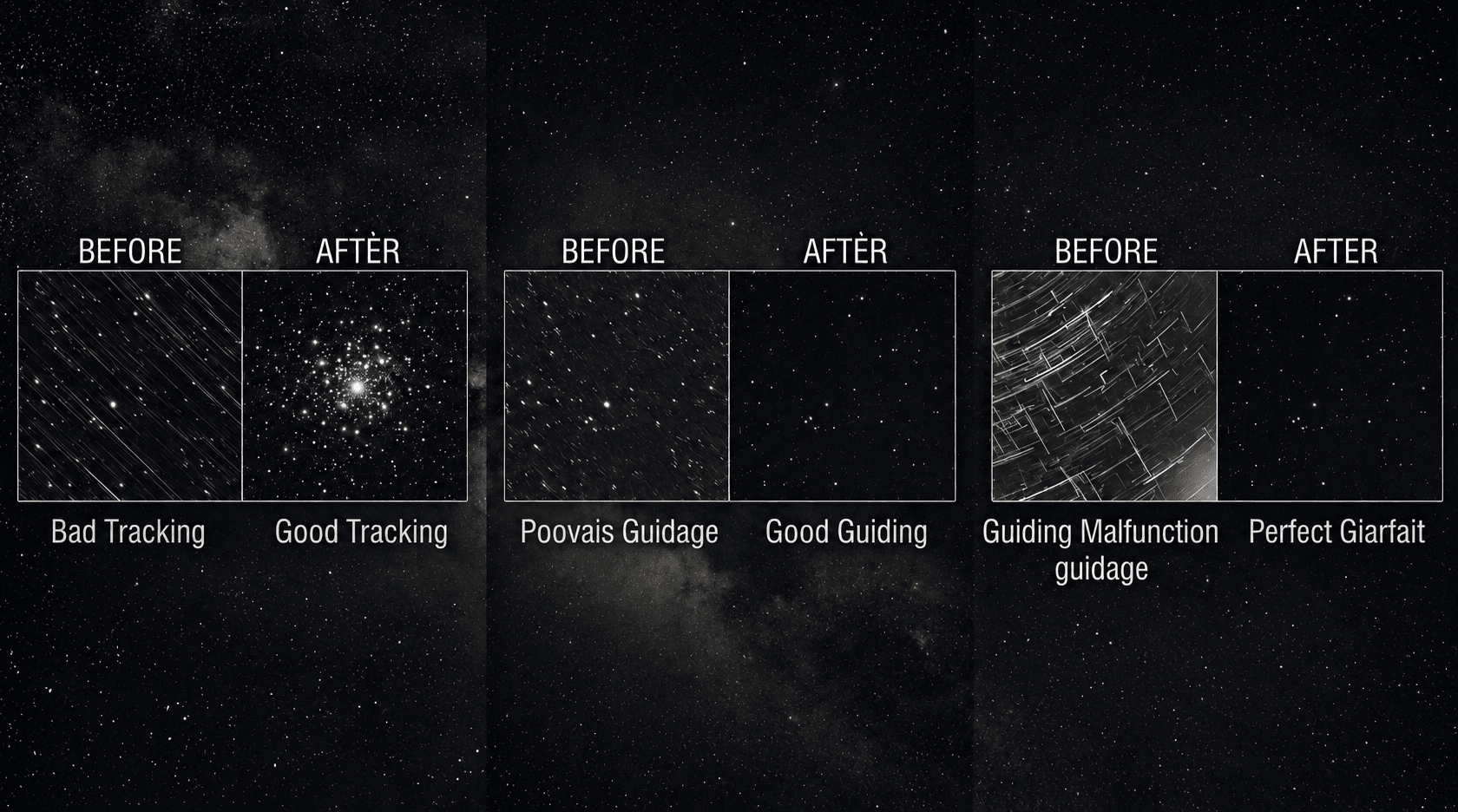
The image is clean on the sky and acquisition-calibration side, but the star shapes reveal two distinct causes that must be separated. First, tracking drift: the PSF sheet shows elongation present even at center C (elong 1.58 while the field floor is 1.39) with a very coherent direction (PA grouped at ~-55 degrees, 7.4 degree spread). A purely optical defect would leave the center round; here it isn't, so the mount/guiding is the primary culprit.
Second, radial broadening is superimposed on the edges: FWHM goes from 2.4px at center to 4.1px at the TR corner (ratio 1.63), with oval, non-comet stars, typical of backfocus/field curvature, plus a slight horizontal asymmetry (0.16) that may hint at some tilt. Since the drift dominates and partly masks the corner reading, fix tracking first, then re-measure: if corners stay stretched once stars are round at center, adjust the backfocus.
The rest is healthy: Bortle 2 background with no gradient, real dark nebulosity (IC1396 confirmed by the DSS), histogram with no clipping. The satellite is anecdotal and will vanish during stacking.
Priority actions
- Secure autoguiding (PHD2) to bring central elongation below the field floor
- Check/refine polar alignment to remove the slow drift
- After clean tracking, re-measure corners and adjust backfocus in 0.5-1mm steps
- Integrate with sigma rejection over >=5 subs to erase the satellite trail