Astrophotography diagnosis of M31: Tracking drift, light pollution gradient and 2 others
Processed
The Doc examined this image of M31 (processed). Estimated overall technical quality: 6/10. 4 defects found: Tracking drift (severity 3/5), Light pollution gradient (severity 3/5), Noise / underexposure (severity 3/5), Clipped stars (severity 2/5).
&w=1920&q=75)
Info
- Cible
- M31
- Position
- 0h43m34s · +41°11'03"
The last-quarter Moon at 43% illumination is a moderate handicap for a galaxy shot without a filter: M31's broadband continuum takes lunar scattering head on, lifting the sky background and flattening the contrast of the outer arms. Here it compounds a background gradient measured at 97% amplitude, oriented westward. For a broadband target like M31, aim for a window near new Moon, or at least wait until the Moon has set before starting the run. On an emission nebula a dual-band filter would have saved the day, but on a galaxy that is not an option.
Setup
- Type d'image
- Traitée
- Phase de lune
- Dernier quartier (43 %)
- FOV
- 3.76°
The Vespera III on M31 is a coherent choice: the 3.76 degree wide field encloses the whole galaxy with room to spare, plus M32 and M110, with no risk of cropping. The framing is well centred and lets the extensions breathe. The limit is the total exposure time, just 1h27, which is short for a galaxy under a 43% Moon: the signal in the outer arms sits right at the noise floor, and the histogram confirms it (background-to-black-point margin of 2.19, 9.55% of pixels clipped in the shadows). Without a filter, the fix is not optical but temporal: stack more, across several nights if needed.
The diagnosis in detail
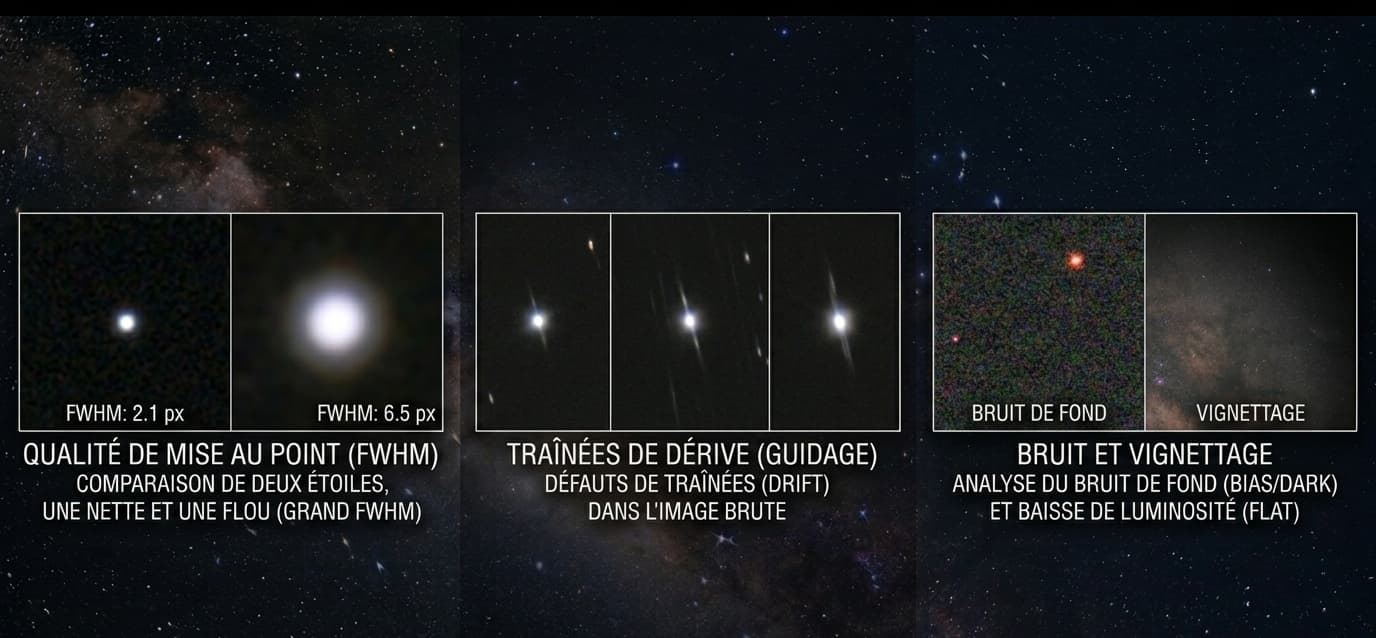
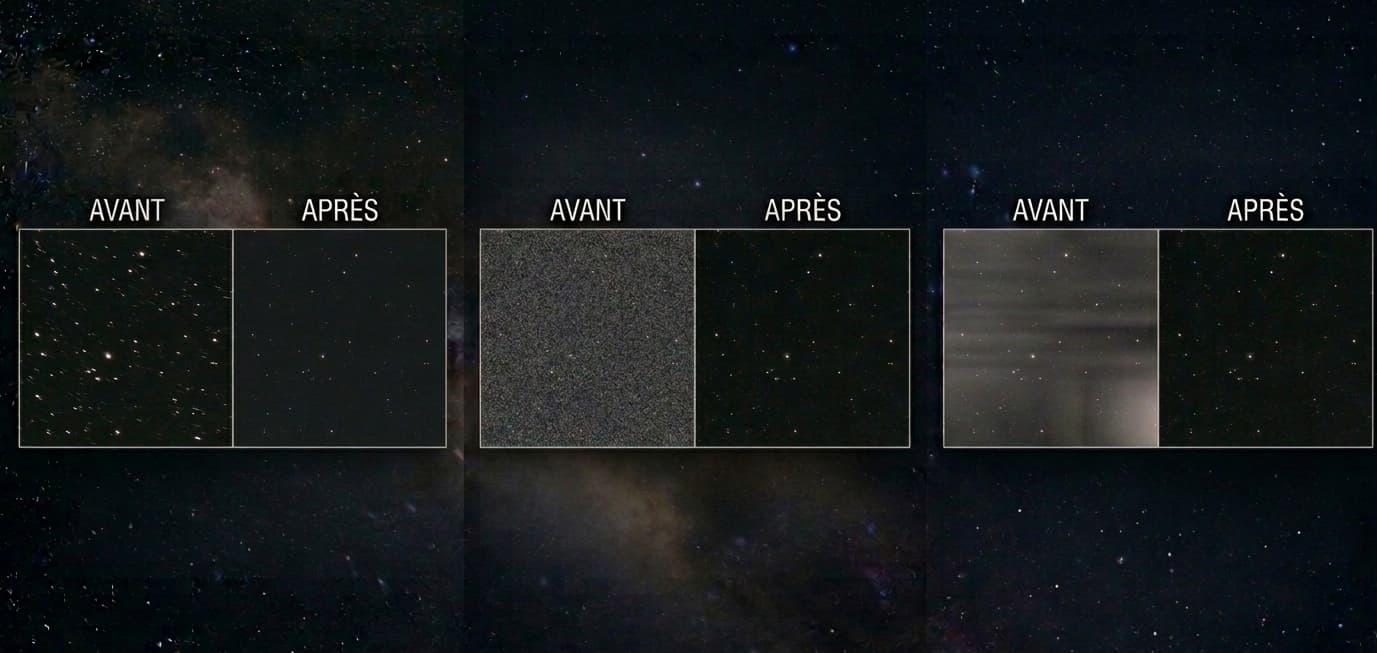
The diagnosis revolves around two independent causes, one at acquisition, the other in processing. At acquisition the PSF sheet is unambiguous: elongation is 1.32 at the centre of the field against a floor of 1.14, and the corner/centre FWHM ratio is 0.994, so the corners are no more degraded than the centre. This is not an optical aberration but a uniform field-wide distortion with clustered position angles (spread 19.9 deg), meaning tracking drift. On a compact alt-az platform this is classic behaviour when levelling or initialisation is not perfect. The tilt candidate at 39% confidence is rejected: it is incompatible with a corner/centre ratio of 1.
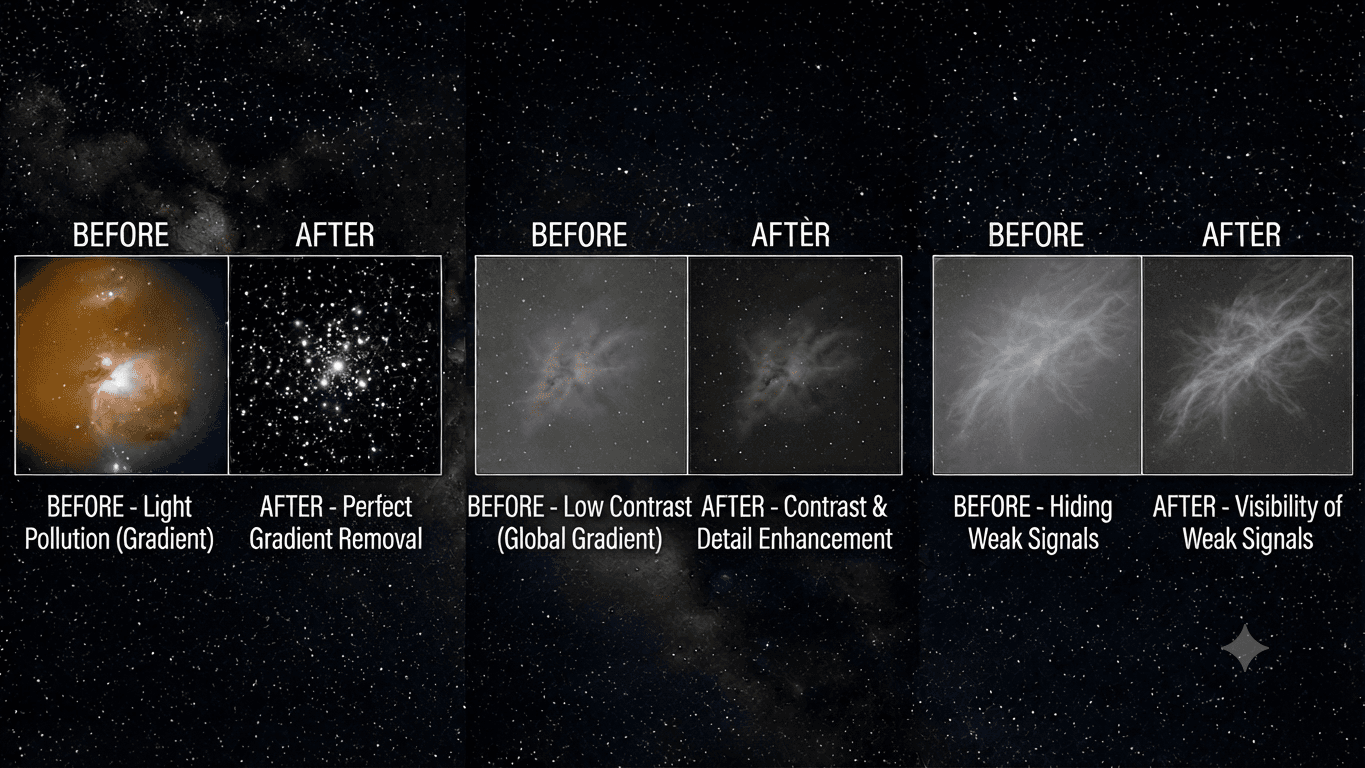
In processing, the background carries a linear gradient clearly dominating the radial component (factor 5.8), which was not extracted before stretching. That gradient likely led to hardening the black point to mask the imbalance, hence 9.55% of pixels crushed in the shadows and a background-to-black margin of only 2.19. At the other end of the histogram, the nucleus and a few bright stars go to a flat white plateau.
With just 1h27, the faint extensions the DSS shows remain out of reach. The logical order is therefore: more integration, gradient extraction, then stretch.
Priority actions
- Re-level and re-initialise the Vespera before each session to eliminate the tracking drift
- Extract the background gradient (GraXpert or DBE) on the linear image, before any stretch
- Accumulate 4 to 6 hours of integration on M31, spread over several nights if necessary
- Redo the stretch with a raised black point to eliminate the 9.55% of clipped shadows
- Favour a moonless window for this broadband target