Astrophotography diagnosis of M33: Sensor tilt, clipped stars and 1 other
Processed
The Doc examined this image of M33 (processed). Estimated overall technical quality: 7/10. 3 defects found: Sensor tilt (severity 2/5), Clipped stars (severity 2/5), Noise / underexposure (severity 2/5).

Info
- Cible
- M33
- Position
- 1h33m55s · +30°39'54"
A waxing crescent at only 10%: the sky background barely suffered, and the background map confirms it with a plane gradient amplitude of just 1% (R² 0.02, so no preferred direction). These lunar conditions are ideal for a galaxy like M33, which needs broadband contrast and does not tolerate moonlight. The weak point therefore is not the sky but the cumulated time: with such a discreet moon, you should have capitalised and stacked far longer. On upcoming near-new-moon nights, reserve them in priority for low surface brightness targets of this kind.
Setup
- Type d'image
- Traitée
- Phase de lune
- Waxing crescent (10 %)
- FOV
- 1.68°
A 1.68° wide field for M33 (about 70 arcmin): the framing is well sized, the galaxy fills a good half of the frame with the margin needed for the faint extensions towards the north-east, and nothing is cut off. Monochrome camera, with a central FWHM of 3.08 px: the useful resolution is there, the optics deliver on axis. The downside is the imaging train, which degrades the edges by roughly 30% through a residual tilt. On such a tight field, this is exactly the kind of defect fixed by mechanically revisiting backfocus and clamping, not by software. Also check the flatness of the corrector before the next session.
The diagnosis in detail
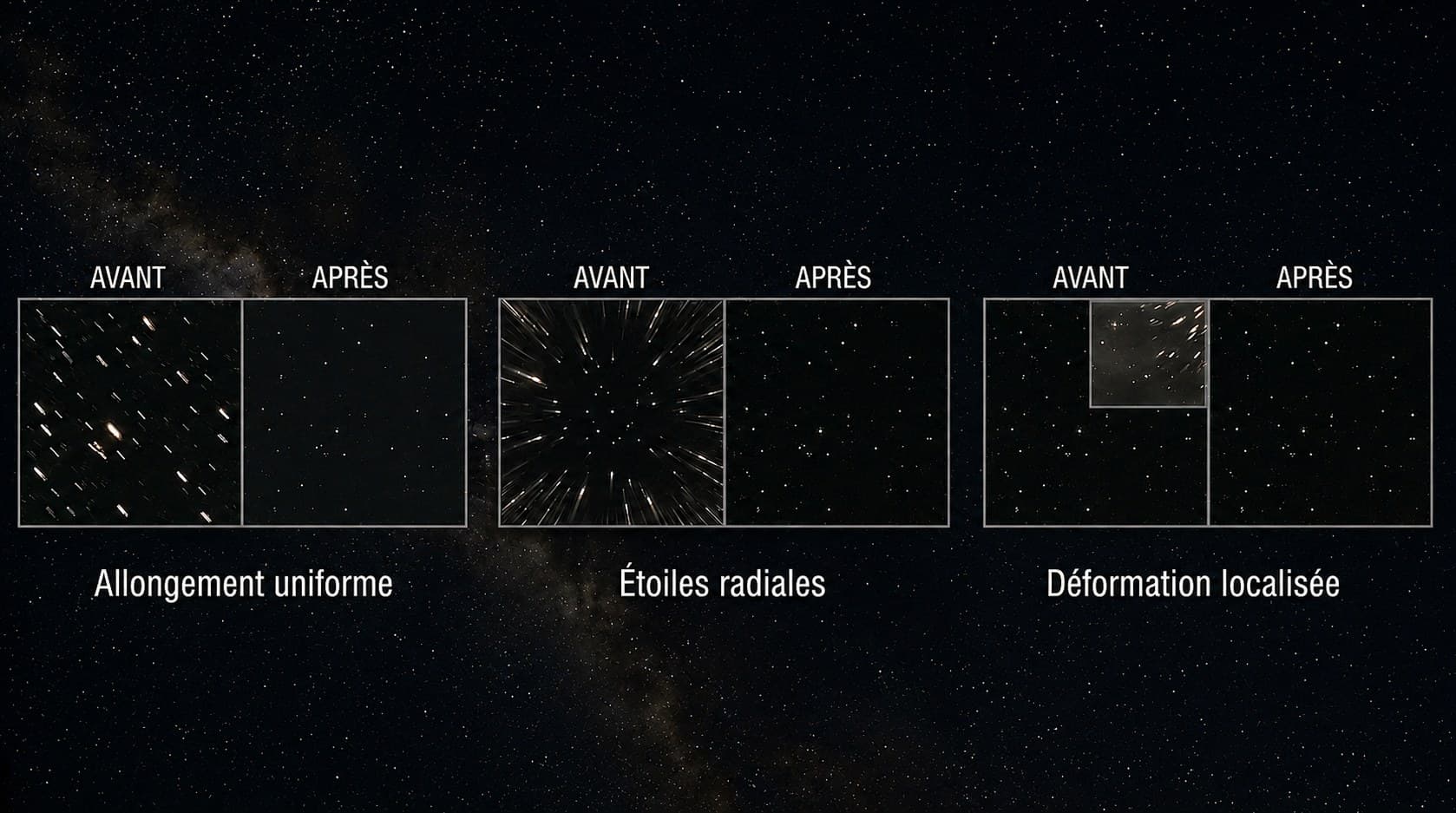
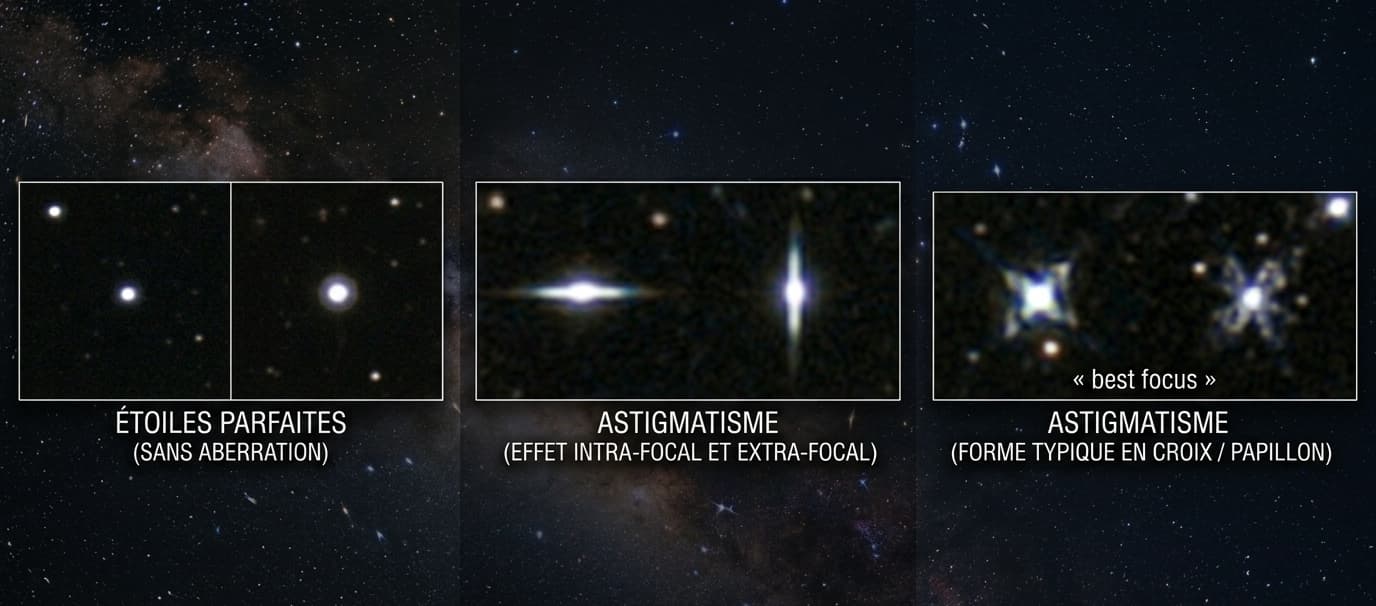
The diagnosis centres on a single mechanical axis. The Moffat measurement is unambiguous: elongation at centre 1.06 against a field floor of 1.01, PA dispersion of 35°, hence no tracking component. Stars are round everywhere, which rules out drift, periodic error and guiding oscillation. The corner/centre FWHM ratio, however, reaches 1.31 with an uneven asymmetry between opposite corners: top-right stays at 3.8 px and elong 1.01 while bottom-right climbs to 4.06 px elong 1.07 and the left edge to 4.27 px. This uni-axial signature, sharp centre and unequal opposite corners, matches a sensor plane tilt rather than field curvature, which would give a homogeneous radial degradation across all four corners.
The rest comes down to processing and data quantity. A few stellar cores are clipped to neutral white, without seriously harming readability. More limiting, the background keeps a clear graininess and M33's outer arms, rich in HII regions, stay timid: the background-to-black-point margin of 1.84 signals a still weak signal. Calibration itself is sound: the background map shows radial symmetry with no oriented gradient, so flats and background subtraction did their job.
Logical priority: fix the tilt mechanically, then lengthen integration. The two combine to gain sharpness at the edges and depth on the extensions.
Priority actions
- Fix the imaging train tilt: revisit the clamping, limit adapters, then fine-tune with a tilt adjuster while checking via aberration inspector
- Substantially lengthen integration on M33, aim for 8-15 h to lift the outer arms out of the noise
- Add a few hours of Ha to reveal the galaxy's HII regions, NGC 604 first
- Protect highlights during the stretch (luminance mask or star/starless processing) to restore the colour of stellar cores