Astrophotography diagnosis of M42 - The Great Orion Nebula 1st capture (2019): Oversaturation, tracking drift and 1 other
ProcessedL 17×120s (total ~0.6 h)28 oct. 2019
The Doc examined this image of M42 - The Great Orion Nebula 1st capture (2019) (processed, L 17×120s (total ~0.6 h)). Estimated overall technical quality: 6/10. 3 defects found: Oversaturation (severity 3/5), Tracking drift (severity 2/5), Noise / underexposure (severity 2/5).
&w=1920&q=75)
Info
- Cible
- M42 - The Great Orion Nebula 1st capture (2019)
- Date
- 28 oct. 2019, 00:00
- Position
- 5h35m17s · -5°23'24"
Moon at 0% on 2019-10-28: ideal in terms of lunar illumination, no moon gradient expected and none visible. This is the main favorable factor of the session: you get a dark sky for a broadband target like M42, which is exactly the right call. The residual background noise therefore comes not from the Moon but from the short integration time and uncooled sensor. To improve on this target, the priority is to accumulate more subs rather than chase a gradient that is not present here.
Setup
- Type d'image
- Traitée
- Télescope
- Nikkor AF Zoom 70-300mm f/4-5.6G
- Caméra
- Nikon D7200
- Monture
- iOptron SkyGuider Pro
- Exposition
- L 17×120s (total ~0.6 h)
- Phase de lune
- 0%
- Notes
- Logiciels : Lightroom, Photoshop, DeepSkyStacker (DSS)
- FOV
- 4.50°
The Nikkor 70-300mm at 300mm gives a ~4.5 wide field: M42 and its surroundings (NGC 1977, NGC 1981) fit comfortably, the framing is generous and well suited to this extended complex. The D7200 + SkyGuider Pro combo is fine for unguided wide-field, but 120s at 300mm is near the limit the mount can handle unguided, hence the slight measured drift. Shortening exposures (60-90s) and refining polar alignment would tighten the stars. For the saturated M42 core, a short-exposure layer is essential with this wide-field setup.
The diagnosis in detail
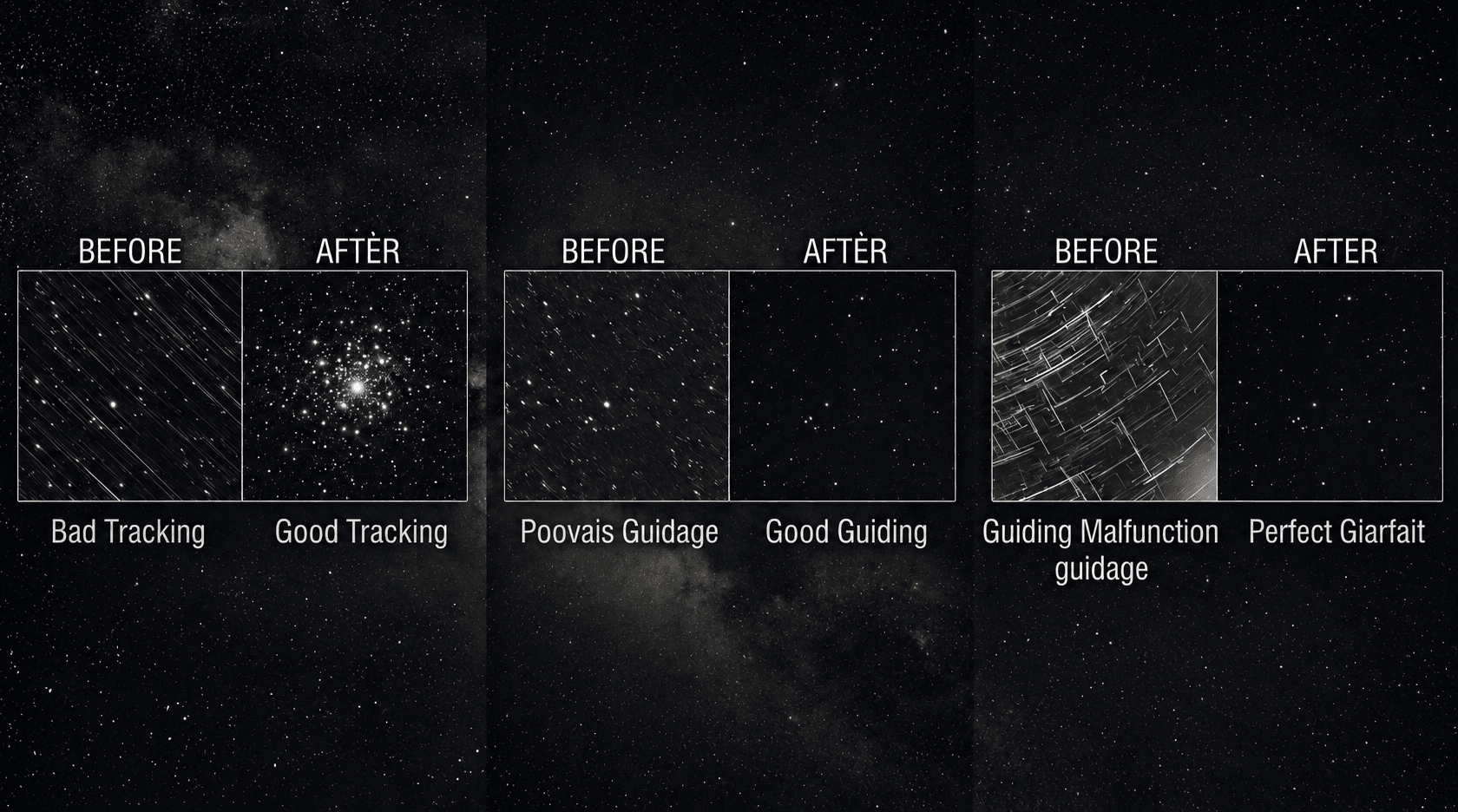
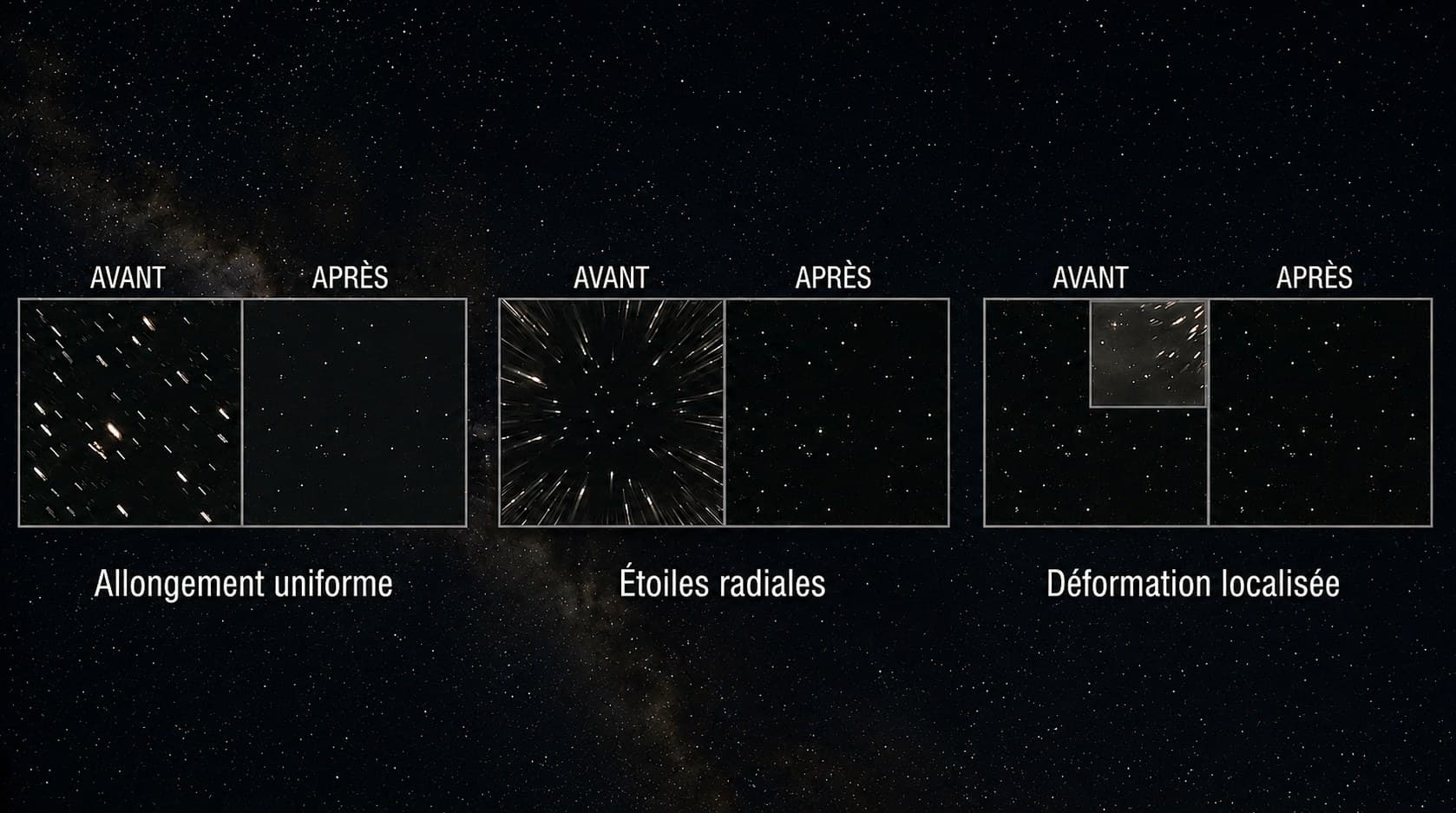
The PSF panel shows a near-round center (elong 1.13, at the field floor 1.12) but corners stretched to 1.25-1.26 with very low PA dispersion (9.8 deg): the signature of uniform tracking drift rather than a field optical defect. This is consistent with an unguided SkyGuider Pro pushed to 120s at 300mm. The optics are not at fault (corner/center ratio 0.92, low asymmetries), so everything comes down to polar alignment and exposure length.
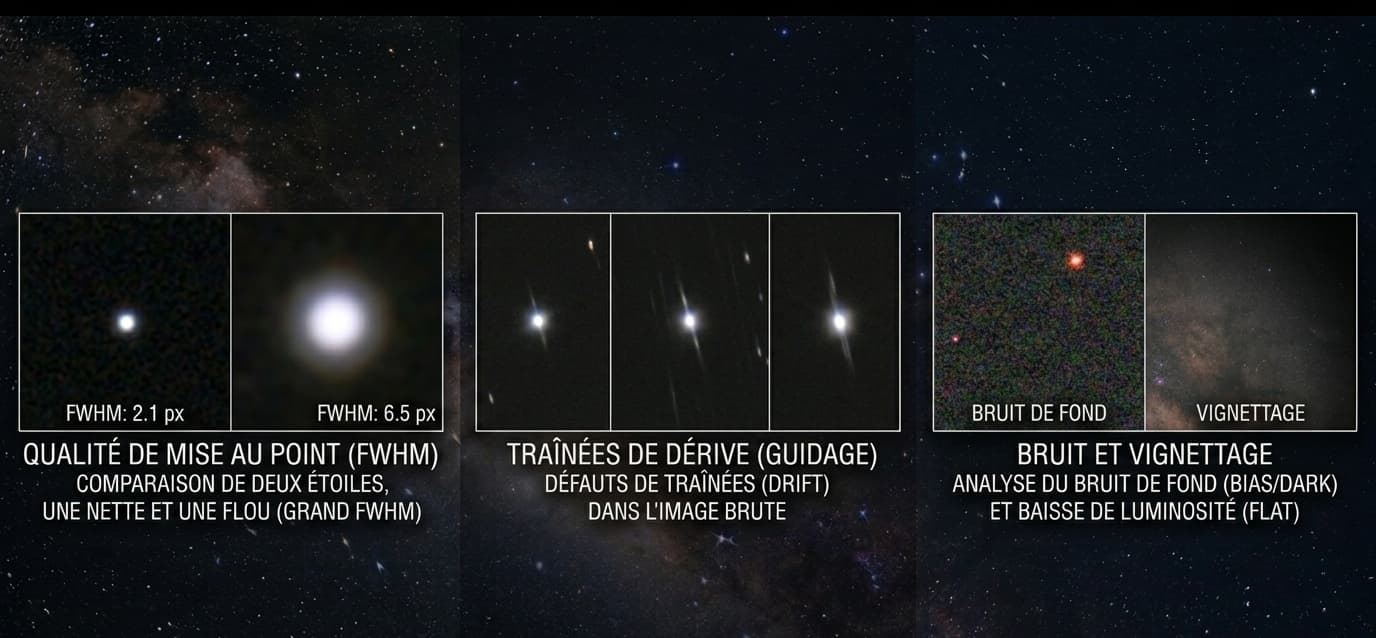
The Trapezium core is clipped to a flat white plateau where the DSS retains structure: this is a recoverable processing defect, fixable with a short-exposure layer and a highlight mask, not an optical shortcoming. The low total integration (~0.6h) finally explains the residual background noise and the lack of detail in the faint extensions.
Overall this is a solid first capture: the priority is not a cosmetic reprocess but acquisition (more time, short subs for the core, better polar alignment).
Priority actions
- Refine polar alignment and shorten exposures to 60-90s to remove the tracking drift at 300mm
- Capture a short-exposure layer (5-15s) to reconstruct the blown M42 core via HDR
- Greatly increase total integration time (aim for 2-4h) to reduce background noise