Astrophotography diagnosis of NGC 1893: Backfocus error and tracking drift
Raw420s03 oct. 2026
The Doc examined this image of NGC 1893 (raw, 420s). Estimated overall technical quality: 7/10. 2 defects found: Backfocus error (severity 3/5), Tracking drift (severity 2/5).

Info
- Cible
- NGC 1893
- Date
- 03 oct. 2026, 00:49
- Lune
- Croissant croissant 44.5% (34.7° d'alt., 13.5° de la cible)
- Site
- Bortle 2 · rural typique (VIIRS)
- Position
- 5h20m24s · +34°09'54"
Bortle 2 is an exceptional sky, and the background confirms it: median at 0.02 with a black point at 0.01, no exploitable light pollution gradient. The Moon is the real story here: 44.5 percent illuminated, 34.7 degrees above the horizon and only 13.5 degrees from the target, essentially a light source inside the frame. On an emission target like IC 410, a narrowband filter handles this configuration very well, confirmed by the absence of any measurable lunar gradient. In broadband or RGB, the same night would have been unusable. If you want continuum or stellar color on this field, shift the session to after moonset.
Setup
- Type d'image
- Brut
- Télescope
- EQMod Mount
- Caméra
- ZWO ASI585MM Pro
- Exposition
- 420s
- Phase de lune
- Dernier quartier (59 %)
- FOV
- 3.36°
Setup is well matched to the target overall. With 190 mm of focal length and a 3840 px sensor you cover 3.36 degrees wide: IC 410 and IC 405 both fit in the frame with room to spare, a deliberate and successful widefield composition. Sampling at 3.148 arcsec per pixel is clearly undersampled though, with stars down to 1.4 px FWHM at center, right at the Nyquist limit: you lose stellar detail, but the tradeoff is defensible on a field this wide. Gain 180 on an ASI585MM is above unity, but with only 0.01 percent saturated pixels and zero dark clipping at offset 15, the histogram is healthy. Sensor at -20 degrees, perfect. The e_margin of 2.28 flags a background sitting close to the black point, but that is normal behavior for a 420 s narrowband sub under a Bortle 2 sky: do not try to push the exposure longer.
The diagnosis in detail
The diagnosis comes down to one hard point: the optical train does not form a flat focal plane across the sensor. The Moffat measurement is unambiguous, 1.42 px FWHM at center against 2.04, 2.33, 1.76 and 2.19 px in the four corners, with horizontal asymmetry of 0.09 and vertical of 0.068, both low. This symmetric rise across all four corners, with no favored diagonal, rules out sensor tilt and points directly at incorrect spacing or uncorrected field curvature. The corner-to-center ratio of 1.48 is beyond what a stack can absorb: edge stars will stay soft regardless of total integration.
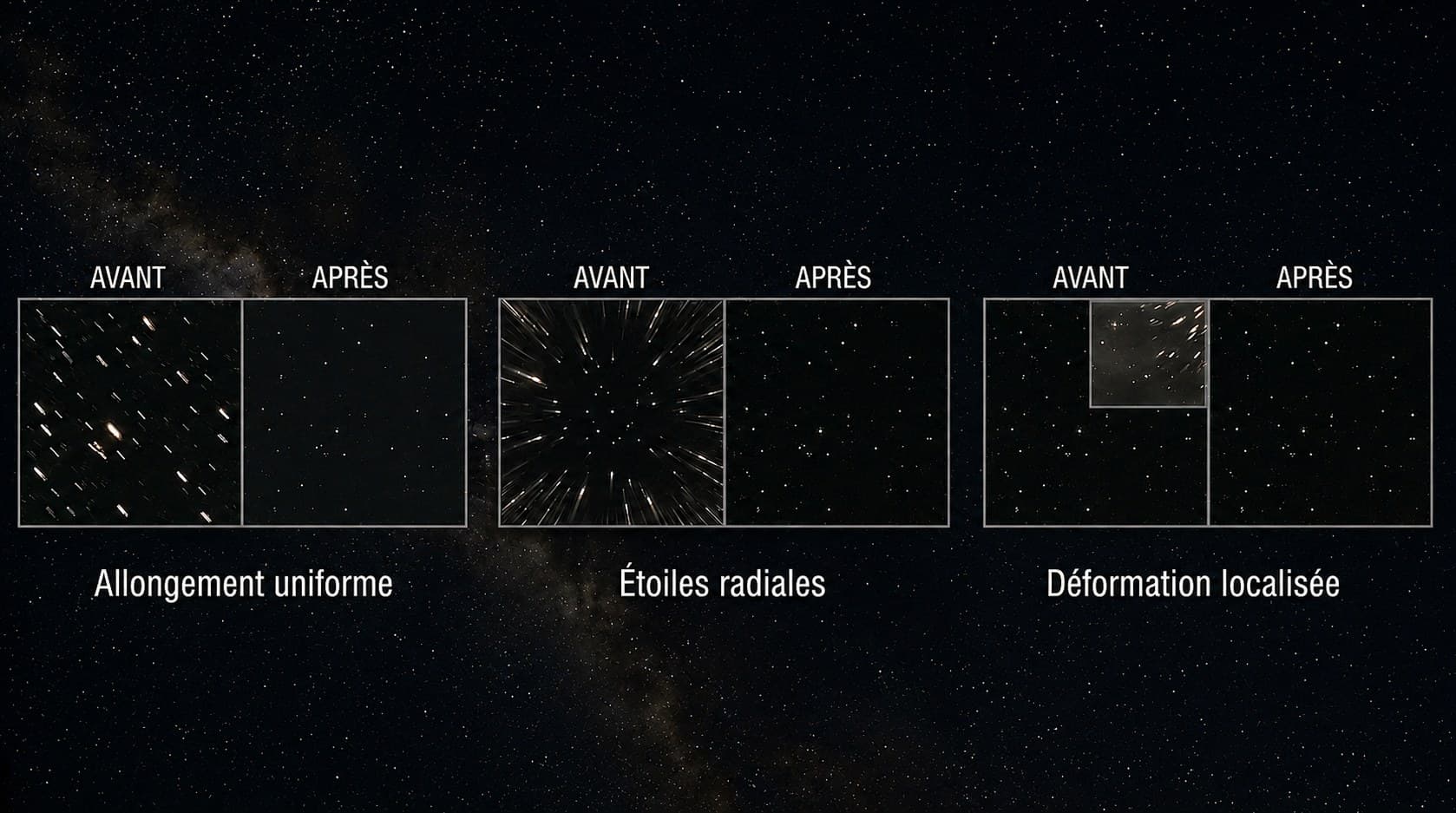
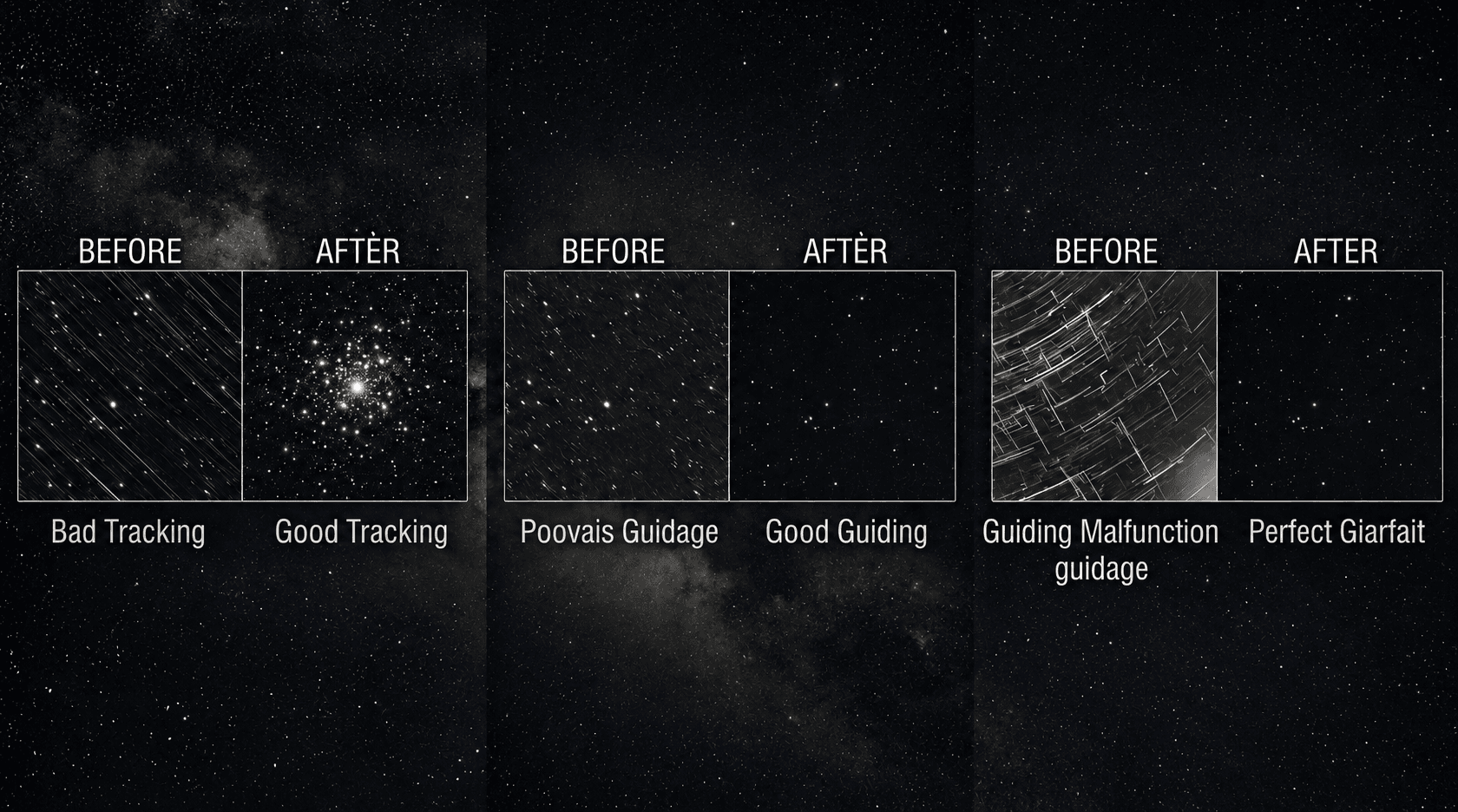
The second component is far more benign. Central elongation of 1.13 sits exactly at the field floor, so center stars are round, but a PA dispersion of only 11.7 degrees shows this residual elongation is coherently oriented across the whole frame. Over a 420 s exposure, that is the signature of slow drift rather than guiding oscillation, which would scatter the PAs. The effect is at the edge of measurability and does not degrade this frame, but it will compound if polar alignment drifts through the night.
Everything else is sound. The DSS comparison validates the nebulosity: the filamentary structures of IC 405 at upper right and the body of the Tadpoles at left sit at the same positions in both images, nothing artifactual. The background map only yields a 15 percent plane with R squared of 0.43 and a radial profile at R squared 0.28, so neither model really holds, consistent with a Bortle 2 sky and extended nebulosity filling the frame. No trails, no invasive hot pixels, clean histogram.
Priority actions
- Correct the corrector backfocus distance in 0.5 to 1 mm steps until the corner/center FWHM ratio drops below 1.2
- Redo a careful polar alignment and check guiding RMS in PHD2 before the next session
- Stay in narrowband while the Moon is within 30 degrees of the target, save broadband for moonless nights