Astrophotography diagnosis of NGC 2239: Backfocus error, over-denoising and 1 other
ProcessedMULTIBAND15×240s06 mars 2024
The Doc examined this image of NGC 2239 (processed, MULTIBAND, 15×240s). Estimated overall technical quality: 6/10. 3 defects found: Backfocus error (severity 3/5), Over-denoising (severity 2/5), Clipped stars (severity 2/5).
&w=1920&q=75)
Info
- Cible
- NGC 2239
- Date
- 06 mars 2024, 00:00
- Position
- 6h31m48s · +4°57'00"
Moon at only 21% on March 6: negligible impact, especially on an emission target captured in multiband which tolerates some stray light well. No light pollution data provided, but the measured background shows no marked instrumental gradient (the +57% variation follows the object). Conditions therefore did not limit this acquisition: the room for improvement is integration time (only 1h) and sampling, not the sky that night.
Setup
- Type d'image
- Traitée
- Télescope
- Sky-Watcher Evostar 72ED
- Caméra
- ZWO ASI585MC
- Filtre
- MULTIBAND
- Monture
- Sky-Watcher NEQ-5
- Exposition
- 15×240s
- Phase de lune
- 21%
- Notes
- Logiciels : Photoshop, Siril, DeNoise AI, ASIAIR
- FOV
- 1.60°
The 72ED (1.60° field) and ASI585MC combo comfortably frames the entire NGC 2239/2244 with margin all around, successful framing. The 585 sampling on a 72ED stays fine and the center shows well-pinpointed stars (FWHM 1.4 px), so the base optics are good. The weak point is the periphery: the bare refractor has marked field curvature, a properly backfocus-spaced flattener/reducer is essential to make the corners usable. The multiband filter is relevant on this emission nebula.
The diagnosis in detail
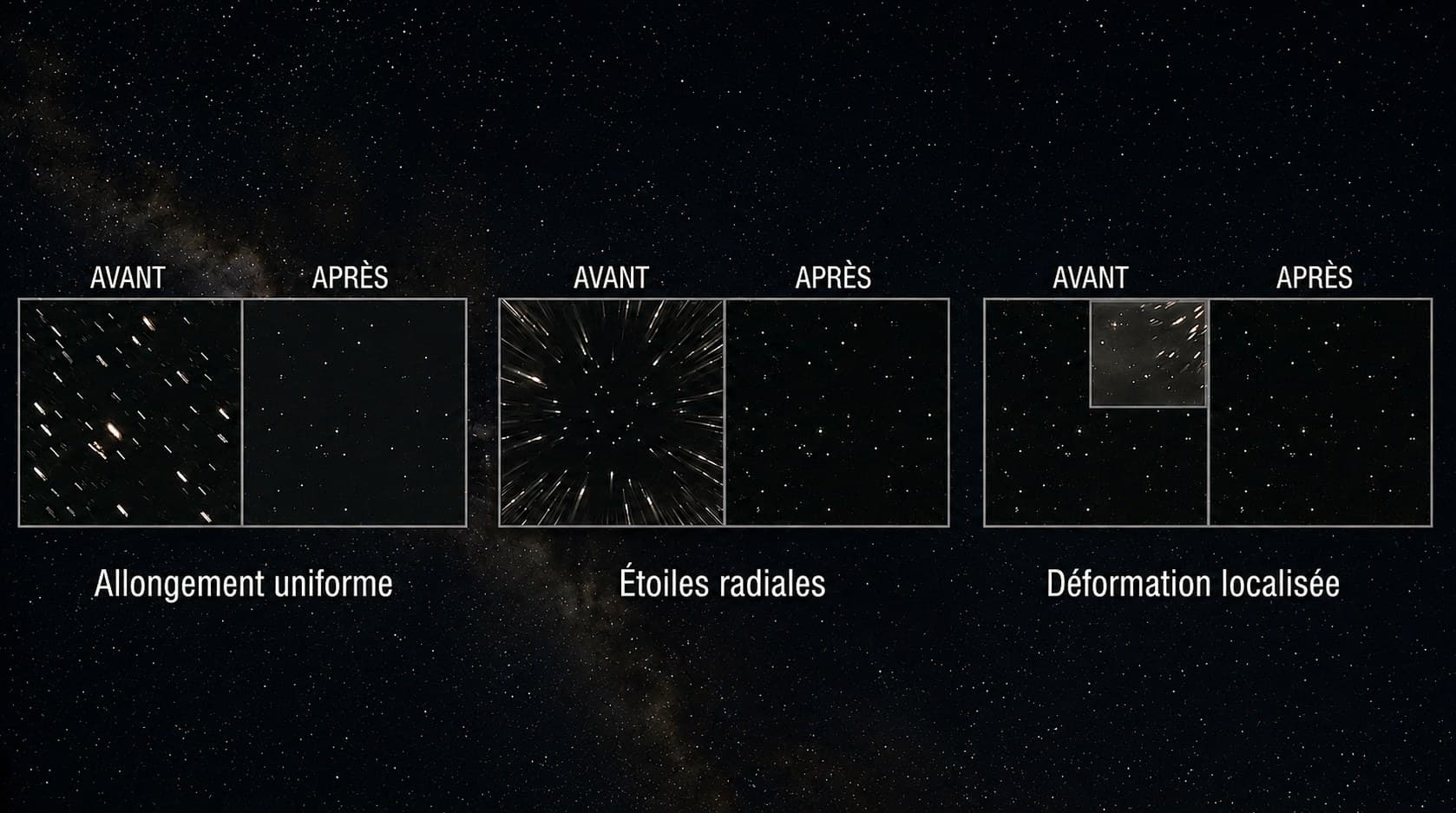
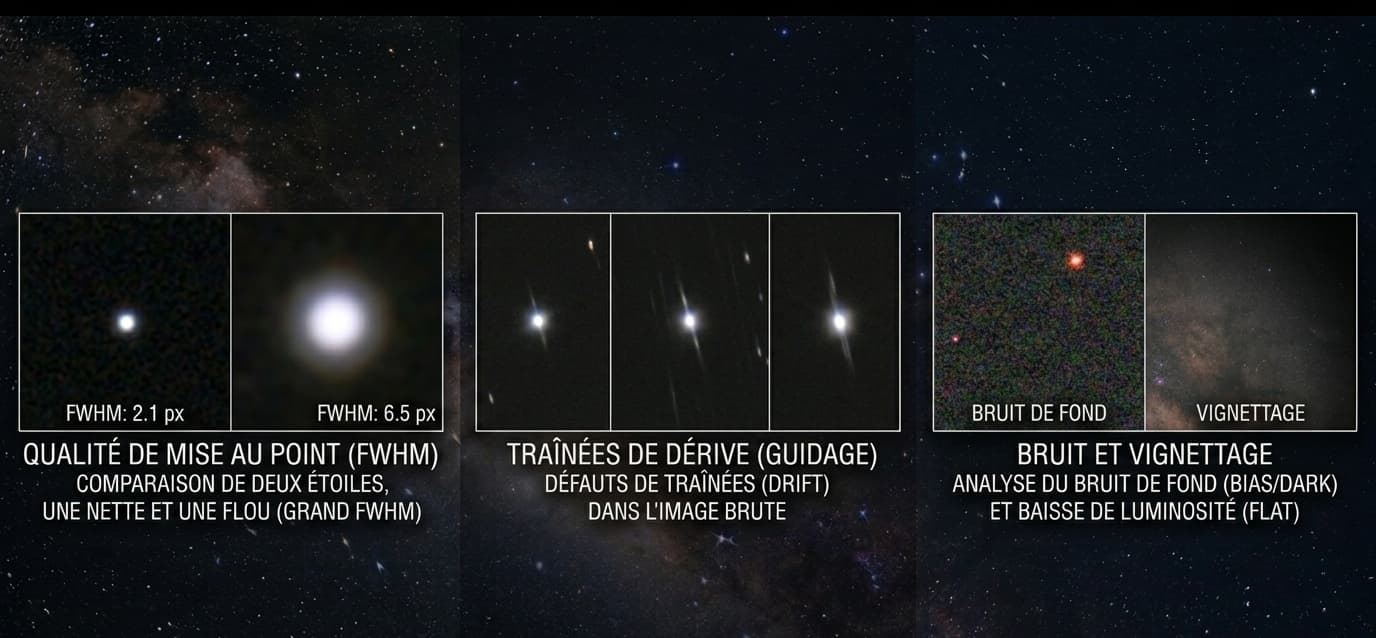
The dominant defect is measured and clear: the PSF goes from a sharp center (FWHM 1.4/0.75, the field minimum) to clearly stretched corners (TL 2.41 elong 1.71, BL 2.03 elong 1.71), with a corner/center ratio of 1.79 and a symmetric rise on all four corners. This is the signature of field curvature / mis-set backfocus, classic on a 72ED refractor without a properly spaced flattener. Tracking, on the other hand, is healthy: the PA dispersion (27.7°) and consistent elongation do not point to mount drift, the NEQ-5 did its job over 240s.
On processing, the short integration (15x240s = 1h) limits SNR, and the use of DeNoise AI leaves a smoothed look on the wisps: the background is very clean but the nebula micro-structure is impoverished compared to the expected richness. A few bright cluster star cores are clipped to pure white, without chromatic gradient.
The background variation (+57%) follows the object and is not an instrumental artifact: no vignetting or gradient to correct here.
Priority actions
- Precisely set the flattener/reducer backfocus (to the mm) to flatten the corners
- Increase total integration time (aim 4-6h) to cut noise at the source
- Moderate DeNoise AI and apply it via a background-only mask
- Protect highlights during stretch to preserve star cores