Astrophotography diagnosis of NGC7331: Tracking drift and backfocus error
Rawsans filtre120s06 sept. 2026
The Doc examined this image of NGC7331 (raw, sans filtre, 120s). Estimated overall technical quality: 5/10. 2 defects found: Tracking drift (severity 3/5), Backfocus error (severity 2/5).
&w=1920&q=75)
Info
- Cible
- NGC7331
- Date
- 06 sept. 2026, 19:29
- Lune
- Gibbeuse croissante 77.3% (sous l'horizon)
- Site
- Bortle 6 · banlieue dense (VIIRS)
- Position
- 18h39m04s · +39°02'21"
Decent conditions for this target. The Moon is below the horizon and 115 degrees from NGC 7331, so no lunar contribution is expected: the measured background confirms it, with a background map dominated by radial symmetry and no marked oriented gradient (5% amplitude, R squared 0.26). Bortle 6 remains the real limiting factor on a broadband galaxy with no filter: the spiral arms and outer halo of NGC 7331 will drown unless total integration is long. With seeing given at 2.5 arcsec and sampling at 0.44 arcsec/px, you are heavily oversampled: seeing, not optics, sets the achievable detail.
Setup
- Type d'image
- Brut
- Télescope
- C11
- Caméra
- ZWO ASI533MC Pro
- Filtre
- sans filtre
- Monture
- EQ6r pro
- Exposition
- 120s
- Phase de lune
- Dernier croissant (25 %)
- Seeing
- 2.5
- Notes
- F=6.3
- FOV
- 22.0'
The setup is sound in principle but poorly matched in sampling. At 1764 mm with 3.76 micron pixels you sit at 0.44 arcsec/px for 2.5 arcsec seeing, a factor of five oversampling: you spread signal over too many pixels and visually amplify the slightest tracking error. Binning 2x (0.88 arcsec/px) would gain signal to noise with no real loss of detail. The 0.37 degree field suits NGC 7331 well, which sits comfortably at centre. On settings: gain 100 (unity) and offset 20 are healthy, no dark clipping, and -5.2C is acceptable even if -10C would cut dark current further. The 2.82 background to black point margin is low, but that is expected in broadband at 120s and f/6.3.
The diagnosis in detail
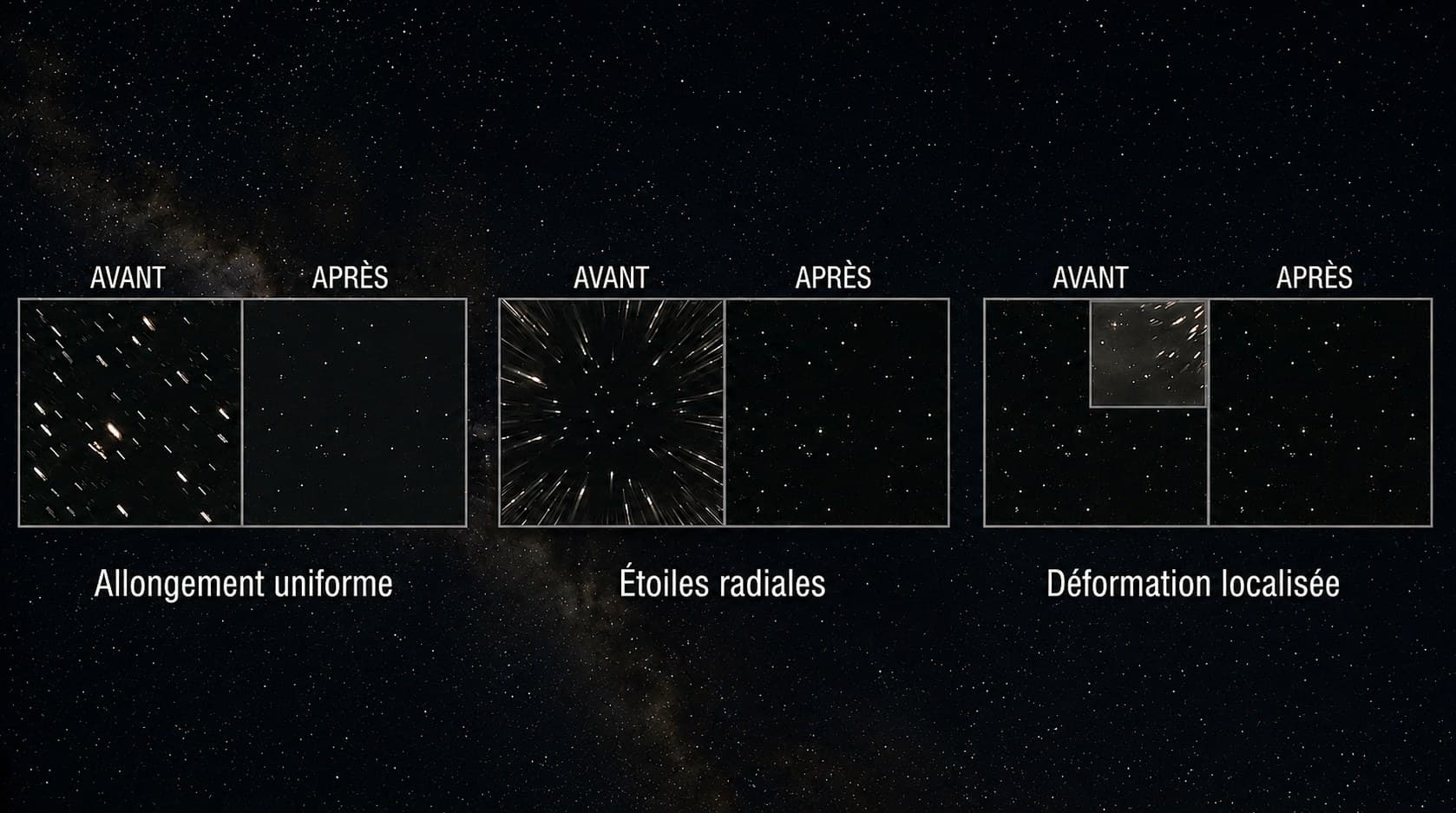
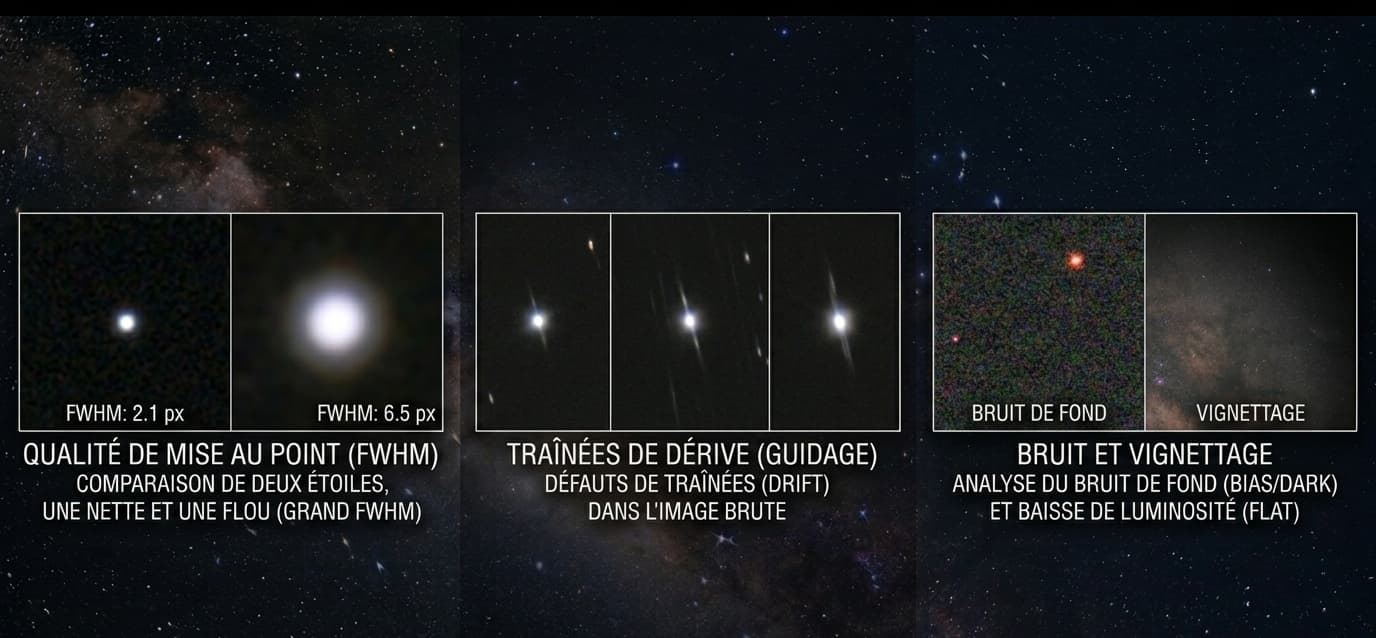
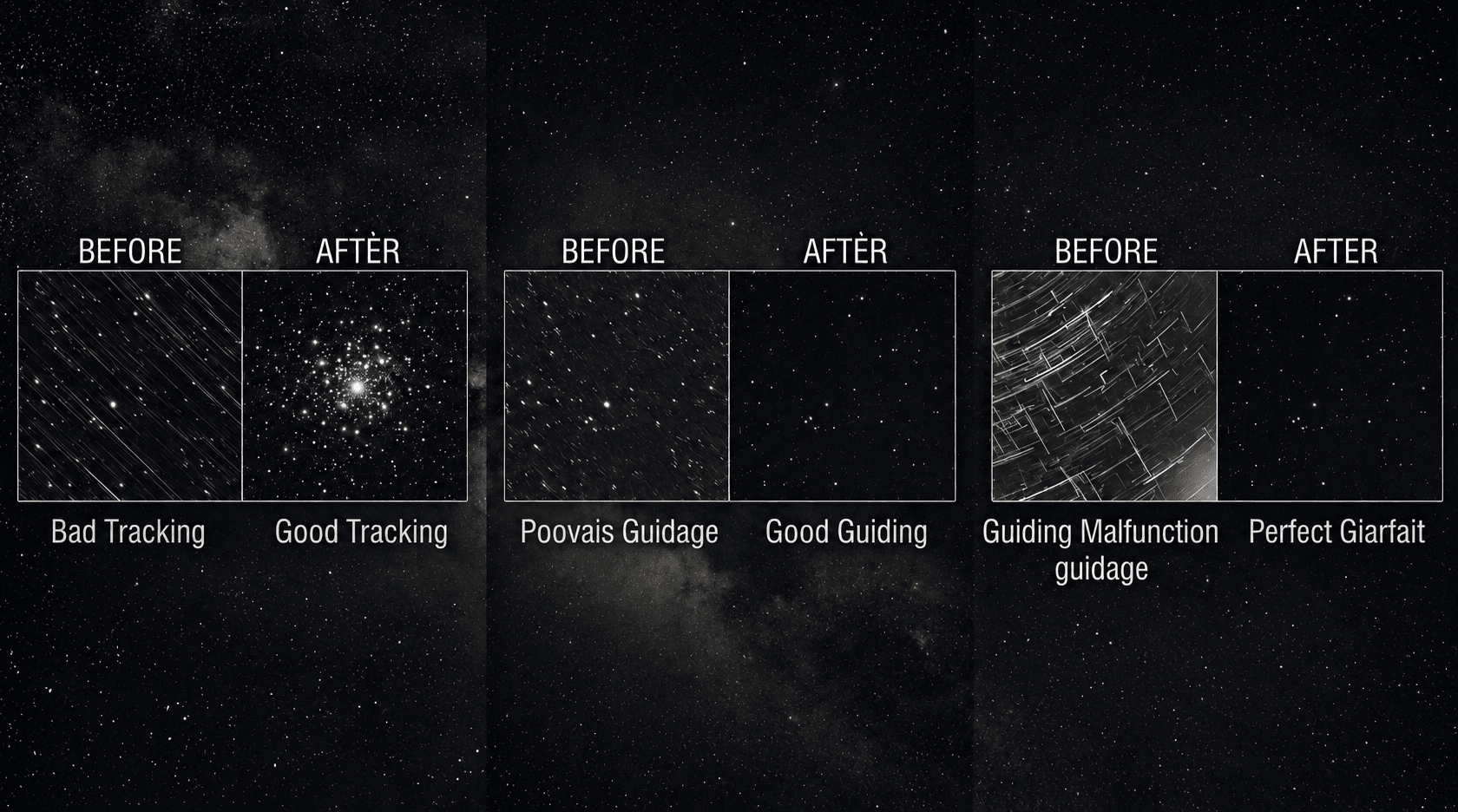
The diagnosis is dominated by a single cause: tracking. The 1.34 elongation measured AT THE CENTRE of the field, well above the 1.16 OSC debayer floor, rules out a purely optical origin from the start, since a field aberration leaves the centre clean. A PA spread of only 9 degrees across the nine zones confirms that every star stretches in the same direction, around 40-50 degrees, which is the signature of drift rather than a guiding oscillation. Over 120s at 1764 mm, this points to imperfect polar alignment, no guiding at all, or differential flexure, very common on a C11 when guiding runs through a piggybacked guide scope rather than an off-axis guider.
On top of that drift, FWHM rises from 6.36 px at centre to 7.1-8.11 px in the corners, fairly symmetrically. That signature matches residual field curvature or an f/6.3 reducer spacing slightly off specification. I keep it at moderate severity, because the tracking drift contaminates the measurement: part of the corner bloat may belong to it.
Everything else is healthy. The sky background shows neither a clear oriented gradient nor anisotropy (0.01), the histogram has no clipping, and the framing places NGC 7331 at centre with its companions visible around it. The path forward is clear: fix tracking first, then take a fresh test frame to settle the backfocus question properly.
Priority actions
- Redo polar alignment and set up autoguiding, preferably with an off-axis guider on the C11
- Switch to 2x binning to bring sampling back near 0.9 arcsec/px and gain signal to noise
- Check and adjust the f/6.3 reducer spacing (about 85 mm), then inspect corner FWHM on a test frame
- Shorten sub exposure to 60-90s until tracking is stable
- Build up substantial total integration, essential in Bortle 6 on a broadband galaxy