Astrophotography diagnosis of Altair: Backfocus error and clipped stars
RawL300s06 sept. 2026
The Doc examined this image of Altair (raw, L, 300s). Estimated overall technical quality: 7/10. 2 defects found: Backfocus error (severity 3/5), Clipped stars (severity 2/5).
&w=1920&q=75)
Info
- Cible
- Altair
- Date
- 06 sept. 2026, 19:47
- Lune
- Gibbeuse croissante 77.4% (sous l'horizon)
- Site
- Bortle 2 · rural typique (VIIRS)
- Position
- 19h50m48s · +8°51'12"
Excellent conditions. A Bortle 2 sky is as good as it gets for broadband luminance, and the Moon, though 77% gibbous, was below the horizon during the exposure and 145 degrees from the target: no lunar contribution is possible, and the measured plane gradient (19%, R2 0.22) is weak and dominated by the radial symmetry of vignetting rather than by directional light pollution. The background sits at a median of 0.01 with a background-to-black-point margin of 1.84, well short of sky-limited: normal under such a dark sky in luminance, but it means read noise still matters. On this sky you can lengthen exposures without risking background saturation.
Setup
- Type d'image
- Brut
- Télescope
- Takahashi FSQ 530@F\5.0
- Caméra
- PlayerOne CCD Zeus 455M PRO
- Filtre
- L
- Exposition
- 300s
- Phase de lune
- Dernier croissant (25 %)
- FOV
- 3.89°
A very coherent setup. The FSQ at 530 mm with 3.76 um pixels gives 1.46 arcsec/px, comfortable sampling for typical seeing, and the measured central FWHM of 3.0 px, about 4.4 arcsec, points to average seeing rather than undersampling. The 3.89 degree field is very wide for Altair, which is a point source: the real subject here is the dense Scutum star field, which makes sense. On the settings side, gain 125 is a bit above unity and eats into highlight headroom on a magnitude 0.8 star; a lower gain would give you margin back. Offset 50 is fine (0% dark clipping). Sensor temperature at 0C, however, is high: cooling to -10 or -20C would markedly cut dark current on 300 s subs.
The diagnosis in detail
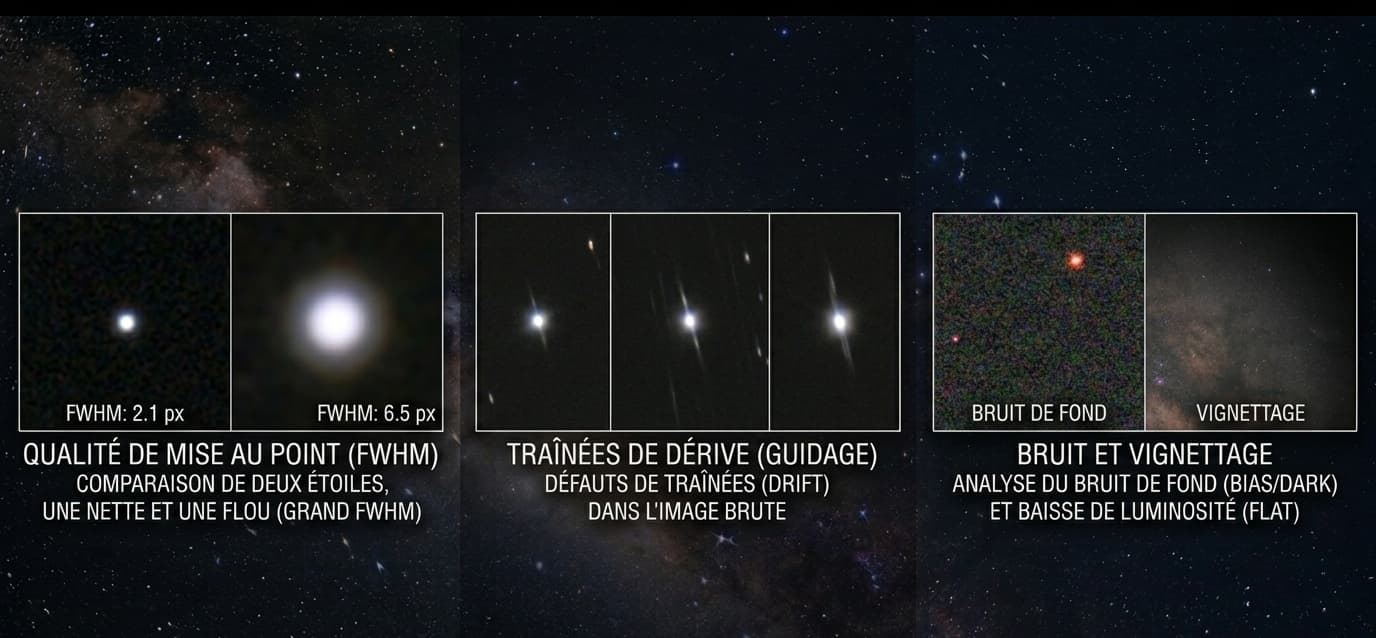
The diagnosis comes down to one dominant point: focal plane geometry. The field center is flawless, FWHM 3.0 px and elongation 1.06 just above the field floor of 1.03, which immediately rules out any tracking or guiding cause, since a mount defect would hit the center as hard as the edges. The degradation is therefore purely optical and grows with radius: corner/center FWHM ratio of 1.63, with the bottom-left corner at 5.2 px and the bottom-right at 3.9 px with 1.40 elongation. This symmetric FWHM rise, without the radial comet shape characteristic of coma, is the signature of residual field curvature or a backfocus slightly out of tolerance.
One detail deserves your attention: the measured vertical asymmetry (0.295) is nearly double the horizontal one (0.17), and both top corners are clearly better than both bottom corners. Pure backfocus would give four equivalent corners. So a small sensor tip component is probably superimposed on the curvature. Fix the spacing first, it is the dominant term, then reassess the top/bottom spread once the corner/center ratio has come down.
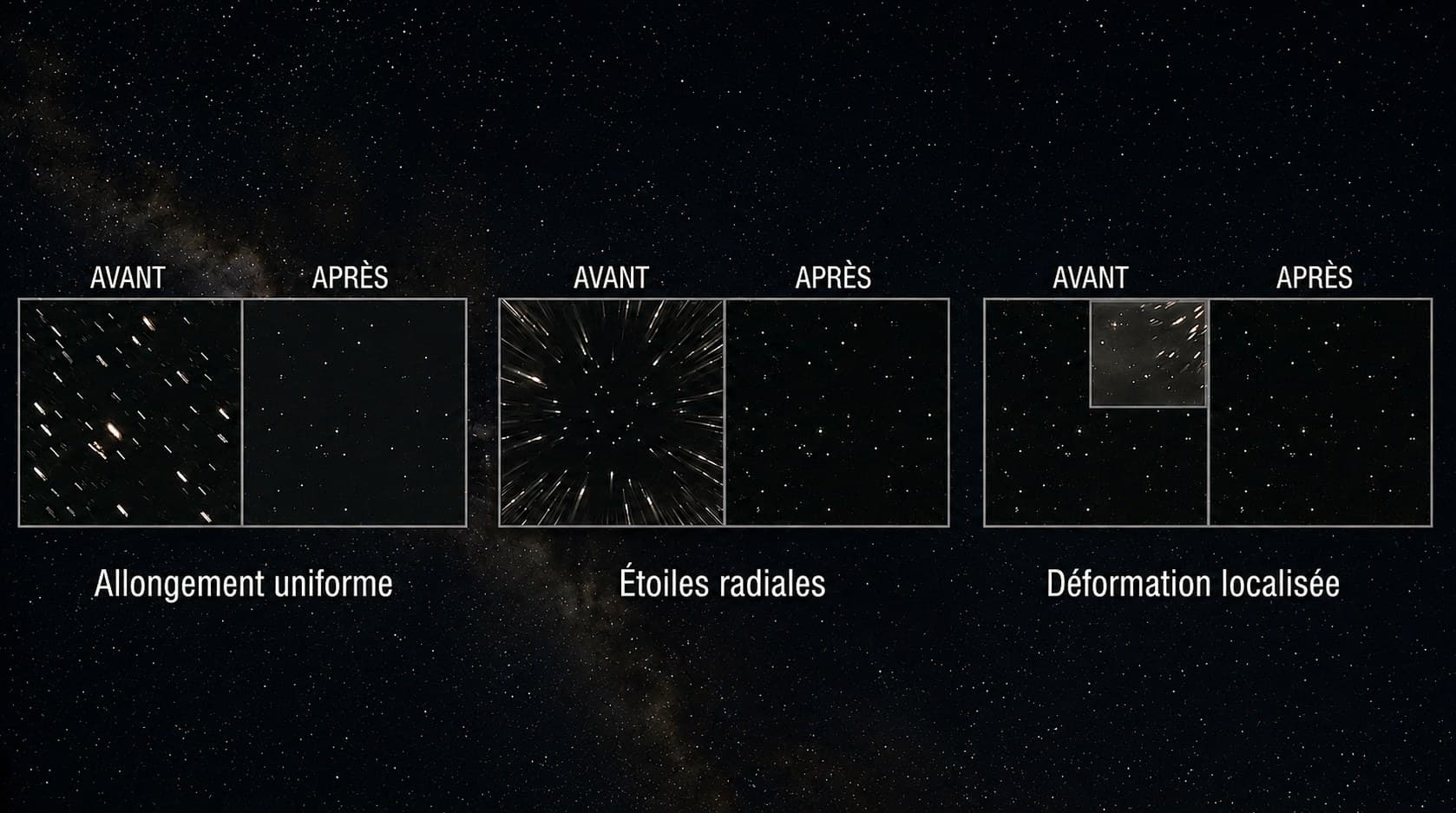
The rest is acquisition routine: 34% rotationally symmetric vignetting exactly as expected before flats on a large sensor, Altair's core clipped over 0.06% of pixels, and a few thin trails including one clear streak in the top-right corner. None of this puts the night in question.
Priority actions
- Correct the optical train spacing to bring the corner/center FWHM ratio from 1.63 down below 1.15, testing in 0.5 mm steps
- Then check sensor flatness, the 0.295 vertical versus 0.17 horizontal asymmetry hints at slight tip on top of the curvature
- Shoot a flat series in the exact configuration of the night to remove the 34% vignetting
- Cool the sensor to -10 or -20C instead of 0C to limit dark current on 300 s subs
- Stack with sigma rejection over at least 15 to 20 frames to erase the satellite trails