Astrophotography diagnosis of NGC 281W: Astigmatism
Raw300s01 août 2026
The Doc examined this image of NGC 281W (raw, 300s). Estimated overall technical quality: 8/10. 1 defect found: Astigmatism (severity 2/5).
&w=1920&q=75)
Info
- Cible
- NGC 281W
- Date
- 01 août 2026, 23:08
- Lune
- Croissant croissant 11.1% (22.7° d'alt., 63.8° de la cible)
- Site
- Bortle 2 · rural typique (VIIRS)
- Position
- 0h54m09s · +56°36'40"
Excellent conditions for this target. Bortle 2 and a Moon at only 11% illumination, 22.7° altitude and 63.8° from the target: lunar pollution is negligible, no moon gradient expected. On an emission nebula like NGC 281 in narrowband, this very dark sky guarantees excellent background SNR. The measured sky/black-point margin (e_margin 2.16) stays low but that is normal in narrowband at 300s: the filter cuts most of the sky, it is not a sign of underexposure. Capitalize on these rare conditions to gather many subs.
Setup
- Type d'image
- Brut
- Télescope
- EQMod Mount
- Caméra
- ZWO ASI585MM Pro
- Exposition
- 300s
- Phase de lune
- Gibbeuse décroissante (87 %)
- FOV
- 1.70°
Setup consistent with the target. At 375 mm focal length, the 1.70° field frames NGC 281 comfortably with room around the Pacman, and the 1.595"/px sampling suits current seeing, neither over- nor under-sampled. Cooling at -19°C is healthy (dark current under control). Gain 252 is high on the ASI585 but usable on a narrowband sub as long as bright stars do not massively saturate, which is not the case here. The 300s exposure fits the Bortle 2 sky in narrowband. Plan flats to correct the slight edge illumination drop, plus darks/bias for calibration.
The diagnosis in detail
This sub is very well made. Moffat metrics confirm a healthy central PSF (FWHM 2.1/2.0 px, elong 1.08 just above the 1.02 field floor) and successful focus; 1.6"/px sampling exploits the sky well. Tracking is excellent: no coherent directional elongation at center, and the PA scatter (48°) rules out mount drift, pointing to a purely edge-optical cause.
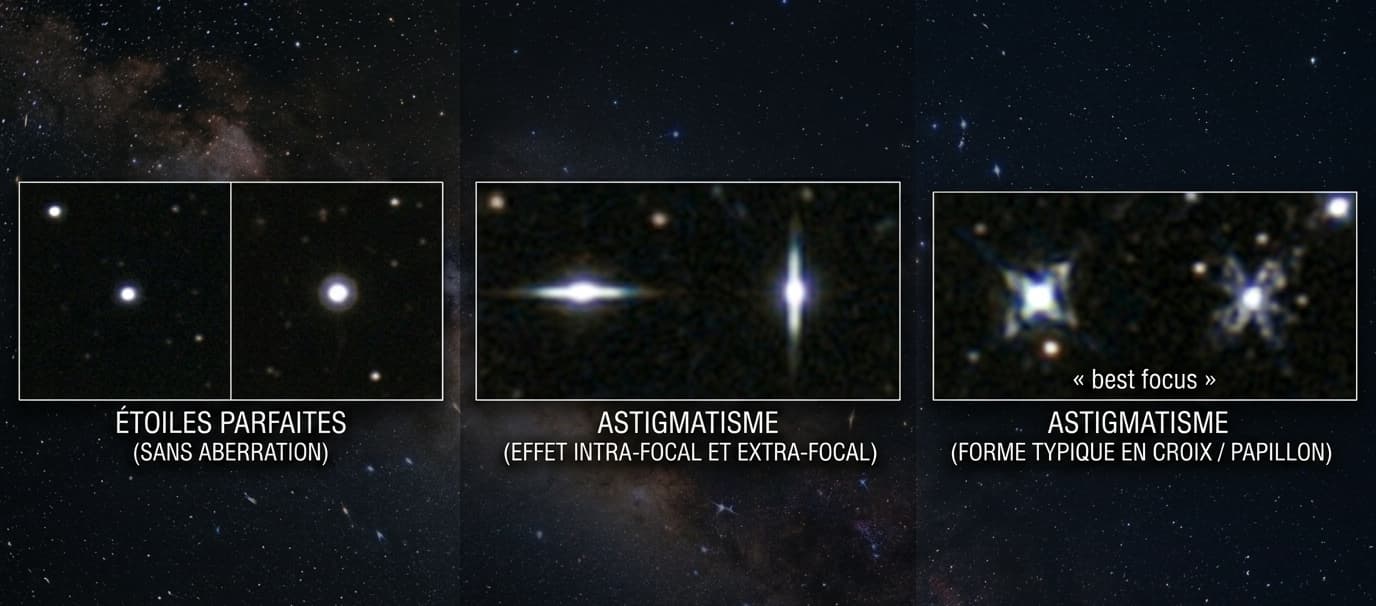
The only structural defect is mild field astigmatism: elongation rises toward the corners (up to 1.31 top-left) without a real FWHM increase, and the ellipse major axes rotate zone to zone. This is the classic signature of a backfocus spacing or optical-train tightening to fine-tune, not a tracking issue or hard collimation error.
On the background, the illumination map shows a slight edge falloff (+8%) and a 9% plane oriented ~180°, modest amplitudes that flats and gradient extraction (GraXpert/DBE) will easily fix. The Ha nebulosity matches the DSS structure well: no gradient artifact to confuse with real signal. Stacking several dozen subs under this sky will yield a high-quality image.
Priority actions
- Check backfocus spacing and the tightening/squareness of the optical train to reduce field astigmatism, then re-verify with an aberration plate
- Acquire flats (edge illumination falloff) and darks/bias at -19°C for clean calibration
- Gather as many 300s subs as possible, taking advantage of the Bortle 2 sky and near-absent Moon