Astrophotography diagnosis of NGC 281W: Sensor tilt
Raw300s28 août 2026
The Doc examined this image of NGC 281W (raw, 300s). Estimated overall technical quality: 7/10. 1 defect found: Sensor tilt (severity 2/5).
&w=1920&q=75)
Info
- Cible
- NGC 281W
- Date
- 28 août 2026, 21:33
- Lune
- Nouvelle lune 0.6% (24.3° d'alt., 66.8° de la cible)
- Site
- Bortle 2 · rural typique (VIIRS)
- Position
- 0h51m26s · +56°54'41"
Excellent conditions for this target. The supplied moon context reports a new moon at 0.6% illumination, 66.8 deg from the target: negligible lunar contribution, despite the declared "full moon 99%" field which contradicts that context and is not retained. Under Bortle 2 the sky background is very dark and allows long exposures without flooding the background. The measured background-to-black-point margin of 1.94 is low, but on a filtered emission field under a very dark sky that is normal: you are not sky-limited, which makes darks and bias calibration all the more critical so read noise does not dominate.
Setup
- Type d'image
- Brut
- Télescope
- EQMod Mount
- Caméra
- ZWO ASI585MM Pro
- Exposition
- 300s
- Phase de lune
- Pleine lune (99 %)
- FOV
- 3.36°
A coherent setup, but very generous in field for NGC 281. With 190 mm of focal length and a 3840x2160 sensor of 2.9 um pixels you cover 3.36 deg wide, and the nebula fills only about a fifth of the frame width: comfortable, well centered framing, but you lose resolution on fine structures. The 3.15"/px sampling is clearly undersampled (a comfortable target is 1 to 2"/px), which explains the 1.5 px FWHM at center, close to the measurement limit. Gain 220 is high for the ASI585MM and reduces dynamic range on bright stars; under Bortle 2 you could drop to a more moderate gain and lengthen exposures slightly. Sensor temperature -18.5C: healthy cooling.
The diagnosis in detail
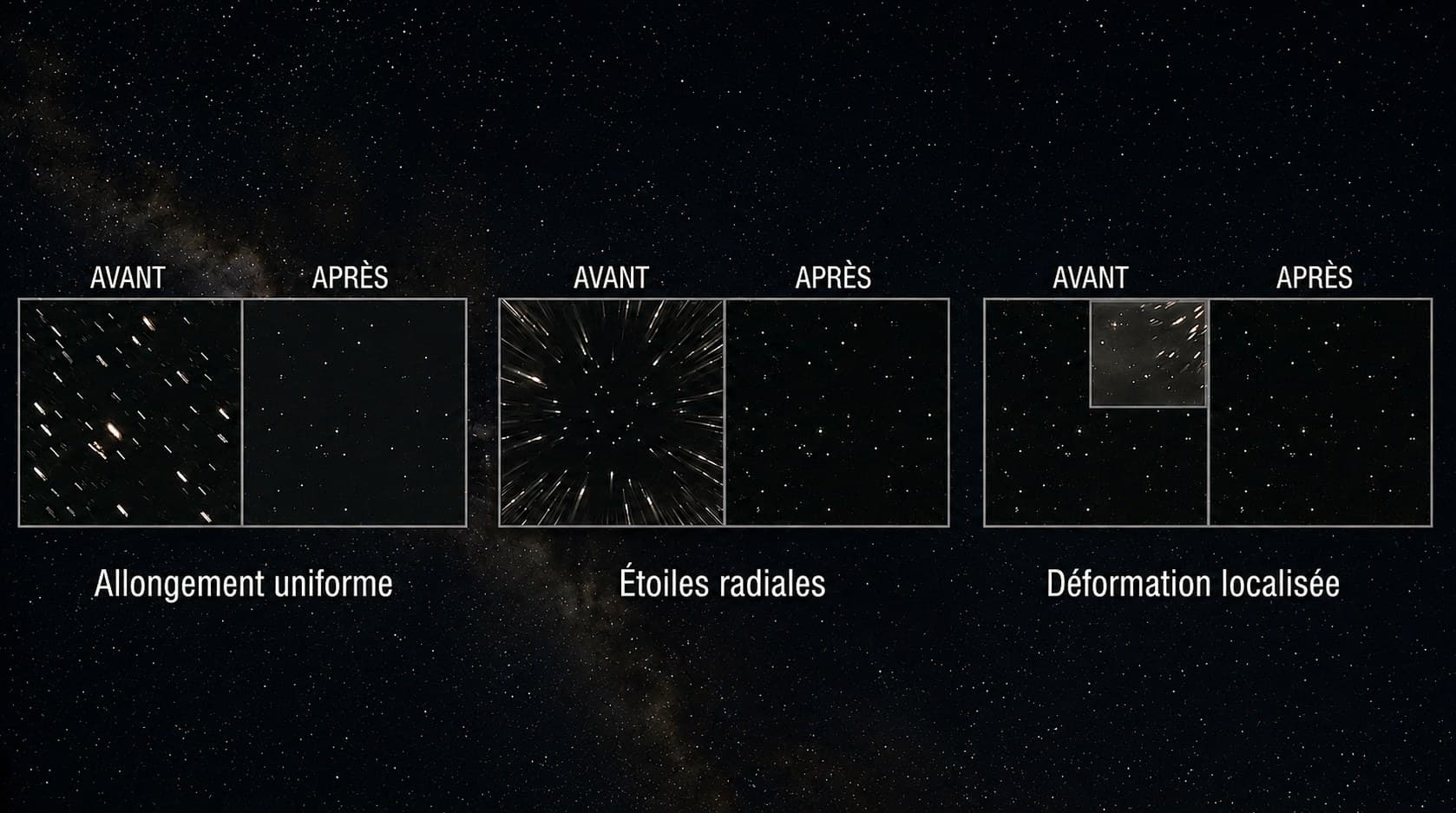
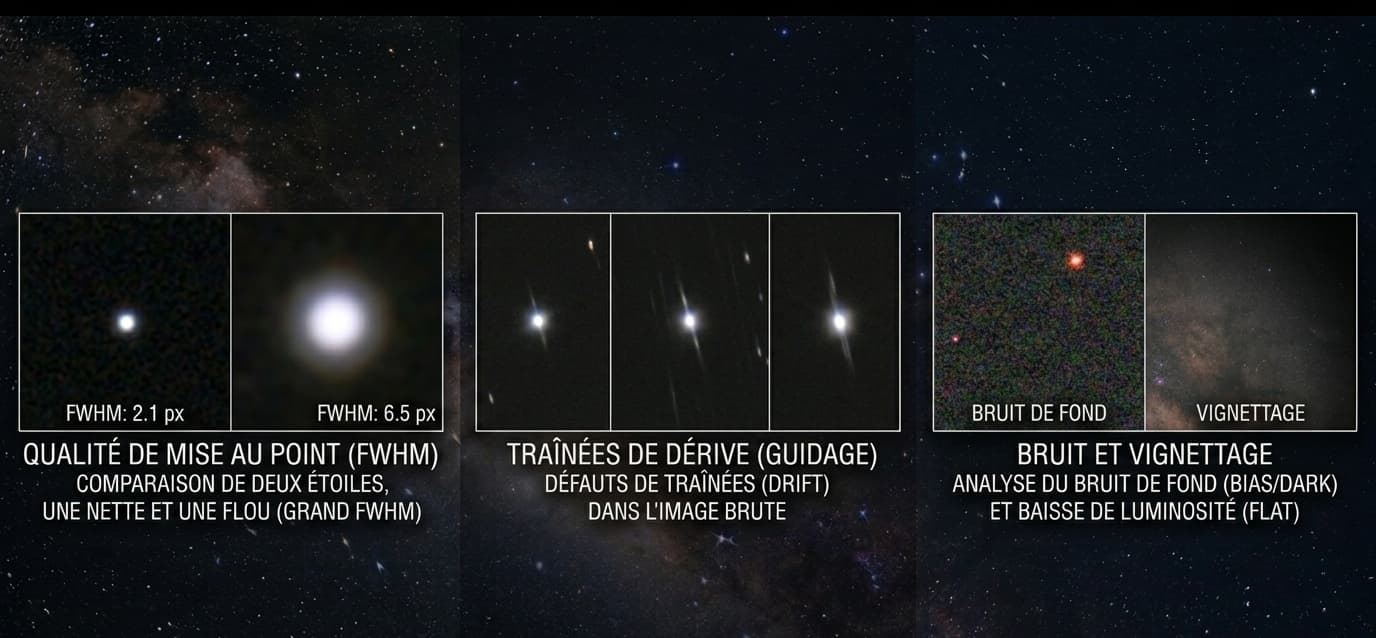
This sub is good. The Moffat measurements give a perfectly pinpoint center (FWHM 1.48/1.37 px, elong 1.07 against a field floor of 1.06), which rules out any tracking or guiding component: over 300 s, guided or not, no global elongation is present. The 25.4 deg PA dispersion confirms round stars at center and along the top and bottom edges.
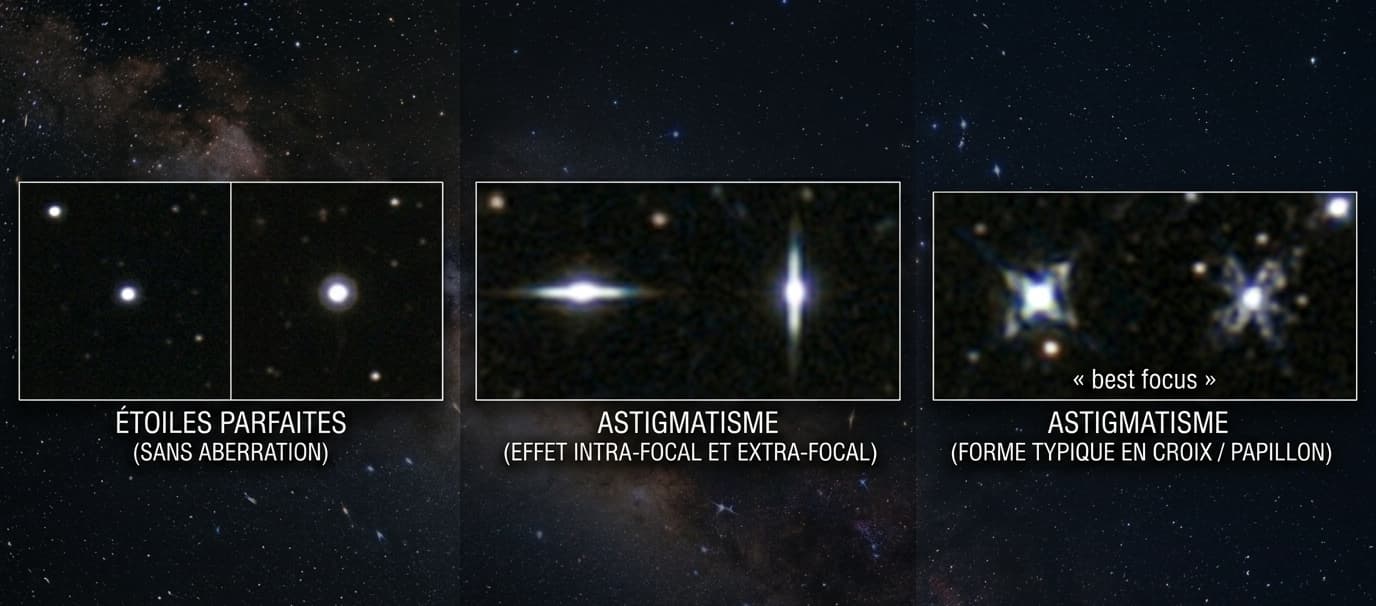
The only measured degradation is optical and non-uniform: FWHM asymmetry is 0.209 on the horizontal axis versus 0.018 on the vertical, with the top-right corner at elong 1.34 while the top edge stays at 1.06. That is the signature of a tilted sensor plane rather than field curvature, which would degrade all four corners symmetrically. The corner/center ratio of 1.246 stays modest, so the visual impact on the preview is small, all the more since the coarse sampling hides part of the effect.
On the background side, the model measures a 7% amplitude plane gradient at 15 deg, with a plane/radial dominance of 5.17. No background defect was retained as a candidate, and comparison with the DSS shows the nebulosity and star field match well: nothing to correct there at the raw stage, a simple gradient removal after stacking will be enough.
Priority actions
- Correct the sensor tilt on the right side of the field (push-pull tilt plate or re-seating the imaging train clamping), in controlled iterations checked with the aberration inspector
- Consider lowering the gain from 220 to a more moderate value to preserve dynamic range on bright stars under Bortle 2
- Stack enough subs with dithering and a full darks and bias calibration, since the background is not sky-limited (e_margin 1.94)