Astrophotography diagnosis of NGC 281W: Sensor tilt
Master49×300s02 août 2026
The Doc examined this image of NGC 281W (master, 49×300s). Estimated overall technical quality: 7/10. 1 defect found: Sensor tilt (severity 3/5).
&w=1920&q=75)
Info
- Cible
- NGC 281W
- Date
- 02 août 2026, 00:20
- Lune
- Croissant croissant 11.3% (31.3° d'alt., 63.3° de la cible)
- Site
- Bortle 2 · rural typique (VIIRS)
- Position
- 0h52m27s · +56°35'52"
Near-ideal conditions for this target. In Bortle 2 the SNR on an Ha emission nebula is excellent and background gradients nearly absent, which the very clean master confirms. The Moon is a non-issue: a crescent at 11.3% illumination and 63 deg from the target contributes negligibly in narrowband Ha. Nothing here warrants rescheduling; the remaining lever is simply accumulating more exposure time to bring out the faint extensions.
Setup
- Type d'image
- Master
- Télescope
- EQMod Mount
- Caméra
- ZWO ASI585MM Pro
- Exposition
- 49×300s
- Phase de lune
- Gibbeuse décroissante (87 %)
- FOV
- 1.64°
Setup well matched to the target. At 375 mm focal length the 1.64 deg field frames NGC 281 with comfortable margin, the nebula well centered with no risk of clipping. The 1.60"/px sampling suits current seeing and the central FWHM of 3.4 px (~5.4") shows the optics are not the limiting factor at center. Cooling at -19.5C is healthy. Gain 252 is high for the ASI585MM: watch bright-star saturation, but on 300 s Ha subs it remains acceptable. The e_margin of 2.2 is low in absolute terms but NORMAL in narrowband, and the 300 s exposure is adequate.
The diagnosis in detail
The master is well made: the sky background is smooth and artifact-free (no walking noise, no banding, no visible residual hot pixels), indicating correct calibration and dithering, and the nebulosity matches the DSS reference, ruling out any instrumental gradient. The field center is sharp with a 3.4 px FWHM, consistent with the 1.60"/px sampling and good tracking (low elongation, no directional drift).
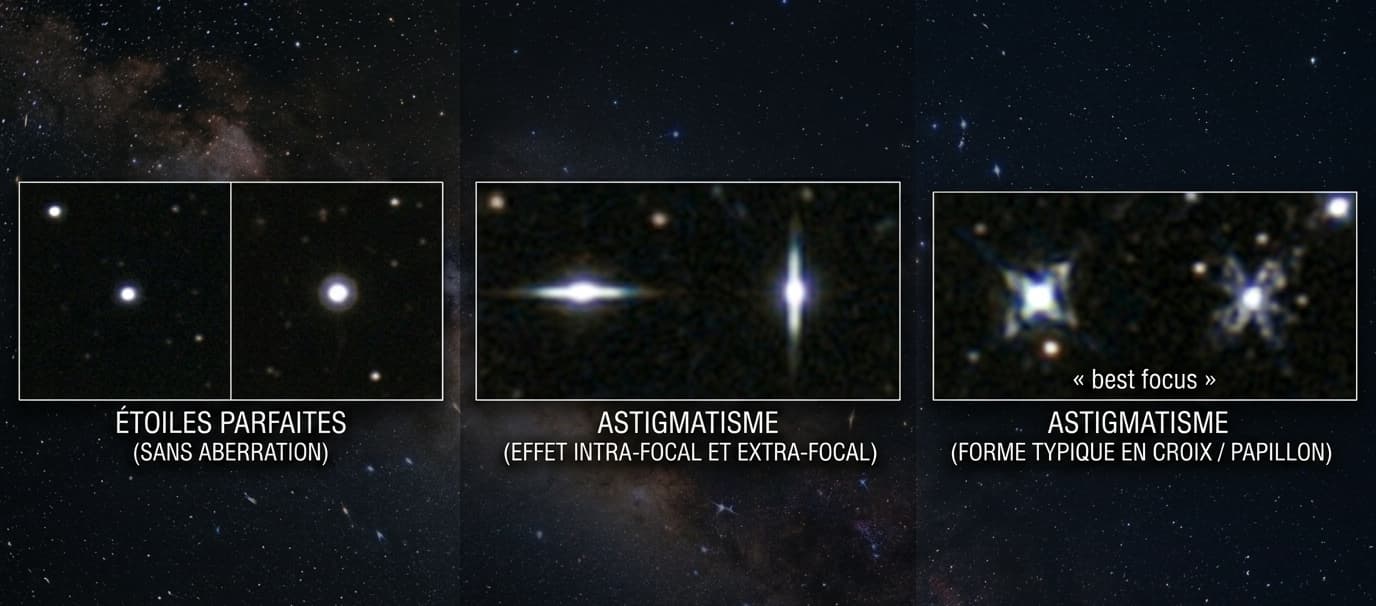
The defining defect is sensor tilt. The PSF panel shows a pinpoint center while corners bloat unevenly: the right side and bottom-right corner reach 5.0 to 5.4 px while the top stays around 4.3-4.5 px. The vertical asymmetry (0.083) far outweighs the horizontal (0.018) and the 1.64 corner/center ratio reflects a tilted focal plane, to be distinguished from coma, which would be radial and symmetric across all four corners. It is usable as is, but a mechanical adjustment of the optical train would recover sharpness across the whole periphery.
In short, a solid acquisition whose yield would be maximized by correcting the tilt and then stacking more subs for the faint Pacman extensions.
Priority actions
- Correct sensor tilt with a tilt ring to equalize FWHM across the four corners, then re-validate with an aberration panel
- Check the tightness and flatness of every adapter in the imaging train
- Accumulate more integration time to strengthen the nebula's faint extensions