Astrophotography diagnosis of NGC 7000: Backfocus error and clipped stars
Raw300s25 sept. 2026
The Doc examined this image of NGC 7000 (raw, 300s). Estimated overall technical quality: 7/10. 2 defects found: Backfocus error (severity 2/5), Clipped stars (severity 1/5).

Info
- Cible
- NGC 7000
- Date
- 25 sept. 2026, 04:33
- Lune
- Croissant décroissant 2.7% (39.2° d'alt., 57.2° de la cible)
- Site
- Bortle 3 · rural peu pollué (VIIRS)
- Position
- 20h55m20s · +44°14'45"
Very favorable conditions. Bortle 3 with a moon at 2.7 % illumination, even 39° high and 57° from the target, produces no significant pollution: the background you get is essentially natural sky. This is exactly the window to exploit for NGC 7000 in broadband with the ASI533MC, since the emission nebula comes through without needing a dual-band. In this context there is no reason to cut the session short: keep stacking subs while the target stays high, the gain is entirely in cumulative integration time.
Setup
- Type d'image
- Brut
- Télescope
- ZWO AM5N
- Caméra
- ZWO ASI533MC Pro
- Exposition
- 300s
- Phase de lune
- Waxing gibbous (99 %)
- FOV
- 2.17°
The setup matches the target well. At 299 mm focal length, the 2.17° field frames the core of NGC 7000 with the Mexico Wall and the Gulf, a tight but coherent framing, the nebula filling the whole square 3008×3008 sensor. The 2.59"/px sampling is deliberately generous, suited to short subs and average seeing, and the 2.81 px central FWHM shows the optics keep up. On settings: gain 100 (unity) and offset 70 are healthy, but the histogram shows 1.35 % dark clipping and a background/black-point margin of only 2.22, so in broadband under Bortle 3 you are not quite sky-limited. Sensor temperature at -5°C is a bit high, going down to -10°C would stabilize darks better.
The diagnosis in detail
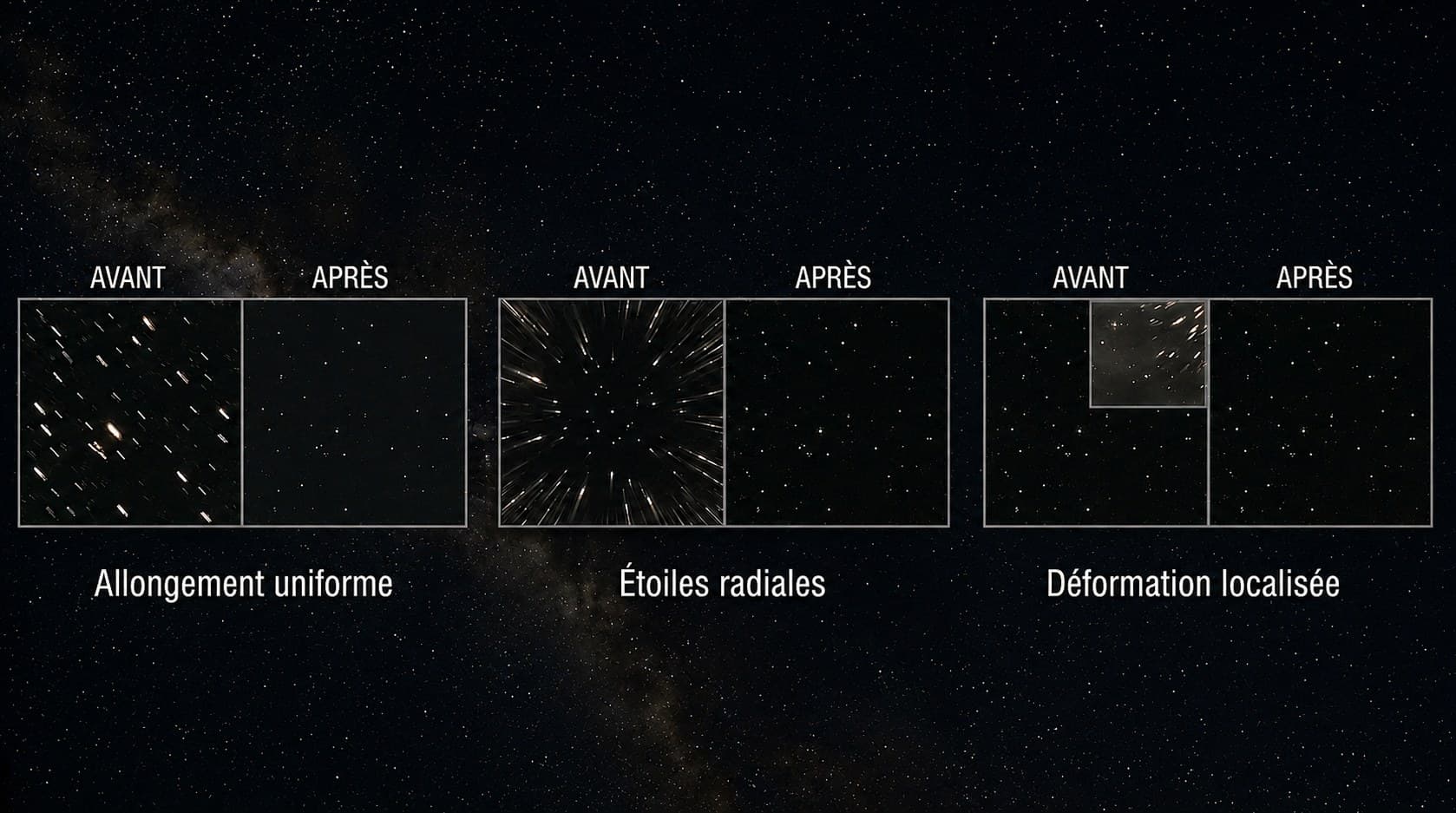
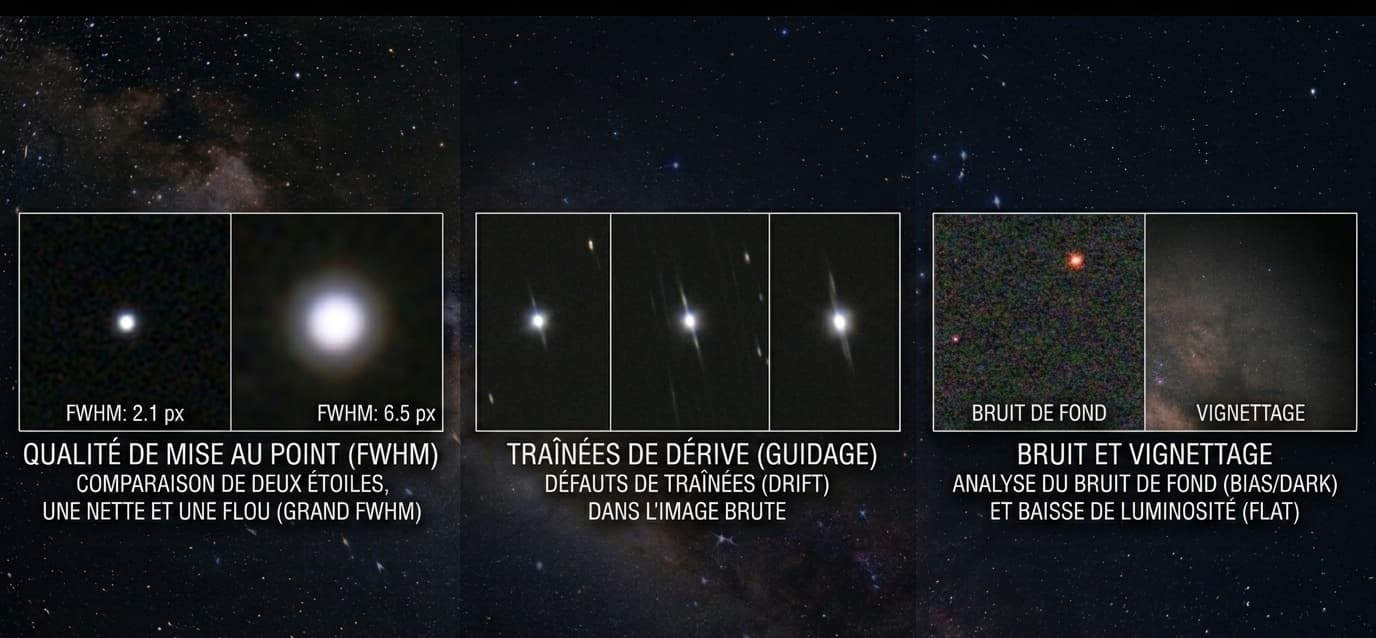
The diagnosis comes down to one instrumental point and one acquisition setting. On star shape the measurement is clear: the center is round (elong 1.08, exactly at the field floor for a debayered OSC sensor) and FWHM is minimal there at 2.81 px. PA dispersion between zones reaches 34.7°, so there is no coherent elongation direction: mount tracking is not at fault on this 300 s exposure, good news for an unguided or lightly guided setup.
The degradation is purely radial: all four corners rise together to 3.47, 2.79, 3.98 and 3.65 px for a corner/center ratio of 1.24. That is the classic profile of residual field curvature or slightly out-of-spec spacing, not of clear tilt, even though the bottom-left corner runs a bit ahead of the others, which may hint at a small flatness component to watch once backfocus is set.
The rest is healthy. The background profile is rotationally symmetric (plane/radial dominance 0.03), so peripheral darkening is normal optical vignetting on an unflatted raw frame, nothing to fix on the sky side. The nebulosity matches the DSS reference, no gradient artifact to report. The real lever remains exposure: with 1.35 % dark clipping and a margin of 2.22, the background grazes the black point.
Priority actions
- Correct backfocus in 0.5 to 1 mm steps and revalidate on a test sub with the aberration inspector
- Raise the offset to remove the 1.35 % dark clipping and avoid clipping read noise
- Lower the cooling setpoint to -10°C for better dark matching
- Check optical train flatness after setting backfocus (bottom-left corner slightly behind)