Astrophotography diagnosis of NGC 7000: Tracking drift, light pollution gradient and 1 other
ProcessedMULTIBAND60x180s16 déc. 2024
The Doc examined this image of NGC 7000 (processed, MULTIBAND, 60x180s). Estimated overall technical quality: 6/10. 3 defects found: Tracking drift (severity 3/5), Light pollution gradient (severity 3/5), Background chroma noise (severity 2/5).
&w=1920&q=75)
Info
- Cible
- NGC 7000
- Date
- 16 déc. 2024, 00:00
- Position
- 20h56m00s · +44°17'60"
Not enough information for an opinion from the Doc.
Setup
- Type d'image
- Traitée
- Télescope
- TS-Optics CF-APO 70mm f/6
- Caméra
- ZWO ASI585MC
- Filtre
- MULTIBAND
- Monture
- Sky-Watcher Star Adventurer GTi
- Exposition
- 60x180s
- Notes
- Logiciels : PixInsight
- FOV
- 1.50°
The setup is coherent for NGC 7000: with a 70mm f/6 and the ASI585MC, the 1.5 degree field frames the Cygnus Wall nicely, the most iconic region of the nebula. Sampling is comfortable for a wide field. The multiband filter is a sound choice on this emission target, especially under polluted skies. The real limitation is the mount: the Star Adventurer GTi is unguided here, and 180s subs expose it to drift, which the PSF panel confirms. Autoguiding or shorter subs (90-120s) would secure rounder stars.
The diagnosis in detail
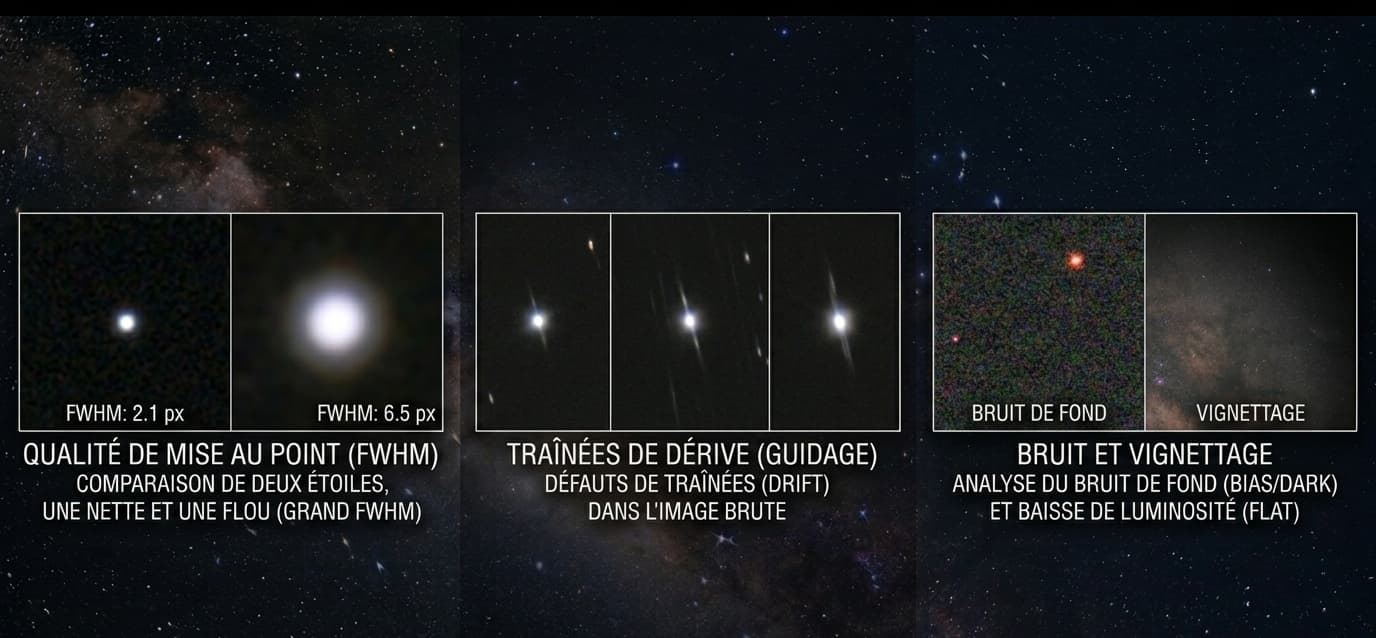
The PSF panel settles the pre-verdict in favor of tracking: the center C is already slightly elongated (elong 1.19, which acts as the field floor), the FWHM asymmetry is essentially horizontal (0.19 vs 0.024 vertical) and above all the PA dispersion is only 7.3 degrees, indicating a directional stretch common to the whole frame. This profile is incompatible with tilt (which would require a sharp center and diagonal asymmetry between opposite corners): the sensor-tilt candidate at 22% is therefore rejected. The corner/center ratio (0.847) stays moderate, which also rules out marked coma or backfocus.
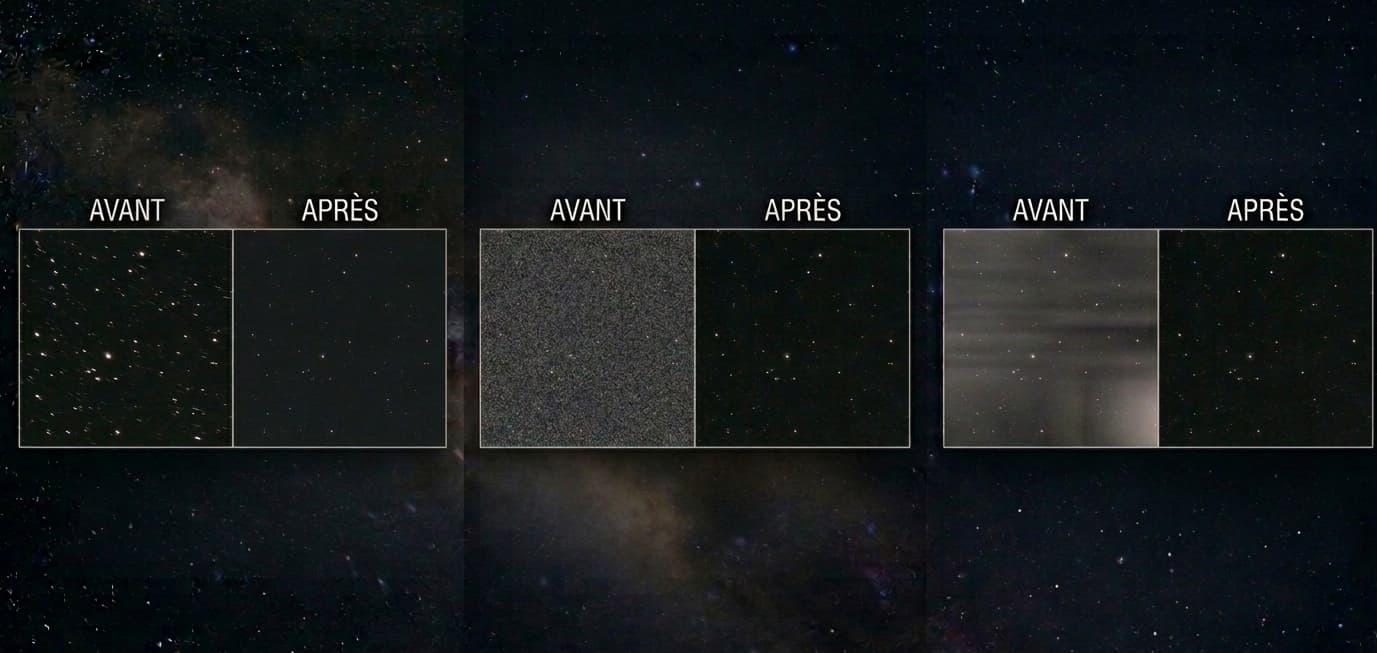
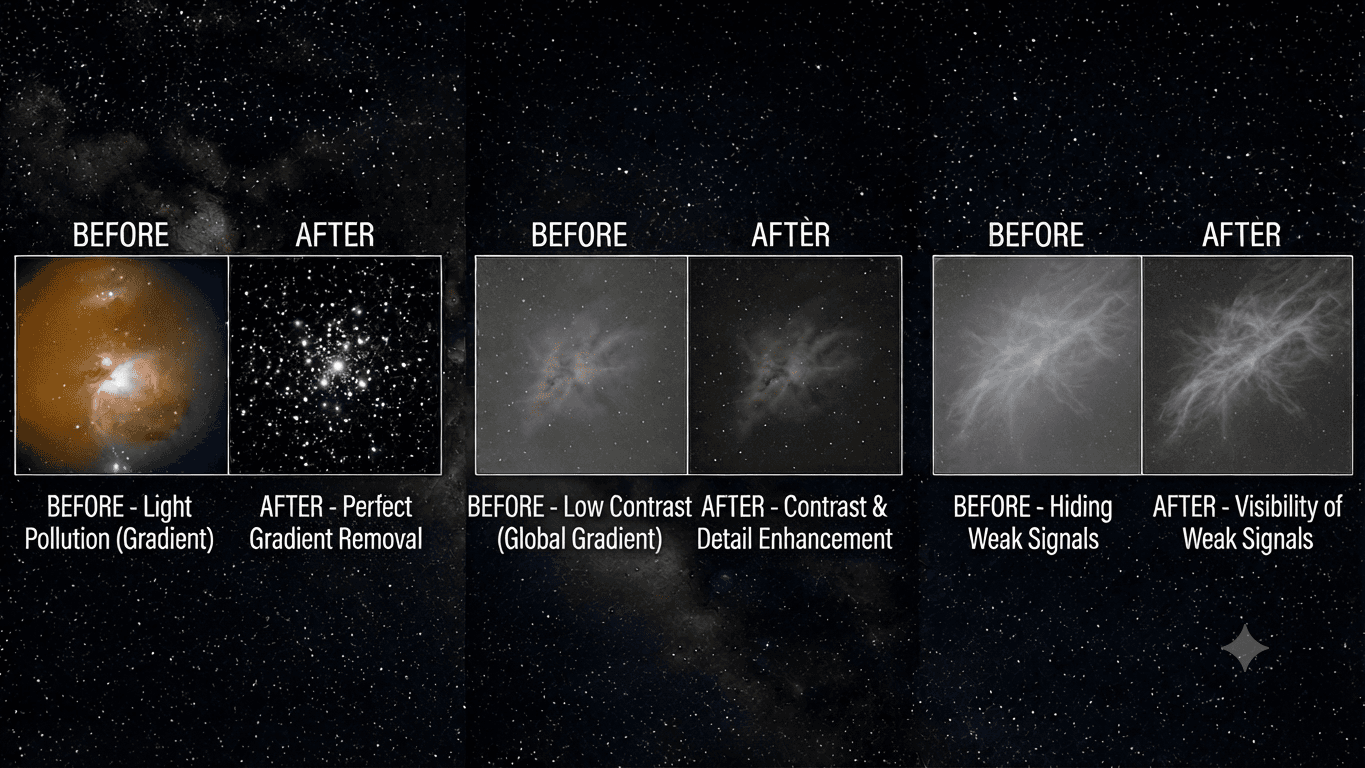
The second work axis is the background. The background map measures a plane gradient at 176% strongly dominating the radial component (x110.7), oriented ~179 degrees. The DSS shows no extended structure along this axis: this is indeed an unextracted pollution/atmospheric gradient, to correct first with DBE/GraXpert before any stretch. Finally, light chroma noise persists in the dark background areas, typical of a color sensor on faint signal, to mitigate in chrominance.
The processing remains honest and the nebulosity well drawn; corrections are mainly upstream (guiding) and in post (gradient, chroma).
Priority actions
- Correct the background gradient with DBE/GraXpert before stretching (biggest immediate visual gain)
- Add autoguiding or reduce subs to 90-120s for rounder stars
- Improve polar alignment of the Star Adventurer GTi
- Apply targeted chroma noise reduction on the background