Astrophotography diagnosis of ngc6992: Backfocus error
Processed
The Doc examined this image of ngc6992 (processed). Estimated overall technical quality: 7/10. 1 defect found: Backfocus error (severity 2/5).
&w=1920&q=75)
Info
- Cible
- ngc6992
- Position
- 20h55m53s · +31°24'54"
The 4% last-quarter crescent plays no role here: the Moon is nearly absent, no lunar pollution to fear. In Ha the background is in any case very insensitive to the Moon and urban skyglow, which explains the clean, even black background obtained. Conditions were therefore favourable for this emission target, and the image confirms it with good contrast on the faint filaments.
Setup
- Type d'image
- Traitée
- Phase de lune
- Dernier croissant (4 %)
- FOV
- 1.64°
The 1.64 deg field frames NGC 6992 well: the arc of the Veil is fully contained and centred, with margin for the faint southern filaments. The sampling yields a central FWHM of ~3.4 px, consistent with decent seeing and a broadly healthy optical train. The only point of attention is backfocus: the FWHM rise in the corners (up to 4.4 px) points to spacing that needs fine-tuning. The measured background (e_margin 2.28) is low but that is NORMAL in narrowband, do not needlessly lengthen the exposure for it.
The diagnosis in detail
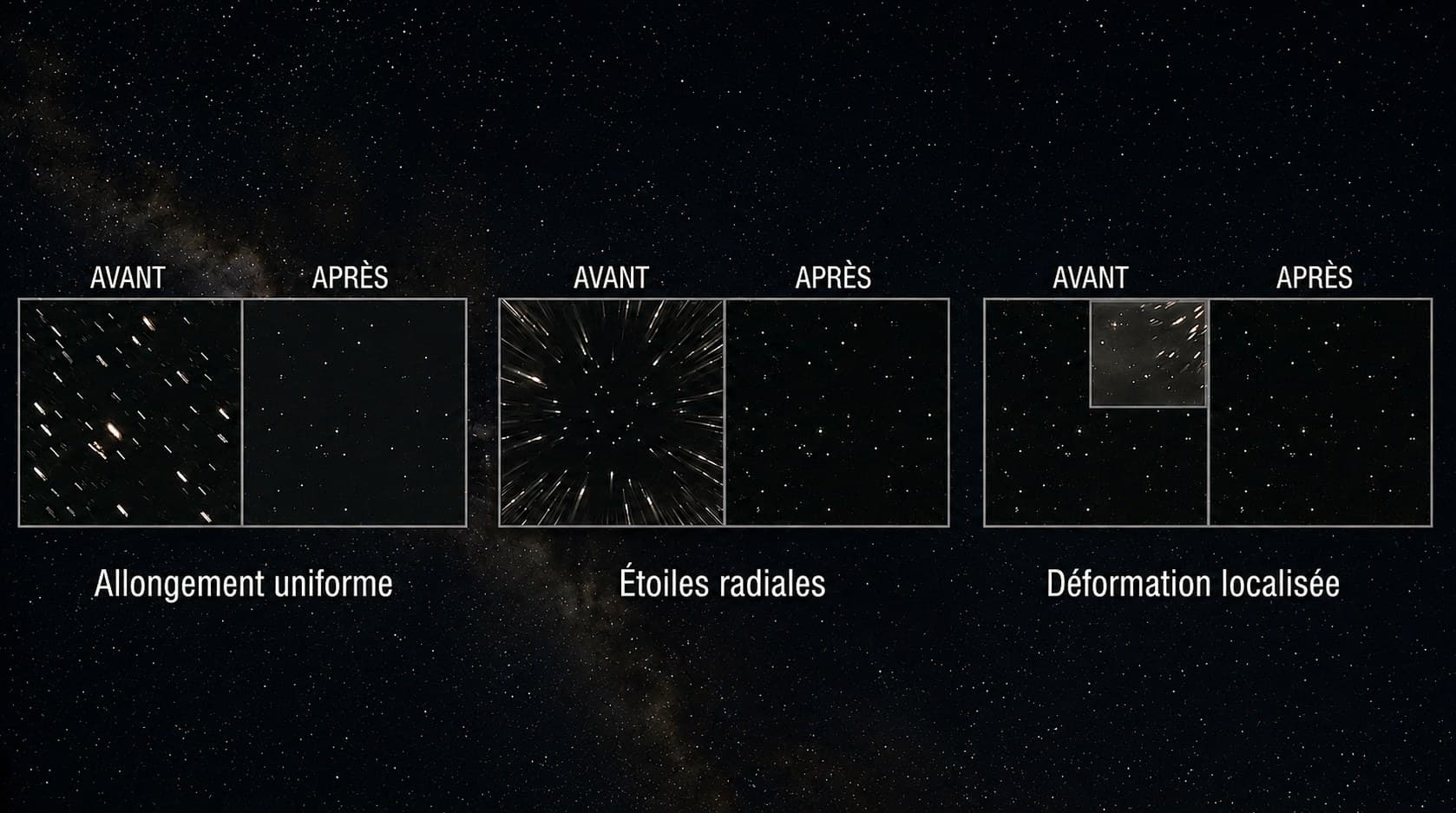
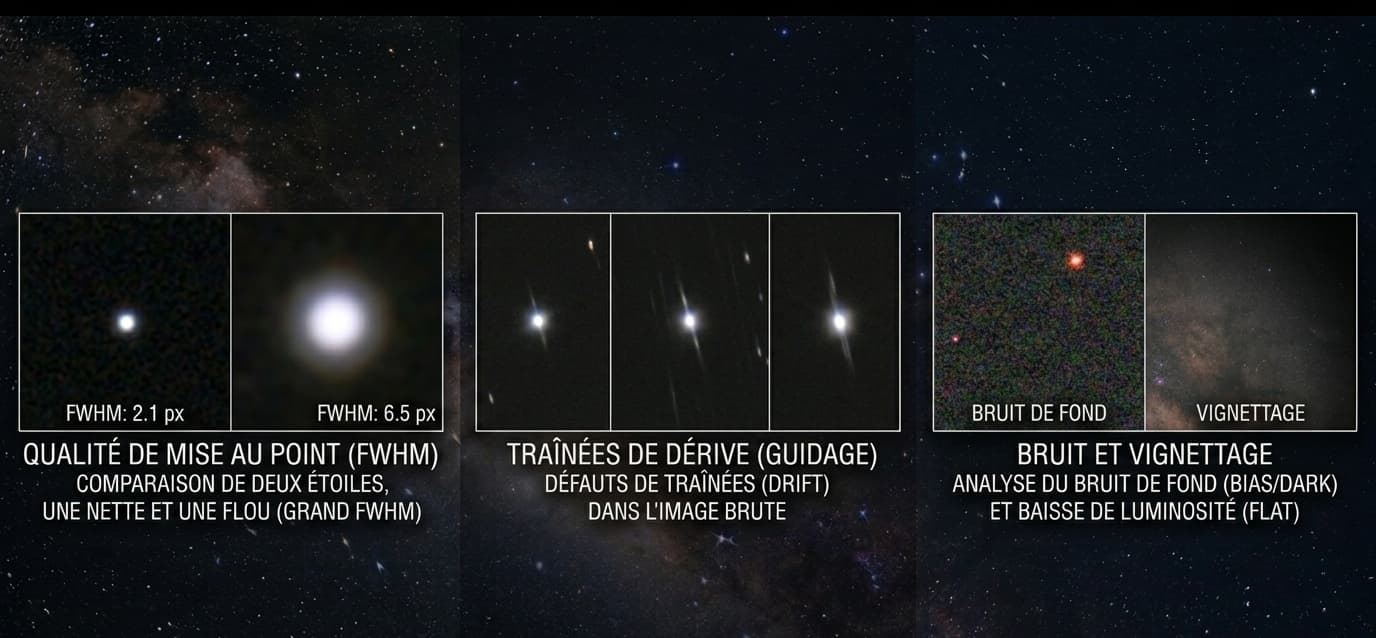
The image is well executed. The field core is sharp: FWHM 3.4 px at centre, elongation 1.07 barely above the measured floor (1.04), round stars, no tracking component (no coherent elongation direction, PA scattered at 48.7 deg). Tracking and focus are therefore on point.
The only real defect is optical: FWHM rises fairly symmetrically at the periphery (corner/centre 1.3, TL 4.42 px, L 3.59, BL 3.31) with oval stars and no clear radial coma. That is the signature of field curvature / a backfocus distance slightly out of tolerance, not marked tilt (the H asymmetry of 0.495 stays moderate and concentrated on the left side). The impact is cosmetic on this extended target, hence a low severity, but a spacing adjustment would tighten the edge stars.
On the background side, the illumination map is clean: radial profile +5% and a plane gradient of only 5%, dominant radial symmetry, low R2 reflecting the absence of marked structure. Nothing to fix on calibration or gradient. The Ha rendering is consistent with the DSS, which confirms the nebulosity is real.
Priority actions
- Fine-tune the corrector backfocus/spacing to tighten the corner stars (aim for a corner/centre ratio near 1.1)
- Check the tightness and coaxiality of the imaging train to rule out a tilt component on the left side