Astrophotography diagnosis of NGC7000: Noise / underexposure, background chroma noise and 2 others
Processedsans76x45
The Doc examined this image of NGC7000 (processed, sans, 76x45). Estimated overall technical quality: 6/10. 4 defects found: Noise / underexposure (severity 3/5), Background chroma noise (severity 3/5), Clipped stars (severity 2/5), Coma (severity 2/5).

Info
- Cible
- NGC7000
- Site
- Bortle 6 · banlieue dense (saisi)
- Position
- 20h59m34s · +43°42'39"
Bortle 6 on an emission nebula like NGC 7000 is workable but demanding without a filter. The sky background builds up fast, which caps the useful sub length and forces you to compensate with sub count. At 45 s per sub over 76 subs you stay under an hour, not enough to dig out the faint Ha extensions under such a bright sky. With no moon data supplied I cannot rule on a lunar contribution, and nothing in the image shows a clear directional gradient, so the background looks properly handled in processing. Practically, aim for several nights stacked, or move to a dual-band filter which would immediately restore contrast on this target.
Setup
- Type d'image
- Traitée
- Télescope
- Skywatcher 150/750
- Caméra
- Canon 550D
- Filtre
- sans
- Exposition
- 76x45
The 150/750 plus Canon 550D pairing suits NGC 7000 well: the APS-C field at 750 mm frames the Cygnus Wall nicely and the chosen composition is balanced, with the target not awkwardly cut. The 550D sampling (4.3 micron pixels) at 750 mm works out around 1.2 arcsec per pixel, comfortable under typical seeing. Two limits: f/5 without a corrector lets coma show in the corners, and going filterless under Bortle 6 makes every background photon costly. A coma corrector and a dual-band Ha/OIII filter would be the two highest-return upgrades for this setup on emission targets.
The diagnosis in detail
The diagnosis fits in one sentence: the image is well processed but starved of signal. Comparison with the DSS confirms that every visible structure, the Cygnus Wall, the dark filaments at lower right, the diffuse nebulosity on the left, is real. So there is no background artifact to correct, which validates the gradient removal and the calibration.
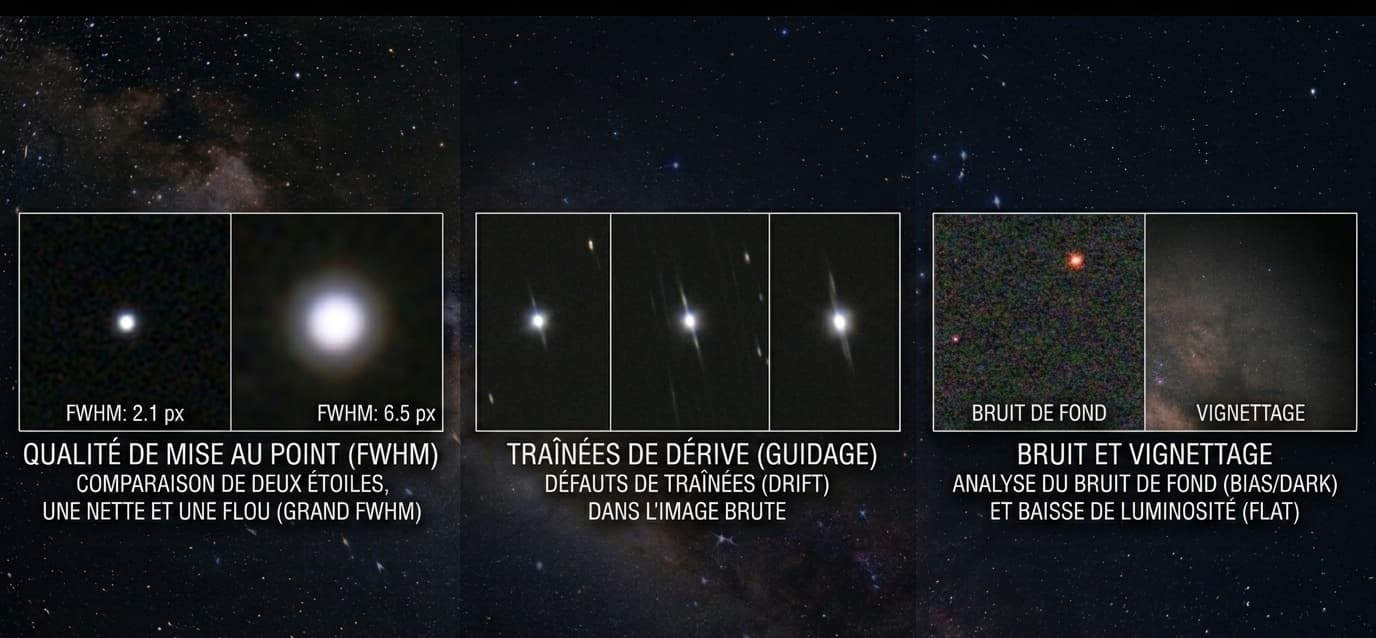
On the other hand, 57 cumulative minutes on an uncooled 550D under Bortle 6 leave pronounced grain, and that grain shows up mainly as chroma noise in the dark areas along the left edge, where magenta and green clumps appear with no DSS counterpart. One single cause explains both defects: not enough photons.
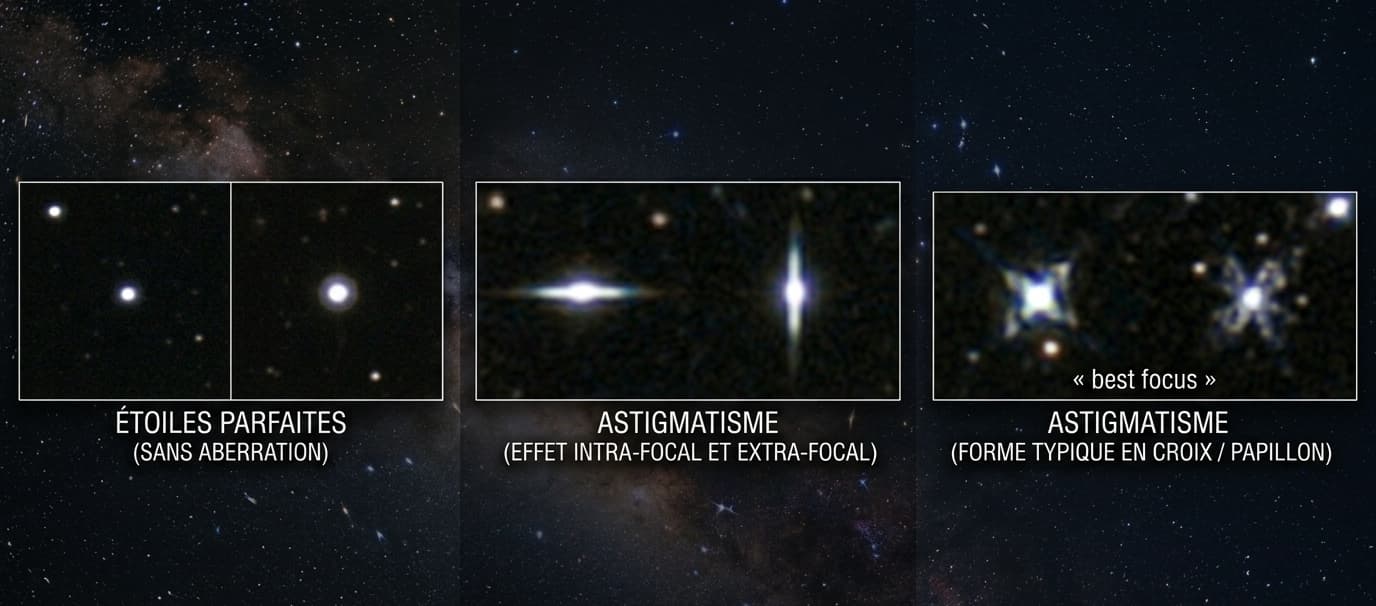
The rest is minor and acceptable. Bright star cores are clipped to pure white, a consequence of a hard stretch pulled to lift the nebula off a bright background, and the corners betray the natural coma of the f/5 Newtonian. Tracking is clean, central stars are pinpoint, the mount did its job on these short subs.
Priority actions
- Gather far more exposure time, aim for 4 to 6 h total on NGC 7000 before reworking the processing
- Lengthen subs to 120-180 s and dither between each one to break up the noise
- Apply chroma-targeted noise reduction on the background rather than a global smoothing
- Fit a coma corrector at the exact backfocus to clean up the corner stars
- Protect the highlights during the stretch to keep color in the star cores