Astrophotography diagnosis of Altair: Sensor tilt and clipped stars
RawL30s12 sept. 2026
The Doc examined this image of Altair (raw, L, 30s). Estimated overall technical quality: 7/10. 2 defects found: Sensor tilt (severity 2/5), Clipped stars (severity 2/5).
&w=1920&q=75)
Info
- Cible
- Altair
- Date
- 12 sept. 2026, 19:44
- Lune
- Gibbeuse décroissante 96.7% (sous l'horizon)
- Site
- Bortle 2 · rural typique (VIIRS)
- Position
- 19h50m49s · +8°51'42"
Excellent and clearly under-exploited conditions. Bortle 2 puts the sky background at the darkest level available, and the 96.7% waning gibbous Moon was below the horizon during the exposure, so no lunar contribution is possible: the measured plane gradient (4% amplitude, R² 0.18) is not meaningful and signals nothing. With such a sky, the limit is not light pollution but exposure: 30s in L at gain 125 leaves a background-to-black-point margin of only 1.94, far from sky-limited. Under Bortle 2 you can safely stretch to 120 or 180s in luminance, the background will stay clean and you gain depth directly on faint stars.
Setup
- Type d'image
- Brut
- Télescope
- Takahashi FSQ 530@F\5.0
- Caméra
- PlayerOne CCD Zeus 455M PRO
- Filtre
- L
- Exposition
- 30s
- Phase de lune
- Premier croissant (1 %)
- FOV
- 3.89°
A coherent wide-field combination. The 530mm FSQ at F/5 with 3.76µm pixels yields 1.463"/px and a 3.89° field, a comfortable sampling that matches typical seeing without oversampling. On Altair, a point-like and very bright target, the 3.89° field is obviously oversized, but it suits an interest in the surrounding star field. On settings: gain 125 sits slightly above this sensor's unity gain, no noise concern but a bit less highlight headroom on bright stars. Offset 50 leaves 0.21% dark clipping, a low and acceptable value. The weak point is the 0°C sensor temperature: going down to -10°C will clearly reduce dark current and stabilize dark frame matching.
The diagnosis in detail
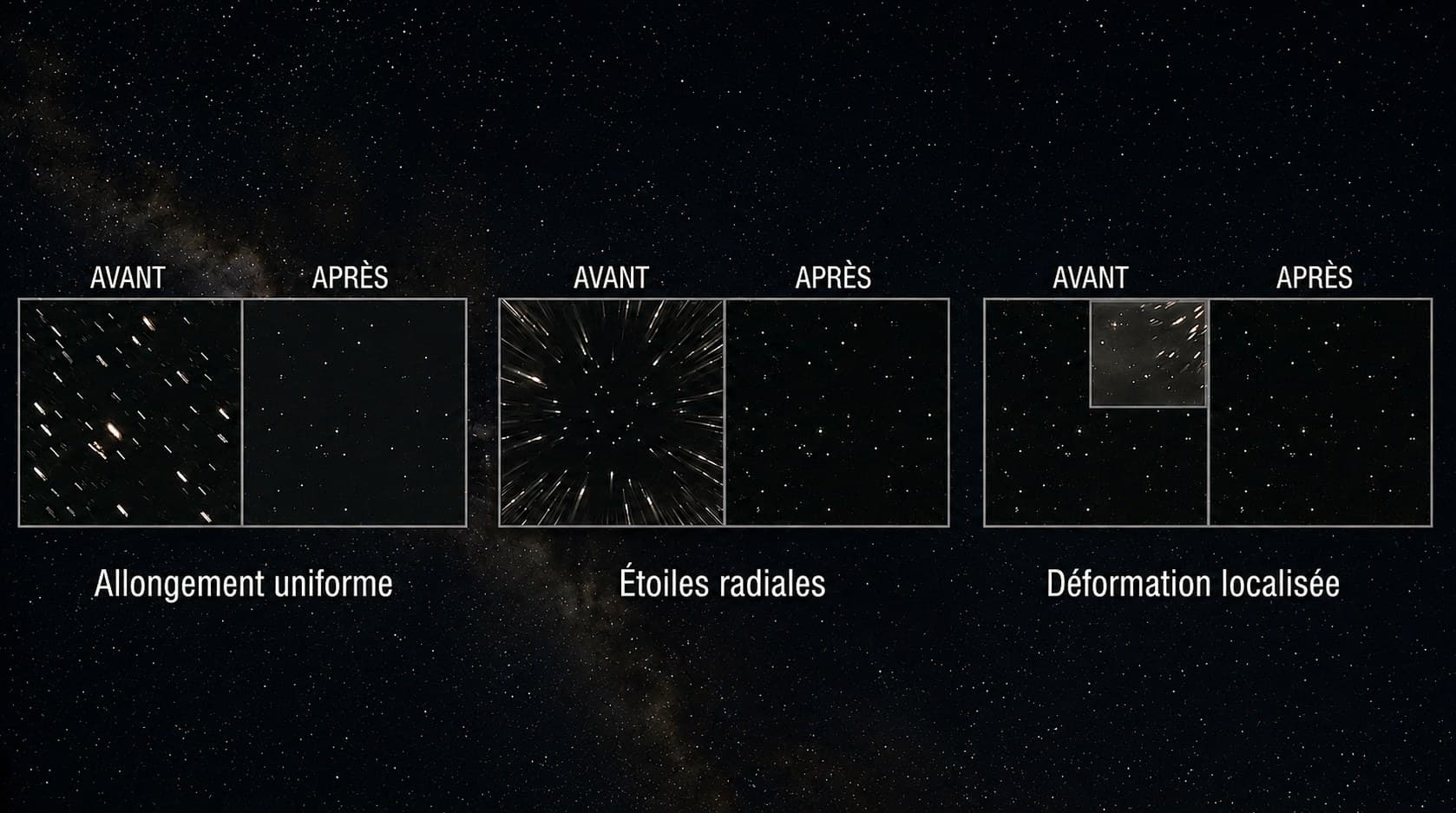
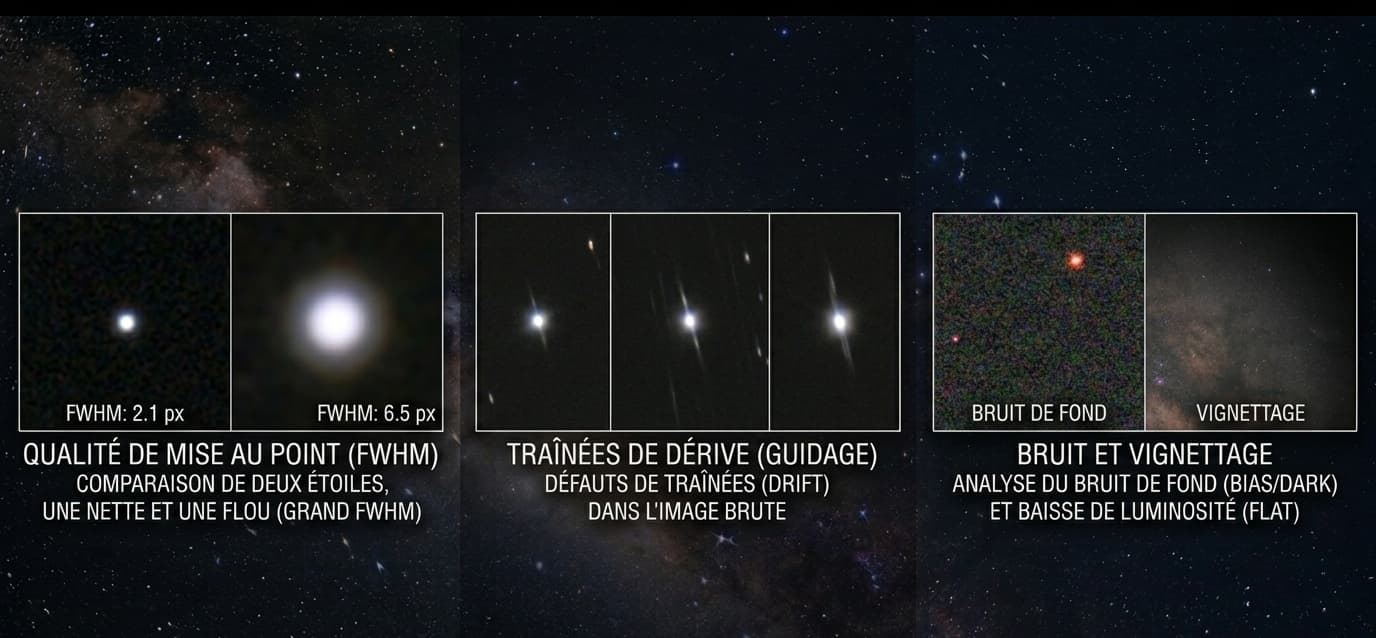
This sub is technically sound and the two findings are minor. The PSF is the best indicator: 2.27/2.04 px at center with an elongation of 1.11 against a measured field floor of 1.07, meaning near-perfectly round stars with no tracking component at all. PA dispersion between zones reaches 33.3°, so there is no preferred elongation direction: the mount held the 30s cleanly and focus is spot on.
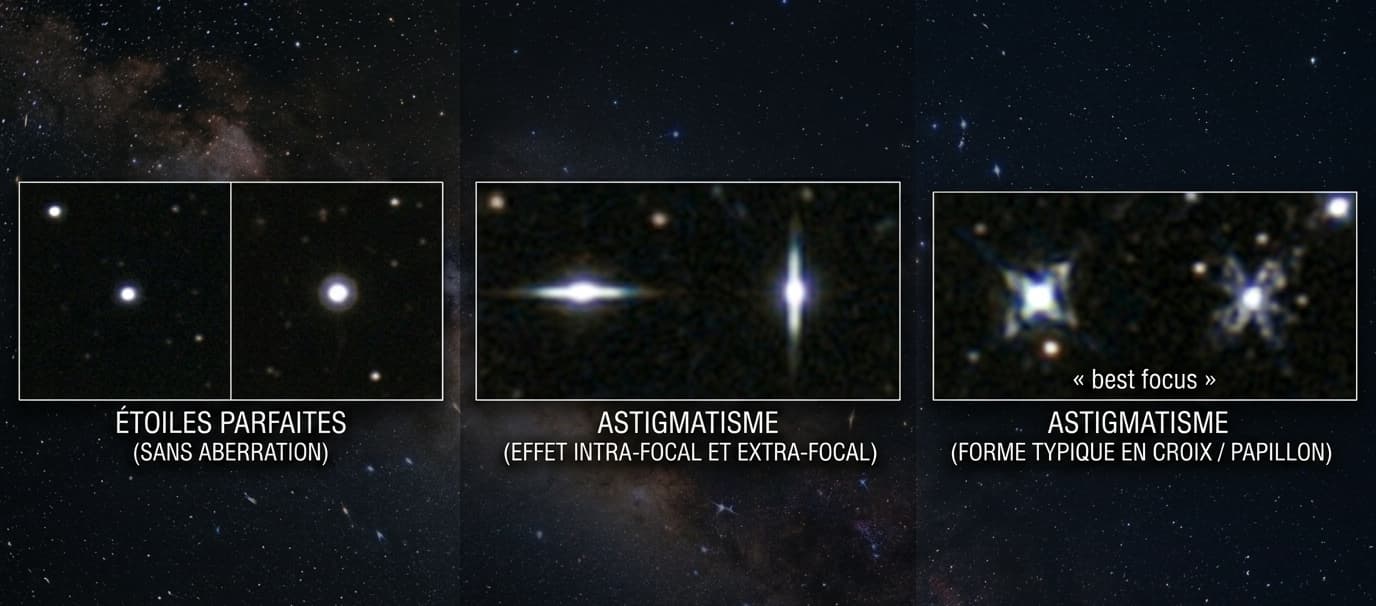
The only shape signal is a single-axis asymmetry: the top-left corner rises to 2.86 px on the major axis while the bottom-right stays at 2.46, with a corner/center ratio of 1.242 and horizontal asymmetry three times the vertical. That is a tilt signature, but low in amplitude and measured on a single sub where noise distorts the Moffat fit. Confirm it on a series before touching the imaging train.
On the background, the radial profile measures a 9% falloff toward the edges with zero azimuthal anisotropy, which is normal optical vignetting before flat calibration on a raw sub, not a defect. The halo around Altair appears identically on the DSS reference: it is the genuine scattering of a magnitude 0.8 star, not an internal reflection.
Priority actions
- Extend the sub exposure to 120 or 180s in luminance: under Bortle 2 the 1.94 background-to-black-point margin shows you are far from sky-limited
- Lower the sensor temperature to -10°C instead of 0°C to cut dark current and make darks reliable
- Confirm the top-left / bottom-right asymmetry across a series of subs before any tilt adjustment, the measured spread being small
- Add very short exposures (0.5 to 2s) for an HDR blend if Altair's core needs to keep structure