Astrophotography diagnosis of Altair: Sensor tilt and clipped stars
RawL30s14 sept. 2026
The Doc examined this image of Altair (raw, L, 30s). Estimated overall technical quality: 8/10. 2 defects found: Sensor tilt (severity 2/5), Clipped stars (severity 2/5).
&w=1920&q=75)
Info
- Cible
- Altair
- Date
- 14 sept. 2026, 19:06
- Lune
- Gibbeuse décroissante 85.7% (sous l'horizon)
- Site
- Bortle 2 · rural typique (VIIRS)
- Position
- 19h50m49s · +8°51'47"
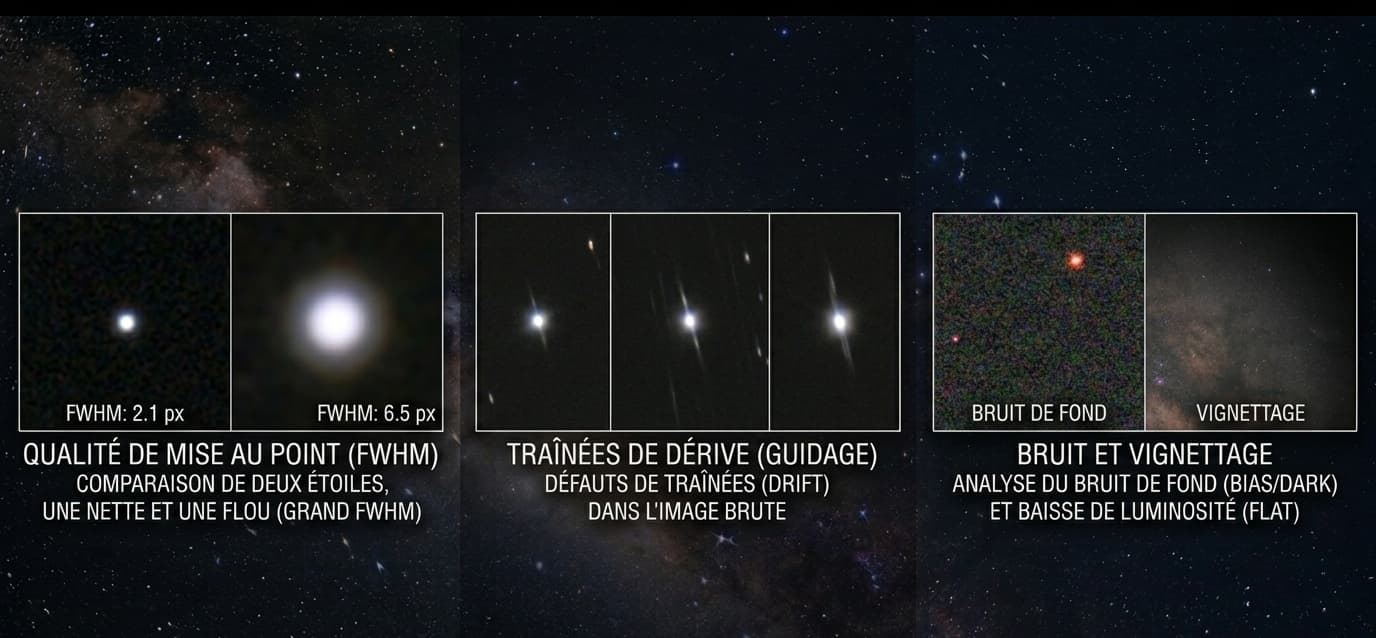
Excellent conditions: Bortle 2 and the Moon below the horizon, so no parasitic gradient source expected. The background map confirms a near flat field (plane amplitude 11%, R2 0.38, anisotropy 0.02), consistent with normal optical vignetting on an uncalibrated sub. For a bright stellar target like Altair these conditions are overkill: keep this dark site for low surface brightness targets (faint nebulosity, IFN) and shoot this kind of star field from a poorer sky. Implied seeing is good, with FWHM around 2 px, roughly 3 arcseconds.
Setup
- Type d'image
- Brut
- Télescope
- Takahashi FSQ 530@F\5.0
- Caméra
- PlayerOne CCD Zeus 455M PRO
- Filtre
- L
- Exposition
- 30s
- Phase de lune
- Premier croissant (10 %)
- FOV
- 3.89°
Coherent setup: the FSQ 530 at f/5 with 3.76 um pixels gives 1.46 arcsec/px, a comfortable sampling neither over nor undersampled for typical seeing, and the 3.89 degree field is wide, suited to large fields rather than a single star. On settings, gain 125 is reasonable on this sensor and offset 50 causes no significant dark clipping (0.33%). Worth noting is the background-to-black-point margin of 2.14, below the 5-10 sky-limited benchmark: in luminance under Bortle 2, 30s is a bit short, you can go to 60-120s without burning the field further. Sensor temperature at 4.5C, deeper cooling (-10C) would reduce dark current.
The diagnosis in detail
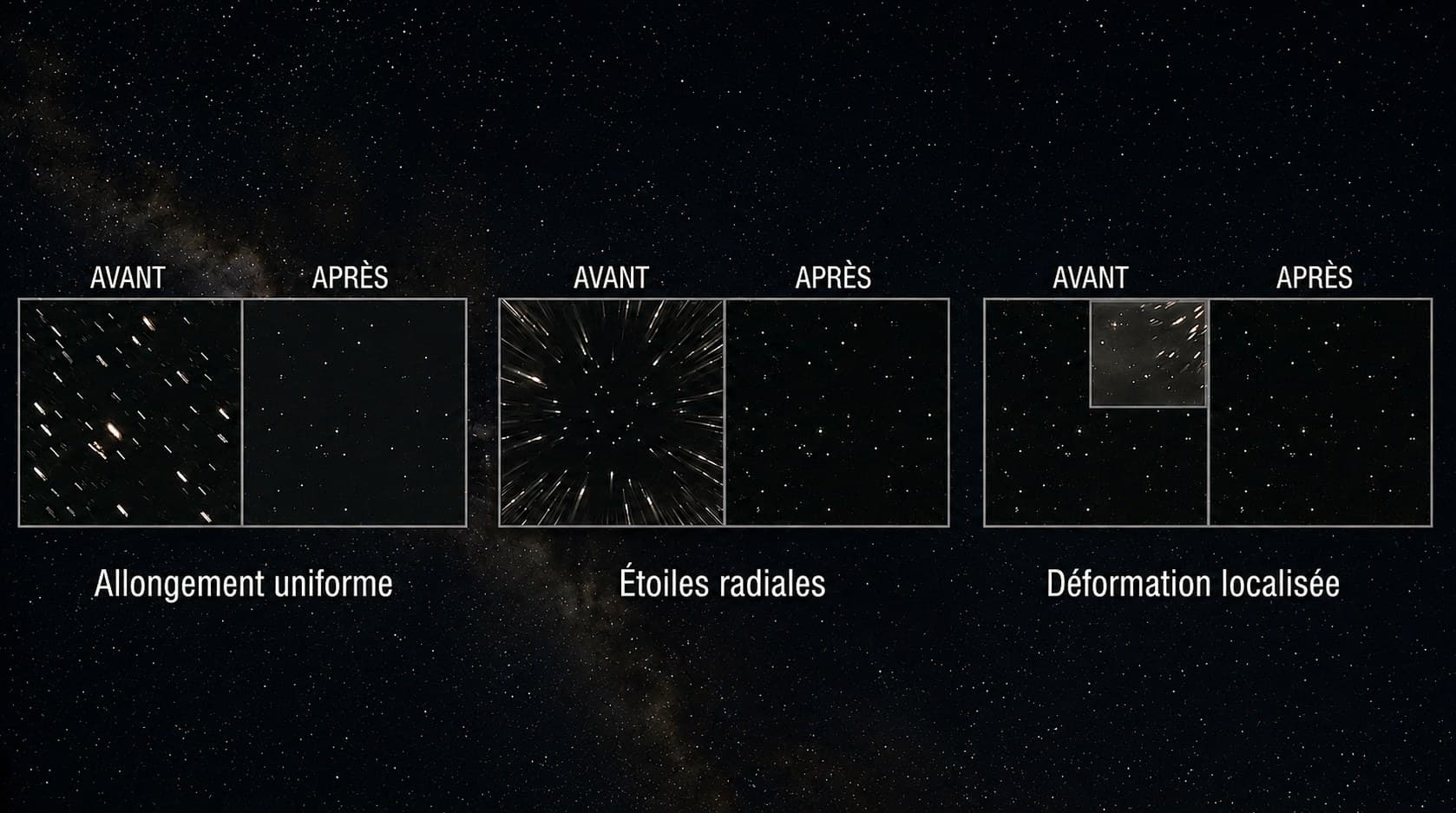
The verdict is clearly positive: this is a technically healthy sub. Moffat measurements give FWHM between 2.03 and 2.51 px across the nine zones, with a central elongation of 1.05 barely above the 1.02 floor of the mono camera. The 46 degree PA dispersion confirms round stars with no preferred elongation direction, so no tracking, guiding or field rotation problem over 30 seconds.
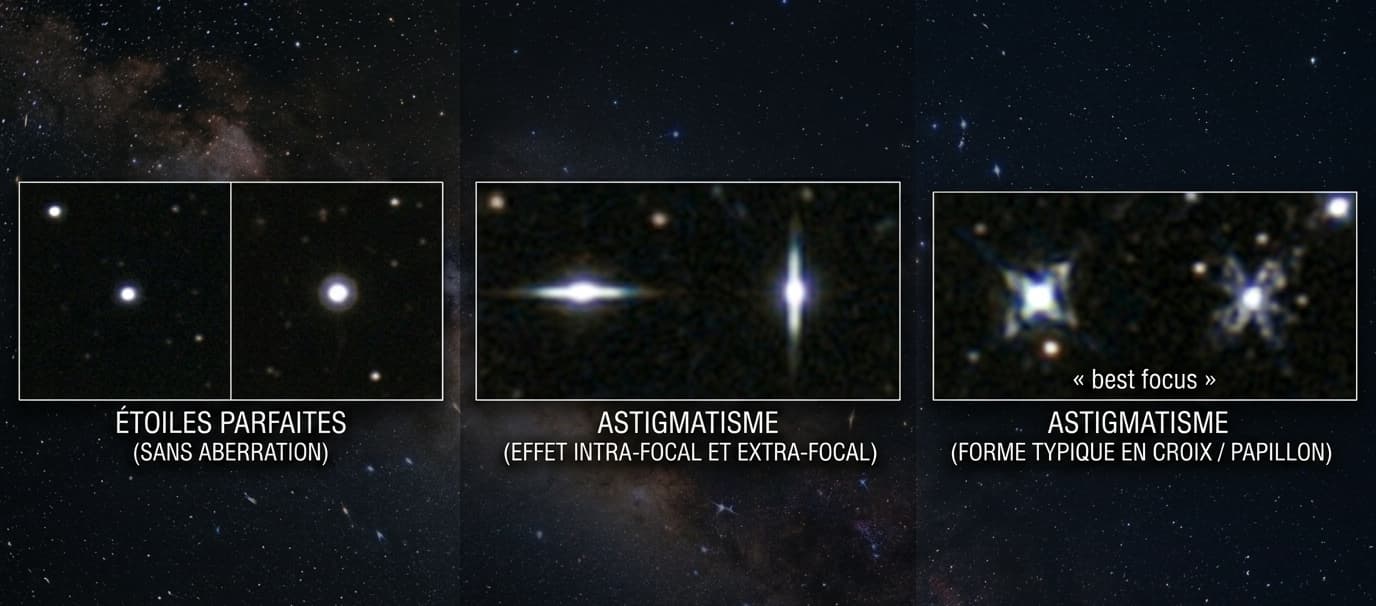
The only measured signal is a strictly horizontal FWHM asymmetry (0.121 against 0.009 vertically): the left edge, TL and especially BL, is slightly more spread than the right edge which stays at 2.0 px. On a 9576x6388 px sensor, a tilt of a few tens of microns is enough to produce this gap. The amplitude stays low, corner/center ratio 1.18, and the frame is usable as is, but repeatability across a full series is worth checking before touching the imaging train.
The rest is physics: Altair inevitably clips, and the background is dominated by normal pre-flat optical vignetting that calibration will correct. The real room for improvement is the sub exposure, a bit short to be sky-limited.
Priority actions
- Lengthen the sub exposure to 60-120s to reach the sky-limited regime (current margin 2.14, target 5-10)
- Check the left/right asymmetry across a full series before any tilt adjustment, the measured gap being small
- Add a short exposure series (1-2s) to rebuild Altair's core in HDR
- Increase cooling to -10C instead of 4.5C to limit dark current
- Shoot matched flats to correct the 13% vignetting measured between center and edges