Astrophotography diagnosis of Boogie: Astigmatism
RawL120s20 févr. 2025
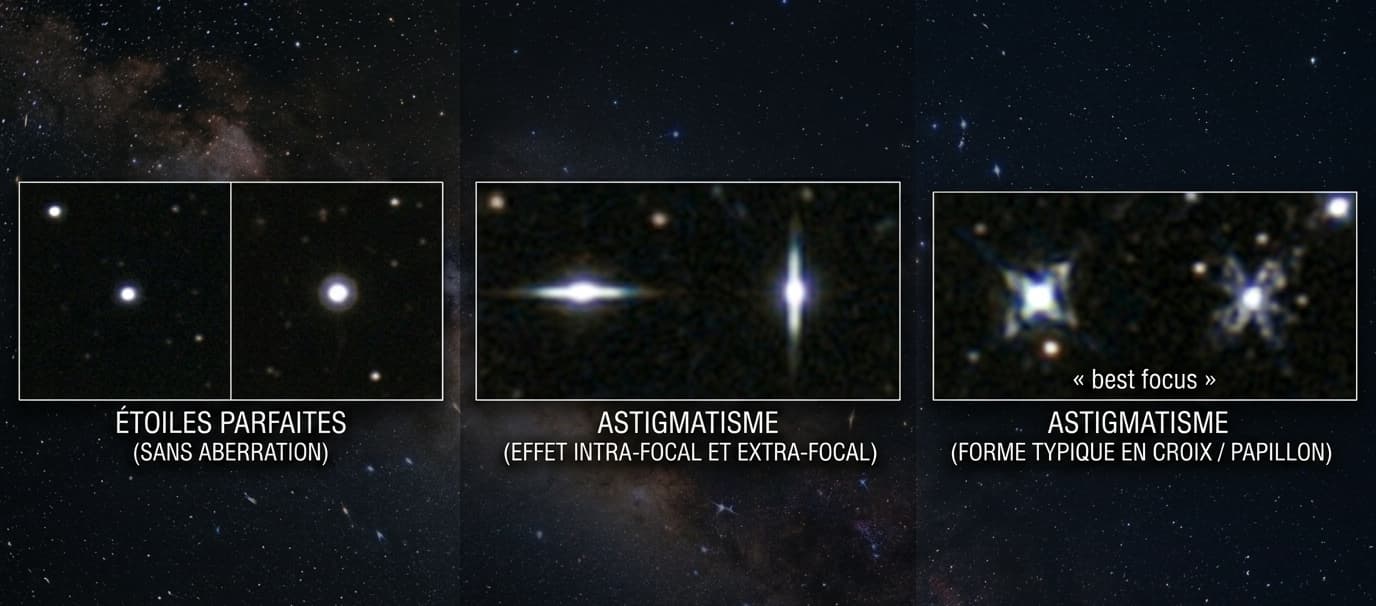
The Doc examined this image of Boogie (raw, L, 120s). Estimated overall technical quality: 7/10. 1 defect found: Astigmatism (severity 2/5).
&w=1920&q=75)
Info
- Cible
- Boogie
- Date
- 20 févr. 2025, 23:53
- Lune
- Premier quartier 53.3% (sous l'horizon)
- Site
- Bortle 1 · ciel pristine (VIIRS)
- Position
- 5h57m45s · +2°11'60"
Excellent conditions: Bortle 1 with the Moon below the horizon, so no lunar contribution or urban pollution to worry about on this frame. The measured background is very low (median 0.01, background-to-black-point margin of 2.15): under such a dark sky, 120s in luminance at f/3.3 is still a bit short to be truly sky-limited, read noise still weighs in. You can push to 180 or 240s with no risk of background saturation, which will improve per-sub signal to noise and cut down the file count. Dark clipping stays negligible (0.04%), so offset 30 is doing its job.
Setup
- Type d'image
- Brut
- Télescope
- Epsilon 160ED
- Caméra
- Poseidon-M PRO
- Filtre
- L
- Exposition
- 120s
- Phase de lune
- Dernier quartier (42 %)
- FOV
- 2.50°
Coherent configuration: 535mm at f/3.3 on a 6252x4176 sensor gives a 2.5 degree field and 1.45"/px, comfortable sampling that matches the measured 2.4 px FWHM at center (about 3.5" on the sky, decent seeing, no oversampling). Gain 125 and -15C are healthy settings on this sensor. The sensitive point on an Epsilon 160ED remains backfocus: at this focal ratio the tolerance is very tight, and that is exactly what the rising elongation on the right edge betrays. With an L filter under Bortle 1, no light pollution filter is needed.
The diagnosis in detail
The overall verdict is good. The Moffat fit gives 2.43/2.16 px FWHM at center for an elongation of 1.13, barely above the field's instrumental floor (1.11): the optical axis is clean, tracking holds well over 120s, and neither drift nor guiding oscillation is readable on the panel, the central PSFs being compact and symmetric.
The only significant deviation is geographic: elongation climbs to 1.33 on the right edge, 1.33 at the bottom and 1.38 in the bottom-right corner, while the bottom-left corner stays at 1.11 and the top of the field at 1.18. This asymmetry comes with a corner/center FWHM ratio of only 1.1, meaning edge stars are not bigger, just more oval. That is the signature of field astigmatism, not of edge defocus or residual coma, which would produce a radial comet shape symmetric across all four corners.
The measured background variation (+48%) is attributed to extended structure in the field, not to an instrumental defect: no vignetting or gradient to correct here, the Bortle 1 sky is doing its work. The 120s exposure is slightly short given the measured background-to-black-point margin, without being a problem.
Priority actions
- Check and adjust backfocus to a tenth of a millimeter, the critical parameter on an Epsilon at f/3.3
- Check squareness and freedom from pinching in the imaging train on the right side of the field
- Extend the sub exposure to 180-240s to lift the background further above read noise under this Bortle 1 sky
- Rerun the aberration inspector after adjustment to validate edge uniformity