Astrophotography diagnosis of Caldwell 101: Astigmatism
RawL180s16 juil. 2026
The Doc examined this image of Caldwell 101 (raw, L, 180s). Estimated overall technical quality: 6/10. 1 defect found: Astigmatism (severity 2/5).
&w=1920&q=75)
Info
- Cible
- Caldwell 101
- Date
- 16 juil. 2026, 08:04
- Lune
- Gibbeuse décroissante 95% (sous l'horizon)
- Site
- Bortle 3 · rural peu pollué (VIIRS)
- Position
- 19h09m41s · -63°50'35"
Very favourable conditions: Bortle 3 and the Moon below the horizon, 126.8 degrees from the target, so no lunar pollution is possible on this sub. That is exactly the context needed for a faint galaxy like NGC 6946 in broadband luminance, where the slightest urban gradient would be crippling. The measured sky background matches that Bortle: dark, with no significant oriented gradient (plane amplitude 5%, R squared 0.02). In other words, the limiting factor here is not the sky but the amount of signal accumulated. Make the most of these moonless nights to stack many hours on the outer spiral arms and the surrounding IFN.
Setup
- Type d'image
- Brut
- Télescope
- RC8_R66
- Caméra
- QHYminiCam8M
- Filtre
- L
- Monture
- CEM40
- Exposition
- 180s
- Phase de lune
- Waxing crescent (2 %)
- FOV
- 34.2'
Coherent setup for the target: 1100 mm at f/6 gives a 0.57 degree field, and NGC 6946 (about 11 arcmin) fits easily with room for the faint arms. The 0.544 arcsec/px sampling is however clearly oversampled for typical seeing: the measured FWHM of 7.9 px at centre corresponds to about 4.3 arcsec, confirming you are seeing-limited, not optics-limited. Binning 2 at integration would give back signal-to-noise without losing real detail. On the settings side: gain 9 and a 180s luminance sub give a background/black-point margin of only 2.1 with 58% dark clipping, which is too tight. Raise the gain towards unity gain or extend to 300s to become sky-limited. Offset 100 and cooling at -19.9C are healthy.
The diagnosis in detail
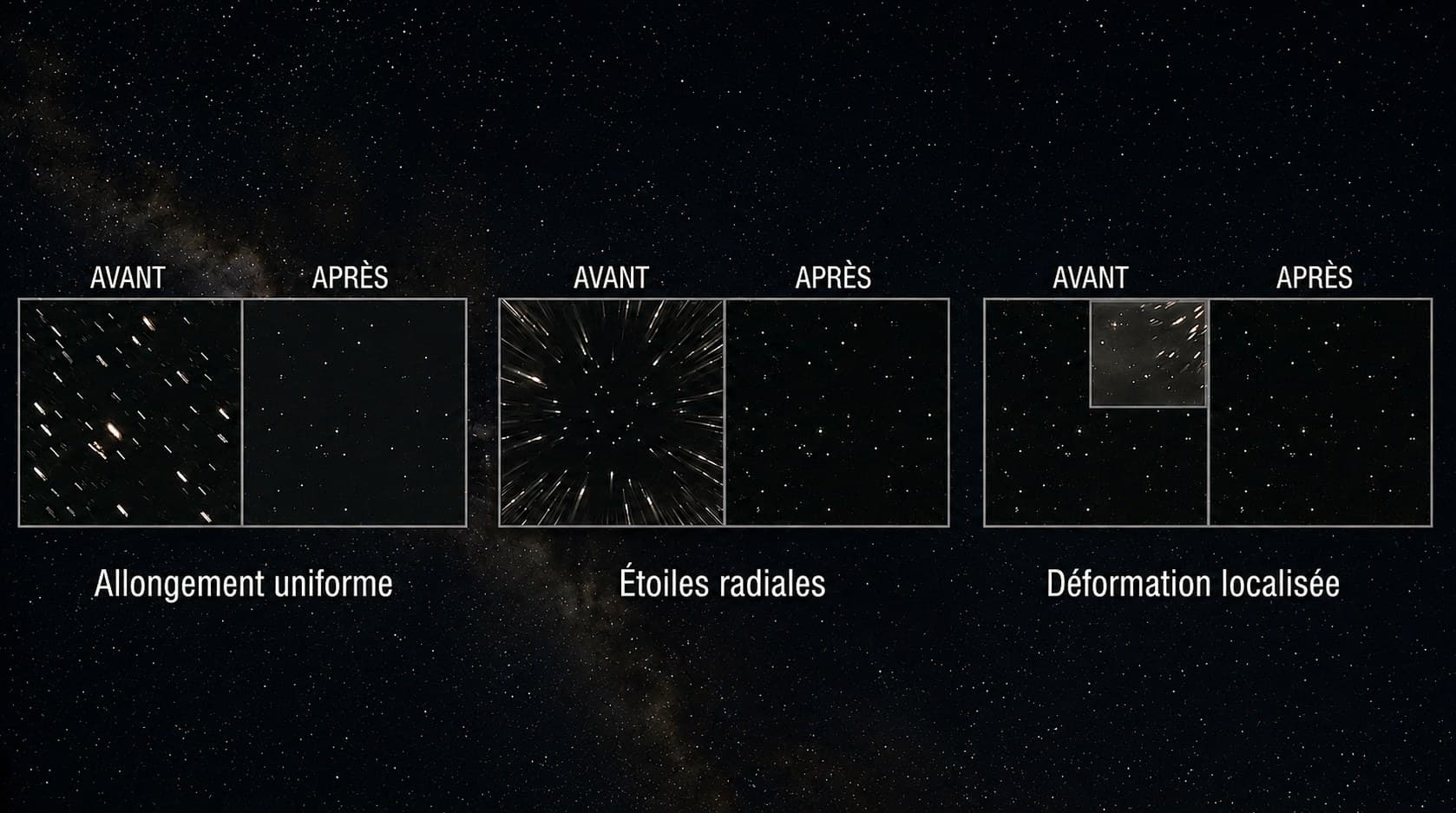
The image is broadly healthy. The PSF sheet shows round stars well fitted by the Moffat ellipse at centre and across the upper half of the field, with 1.04 elongation at centre against a 1.02 field floor: the CEM40 tracking over 180s is faultless, and the 25.4 degree PA dispersion confirms there is no preferred elongation direction, so no drift, no periodic error, no guiding oscillation.
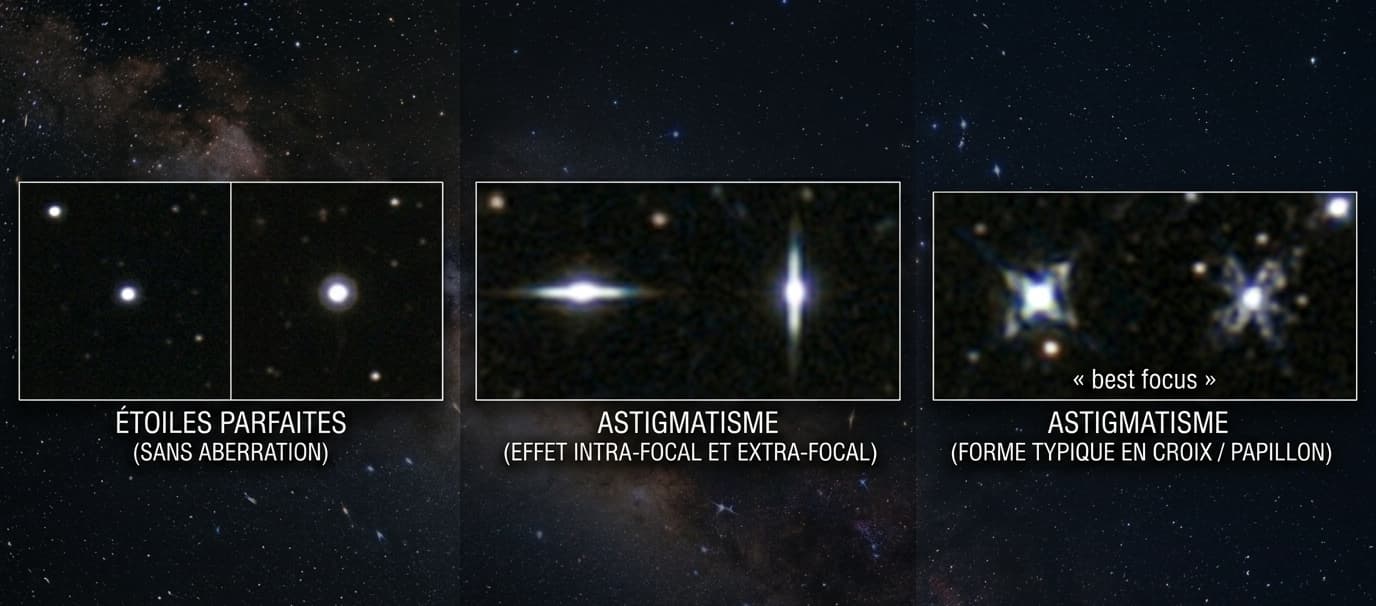
The only instrumental signal retained is a rise in elongation on the right edge and bottom-right corner (1.13-1.14) with no matching FWHM increase, which points to field astigmatism rather than field curvature or coma. The 46% tilt candidate is not retained: the measured vertical asymmetry (0.806) comes from the BL and B zones, whose thumbnails are plainly noise with aberrant ellipse fits (FWHM 1.4/0.4 px), not real stars. With no usable star in those two zones, no diagonal opposite-corner asymmetry can be demonstrated, so the tilt condition is not met.
The real lever for improvement lies elsewhere: exposure. With 58% dark clipping and a background/black-point margin of 2.1, this sub is not exploiting the dynamic range available under a Bortle 3 sky.
Priority actions
- Lengthen the sub exposure towards 300s or raise the gain to become sky-limited (current background/black-point margin of 2.1 is too low)
- Check and adjust the R66 reducer backfocus to reduce edge-of-field elongation
- Stack with binning 2 to compensate the oversampling (0.544 arcsec/px for a 4.3 arcsec FWHM) and gain signal-to-noise
- Accumulate many hours under this moonless sky to bring out the faint spiral arms of NGC 6946