Astrophotography diagnosis of NGC 2683: Tracking drift and backfocus error
Raw45s06 avr. 2026
The Doc examined this image of NGC 2683 (raw, 45s). Estimated overall technical quality: 5/10. 2 defects found: Tracking drift (severity 3/5), Backfocus error (severity 1/5).

Info
- Cible
- NGC 2683
- Date
- 06 avr. 2026, 19:56
- Lune
- Croissant croissant 20.6% (sous l'horizon)
- Site
- Bortle 3 · rural peu pollué (VIIRS)
- Position
- 8h52m58s · +33°10'16"
Conditions are very favorable. Bortle 3 on a broadband galaxy is exactly the context that lets you pull out the faint extensions of NGC 2683 without fighting a gradient, and the background measurement confirms it with near-zero anisotropy. The Moon is below the horizon and 124 degrees from the target, so no lunar contribution is possible on this frame. With such a sky there is no reason to stay at 45s: you can aim for longer subs as soon as tracking allows, to lift the background further off the black point (measured e_margin of 2.64, still well short of the sky-limited regime).
Setup
- Type d'image
- Brut
- Télescope
- Celestron AVX/CGE/CGEM/CGX
- Caméra
- ZWO ASI2600MC Pro
- Exposition
- 45s
- Phase de lune
- Gibbeuse décroissante (79 %)
- FOV
- 54.6'
The combination is coherent on paper but very demanding in practice. At 1478mm on the ASI2600MC you are at 0.525"/px, clearly oversampled: under typical seeing you gain no detail and pay for it in sensitivity and tracking tolerance. NGC 2683 occupies a small part of the 0.91 degree field, so framing is comfortable. Gain 120 and offset 50 are sound, there is no significant dark clipping (0.01%) and the sensor at -10C is well cooled. The real limit is the pairing of a long focal length with an AVX/CGEM mount: 2x2 binning would bring sampling back toward 1.05"/px and make the drift far less punishing.
The diagnosis in detail
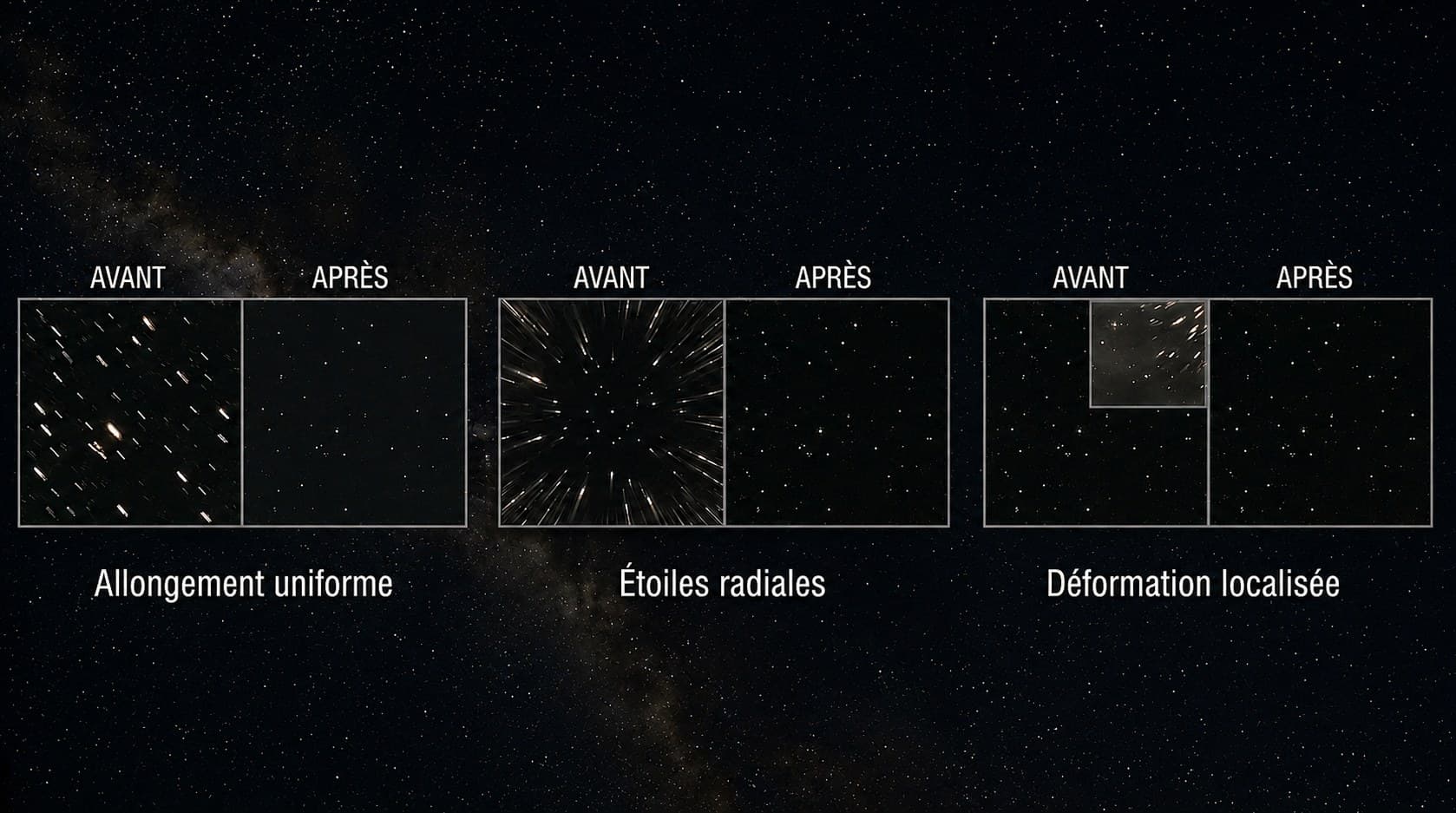
The diagnosis comes down to one point: the star deformation is global, not local. Measured elongation at the center reaches 1.22 while the field floor sits at 1.09, and position angle dispersion between zones is only 19.9 degrees, meaning every star stretches in the same direction from center to corners. A field aberration (tilt, backfocus, coma) would leave the center pinpoint: that is not the case here. So it is the mount talking.
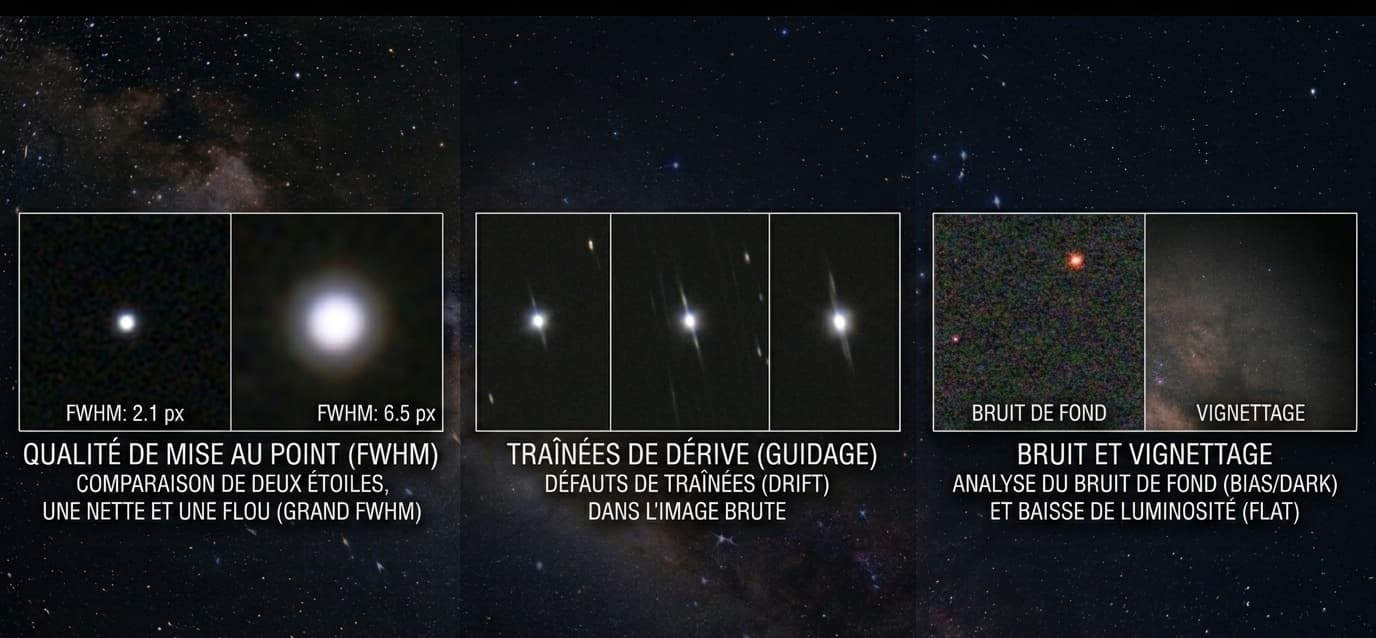
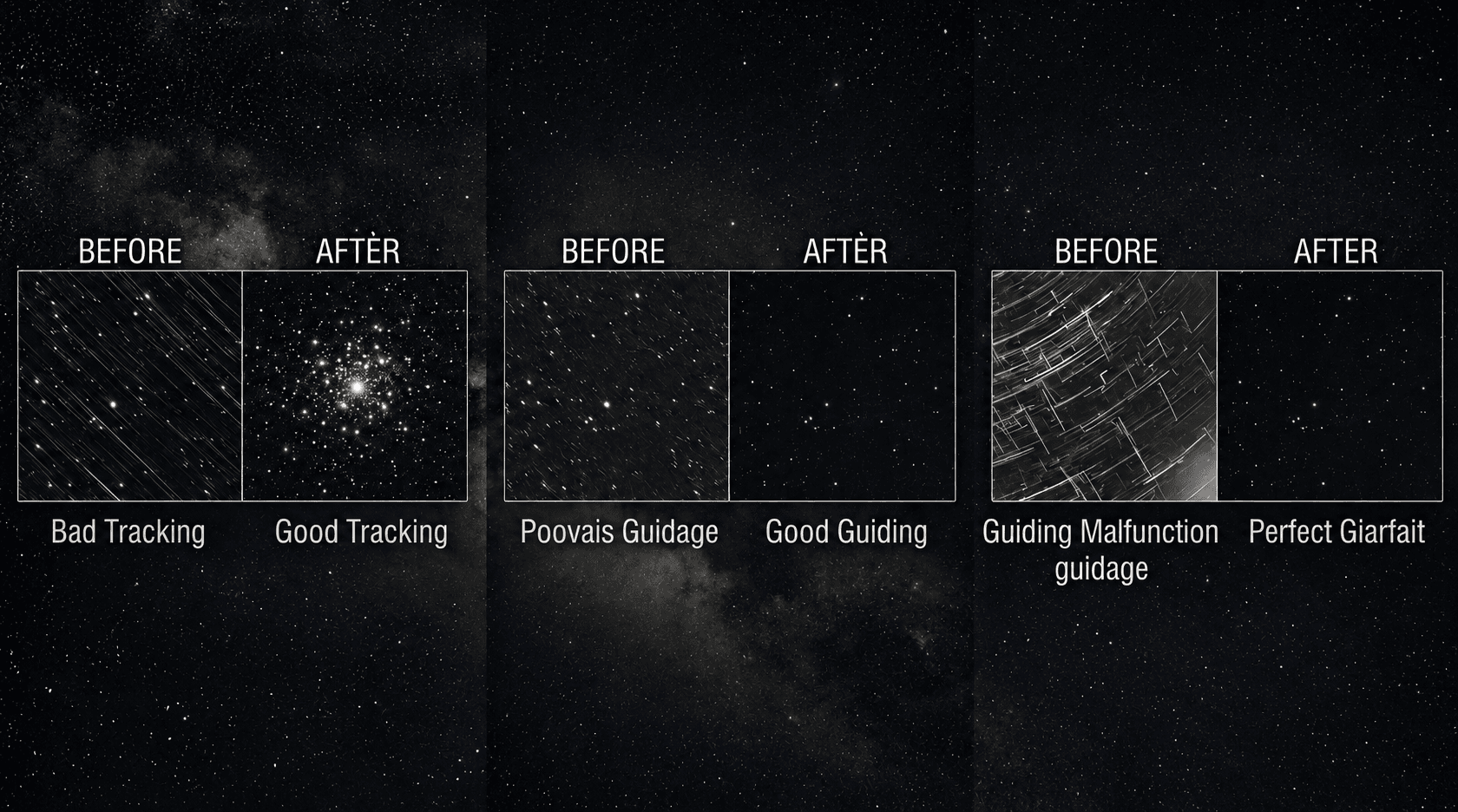
The context confirms it. At 0.525"/px, a single arcsecond of tracking error spreads over two pixels, and 45s is ample time to record it. The overall FWHM around 7px corresponds to nearly 3.7", well beyond what this Bortle 3 sky should allow: part comes from seeing, the rest from drift. The slight FWHM increase toward the edges is noted as a minor point of attention, but the corner/center ratio stays below 1, so nothing justifies touching the spacing while the PSF is polluted by tracking.
The rest of the image is healthy: radially symmetric background with no oriented gradient, no saturation, sensor temperature under control. Fix the tracking and this same configuration will deliver markedly sharper subs.
Priority actions
- Redo polar alignment and set up autoguiding targeting under 0.6" total RMS
- Shorten exposures to 20-30s until tracking is stable
- Consider 2x2 binning to return toward 1"/px, better matched to seeing and to the mount
- Once tracking is clean, shoot a control frame and re-read the PSF sheet before judging backfocus
- Then lengthen exposures to lift the background further off the black point under this Bortle 3 sky