Astrophotography diagnosis of Gamma Velorum Cluster: Light pollution gradient and clipped stars
ProcessedB, G, R, HaHa 30×180s · B 10×180s · G 10×180s · R 10×180s (total ~3.0 h)11 févr. 2026
The Doc examined this image of Gamma Velorum Cluster (processed, B, G, R, Ha, Ha 30×180s · B 10×180s · G 10×180s · R 10×180s (total ~3.0 h)). Estimated overall technical quality: 7/10. 2 defects found: Light pollution gradient (severity 3/5), Clipped stars (severity 2/5).
&w=1920&q=75)
Info
- Cible
- Gamma Velorum Cluster
- Date
- 11 févr. 2026, 00:00
Moon at 18%: negligible influence on the sky background, no lunar gradient expected. The measured gradient is therefore instrumental or atmospheric (low field) in origin, not lunar. With such a wide field at f/2, the sky background is sensitive to residual gradients even under good skies; gradient removal in processing remains the key. The Hα layer helps bring out the emission filaments without depending on transparency conditions.
Setup
- Type d'image
- Traitée
- Télescope
- Very Small Telescope (Chilescope T4) Nikkor 200mm f/2
- Caméra
- FLI ML16200
- Filtre
- B, G, R, Ha
- Monture
- 10Micron GM1000 HPS
- Exposition
- Ha 30×180s · B 10×180s · G 10×180s · R 10×180s (total ~3.0 h)
- Phase de lune
- 18%
- Notes
- Logiciels : Photoshop, PixInsight, BlurXTerminator, NoiseXTerminator, StarXTerminator
The Nikkor 200mm f/2 + FLI ML16200 pairing delivers a very wide field perfectly suited to the Gamma Velorum cluster and its surrounding nebulosity: the target and its context fit comfortably in the frame, coherent framing. The 10Micron GM1000 HPS in modeled pointing explains well-tracked stars over 180s with no marked directional drift (the corner shape scatter is mainly noise). The added Hα layer (30×180s) is sensible for an emission-rich field. Complementary short exposures would help tame the cores of the brightest stars.
The diagnosis in detail
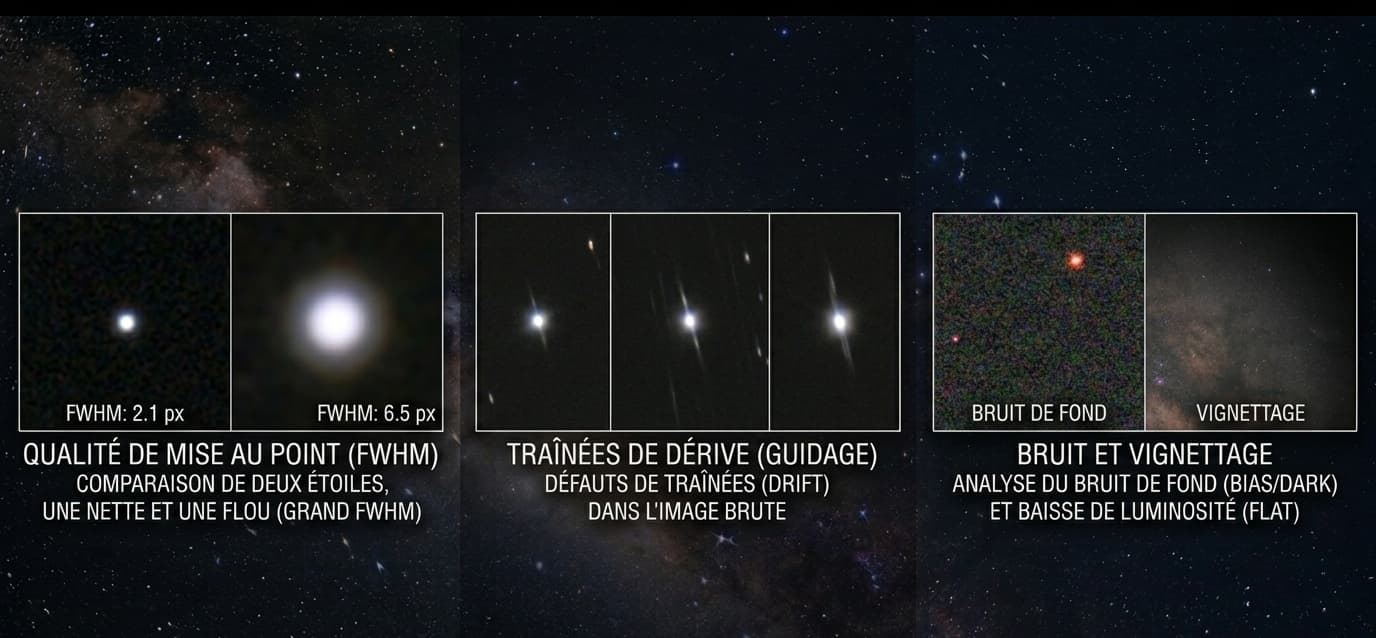
On star shape, the PSF panel gives fine FWHM (1.41/0.94 px at edge B, 1.63/1.31 at edge R) and an indeterminate pre-verdict: the high-elong zones (BL 4.69, BR 3.11) rest on ellipses poorly fitted to a noisy field of faint stars, not on a coherent optical pattern. No readable diagonal asymmetry, no clear radial symmetry: no tilt, backfocus or coma to retain. The GM1000 tracking in modeled mode is clean, with no uniform directional streak. Shape-wise the image is healthy.
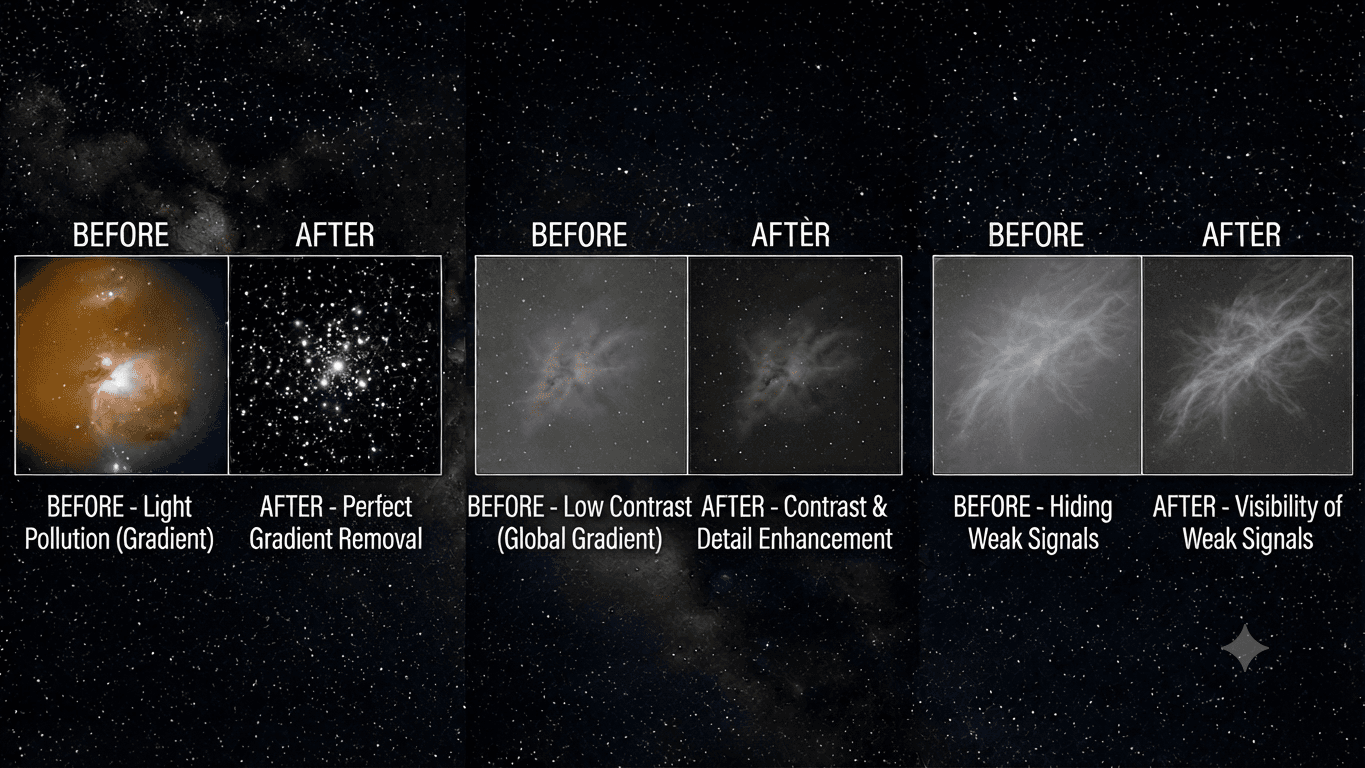
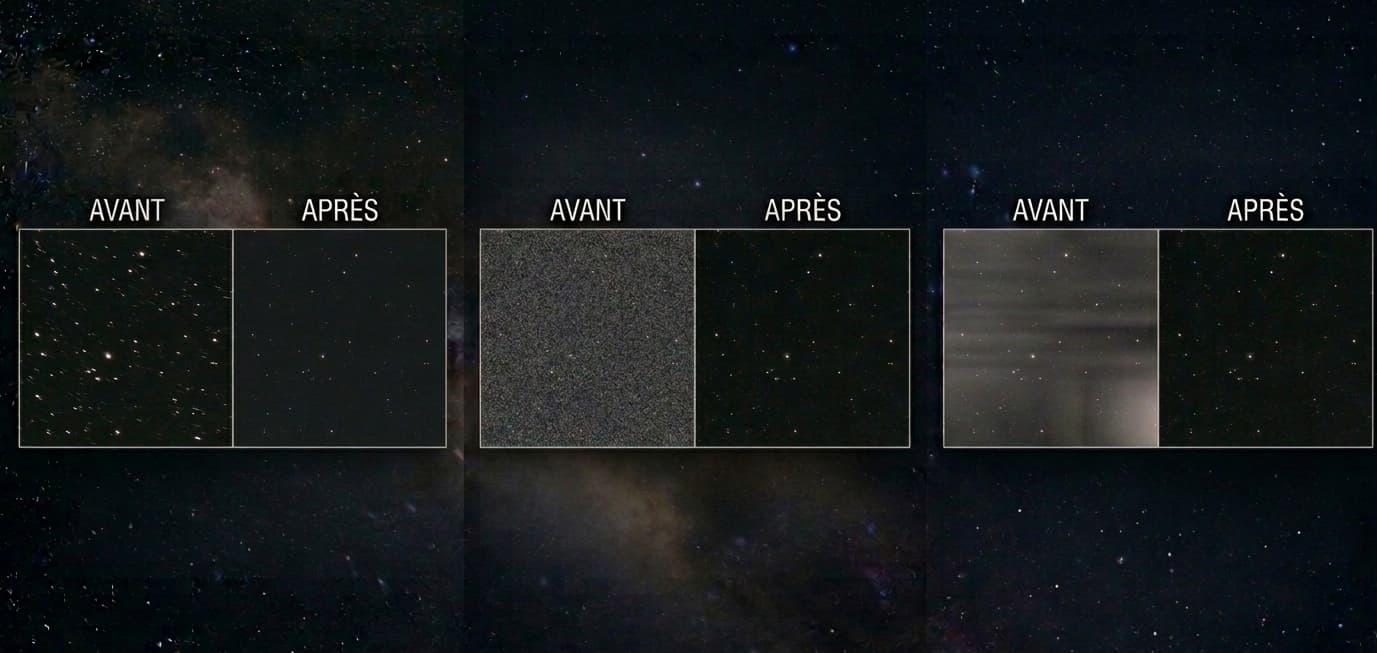
The real subject is the sky background: a linear gradient measured at 119% oriented 111°, with a plane clearly dominating the radial term (x13.9, R²=0.85). Part of the diffuse coloring is real Hα emission from the Gamma Velorum region, to be preserved, but the residual directional imbalance should be removed to flatten the background without eating into the filaments.
Finally, the brightest stars (Gamma Velorum foremost) show cores clipped to pure white, a consequence of the 180s exposures on very luminous stars. This is cosmetic and recoverable via short exposures or highlight protection in processing.
Priority actions
- Remove the background gradient (DBE/ABE or GraXpert) sampling away from Hα areas to avoid absorbing the real emission
- Recover bright star cores via short exposures (HDR) or highlight protection
- Redo background balance and channel equalization after gradient removal