Astrophotography diagnosis of IC 5070_biss3_HA: Tracking drift, light pollution gradient and 1 other
Master30×300s27 juin 2026
The Doc examined this image of IC 5070_biss3_HA (master, 30×300s). Estimated overall technical quality: 7/10. 3 defects found: Tracking drift (severity 3/5), Light pollution gradient (severity 3/5), Clipped stars (severity 2/5).
&w=1920&q=75)
Info
- Cible
- IC 5070_biss3_HA
- Date
- 27 juin 2026, 00:02
- Lune
- Croissant décroissant 8.3% (7.4° d'alt., 97.6° de la cible)
- Site
- Bortle 2 · rural typique (VIIRS)
- Position
- 20h51m12s · +43°59'43"
Excellent conditions for this target: Bortle 2 and a Moon down to 8.3% illumination, only 7.4° above the horizon, with no impact. In narrowband Hα on an emission nebula these conditions are near ideal, the background stays dark and a lunar gradient is excluded. The contrast achieved on the nebula confirms the sky quality. Nothing to fix on the conditions side: it is the tracking, not the environment, that limits this image.
Setup
- Type d'image
- Master
- Télescope
- EQMod Mount
- Caméra
- ZWO ASI585MM Pro
- Exposition
- 30×300s
- Phase de lune
- Gibbeuse croissante (90 %)
- FOV
- 1.70°
Coherent setup: the ASI585MM Pro at 375mm gives 1.595"/px, a comfortable sampling under typical seeing, and a 1.7° field that frames the northern part of IC 5070 well (the Pelican's beak is centered). The Hα filter suits this emission target and fully exploits the Bortle 2 sky. Healthy settings: gain 252 and offset 15 with no problematic dark clipping, sensor temp -11.5°C is fine. The low background margin (e_margin 0.93) is normal in narrowband at 300s, do not read it as underexposure. The weak link is mechanical: aim for better tracking/guiding.
The diagnosis in detail
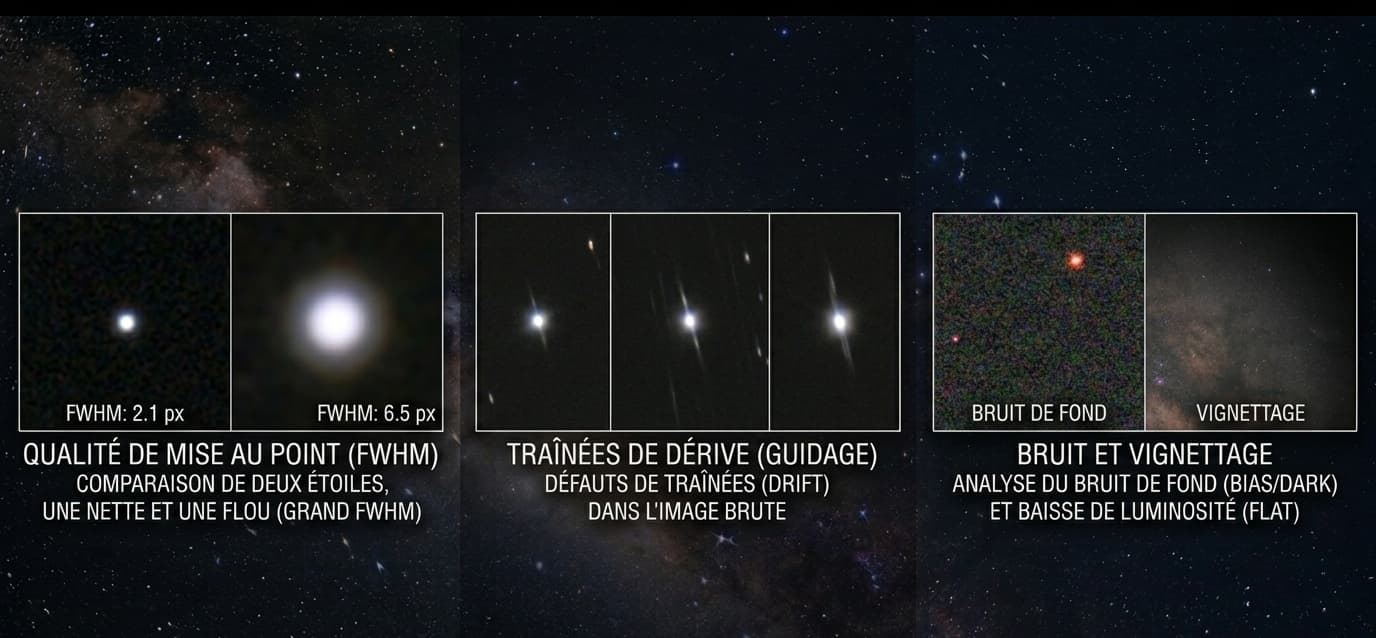
This master is well made and the optical train is healthy: the 1.09 corner/center FWHM ratio and the absence of asymmetry (H 0.05, V 0.004) rule out tilt, backfocus, coma and astigmatism. The PSF plate confirms regular stars everywhere, with a uniform FWHM around 2.6 px.
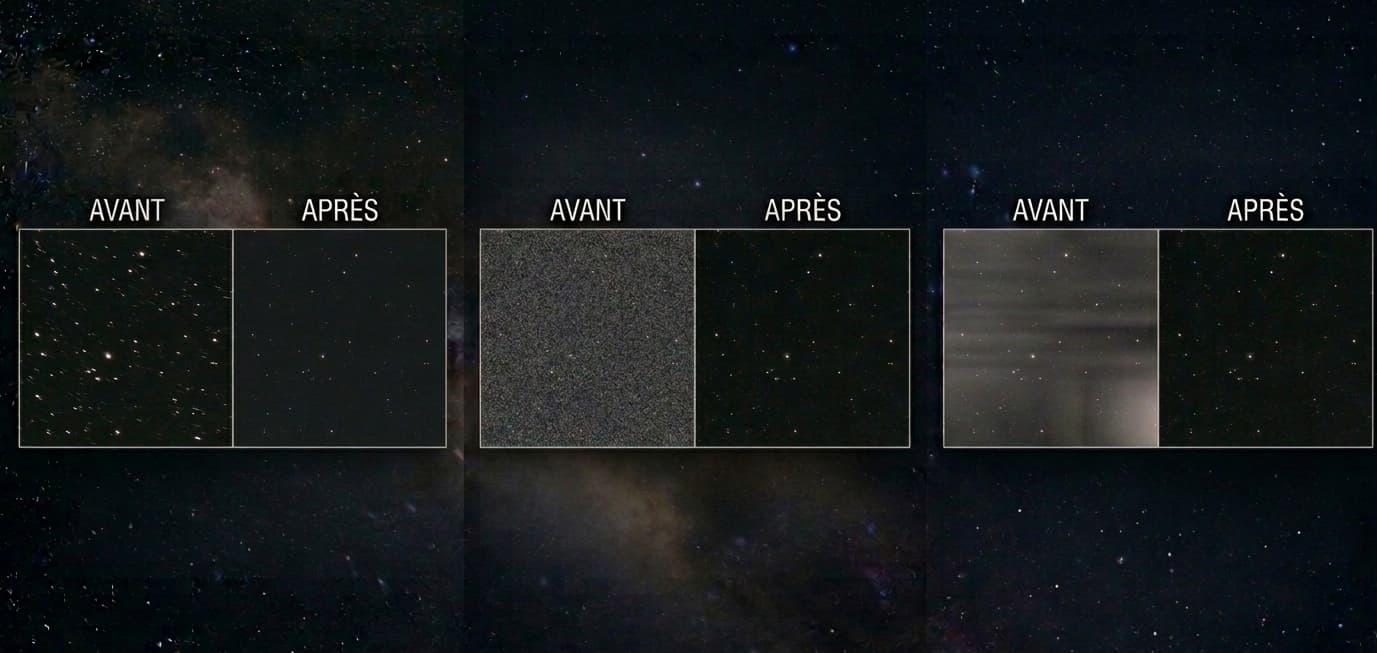
The only real defect is moderate tracking drift. The elongation is not confined to the edges but present from the center (elong 1.26 > floor 1.12), with a stable direction across the whole field (PA scattered by only 9.3°). This is the signature of a uniform shift during the exposure, to be attributed to polar alignment or guiding, not the optics. At 300s, this is the area to make reliable to tighten the stars.
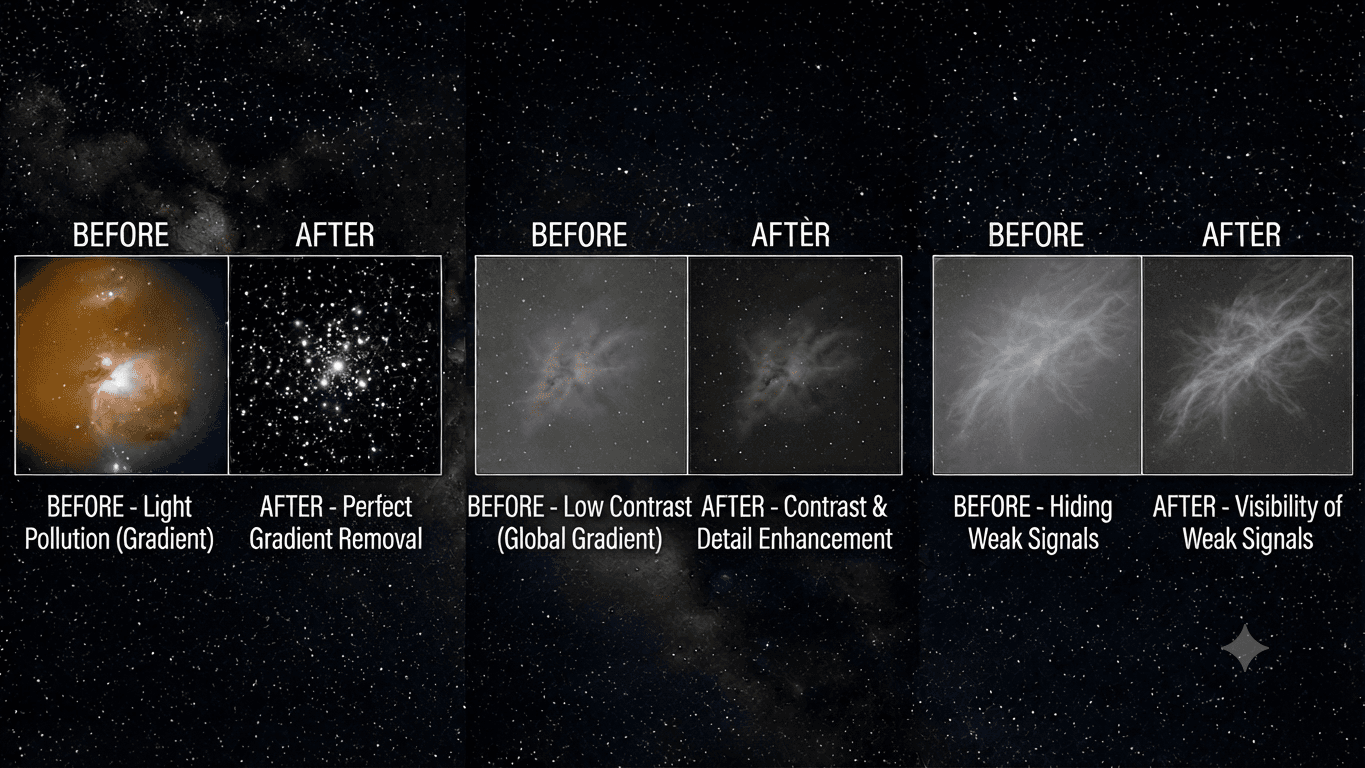
Finally, the measured gradient (142%, oriented ~178°) faithfully reproduces the Hα nebulosity distribution seen in the DSS (bright body on the left/center, empty sky on the right): under Bortle 2 and narrowband, this is real signal and not light pollution, so I do not keep it as a defect. A few clipped star cores remain anecdotal.
Priority actions
- Improve tracking: refine polar alignment and enable/tune autoguiding to aim for <0.6" RMS
- Check balance and optical-train flexure before the next session
- Add a few short exposures to recover bright-star cores in processing