Astrophotography diagnosis of ic5070: Sensor tilt and light pollution gradient
Processed
The Doc examined this image of ic5070 (processed). Estimated overall technical quality: 7/10. 2 defects found: Sensor tilt (severity 2/5), Light pollution gradient (severity 2/5).
&w=1920&q=75)
Info
- Cible
- ic5070
- Position
- 20h52m00s · +44°23'60"
Waning gibbous Moon at 91%: in broadband or RGB these conditions would be crippling for a diffuse emission target. Here you shoot in Ha (narrowband), which massively rejects scattered moonlight, so the impact is strongly attenuated. The background stays clean and the nebula contrast is preserved, confirming the right filter choice for this lunar phase. The mild downward gradient is what remains despite the narrowband: normal and easy to handle in processing. You can keep using full-moon nights on emission targets with this kind of filter.
Setup
- Type d'image
- Traitée
- Phase de lune
- Gibbeuse décroissante (91 %)
- FOV
- 1.20°
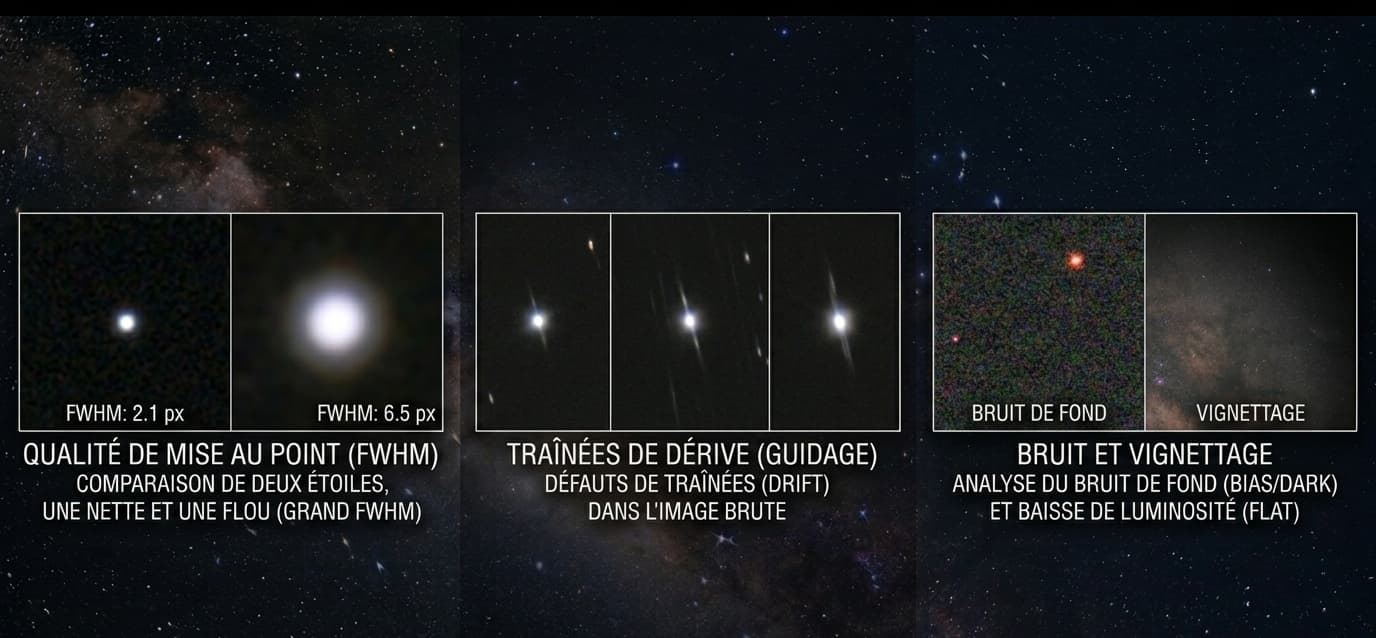
A 1.20°-wide field on IC5070: tight framing on the Pelican's head and ionization ridge, a deliberate and readable composition, with the target not awkwardly cut. The sampling yields a 3.8 px central FWHM with an elong 1.03 core, a sign of well-focused optics and a mount tracking perfectly (no drift or PE signature). The only hardware caveat: the optical train shows a slight tilt (right-corner FWHM ~4.7 px versus 3.4 on the left), to be corrected with a tilt plate to even out the field. Nothing blocking, the setup is coherent with the target.
The diagnosis in detail
Well-executed final Ha image. The Moffat metrics validate excellent tracking and focus: center elong 1.03 (at the field floor), central FWHM 3.8 px, high PA dispersion (43.6°) confirming stars are globally round, with no signature of drift, periodic error or guiding oscillation. That is the solid foundation of this image.
The only optical defect is a slight sensor tilt: FWHM rises steadily from the left edge (3.4 px) toward the right and top side (4.5 to 4.8 px), with a measured horizontal asymmetry of 0.175 and a corner/center ratio of 1.21, without marked directional elongation. This is neither coma nor backfocus (which would be symmetric across the four corners) but a slightly tilted focal plane, to be corrected mechanically.
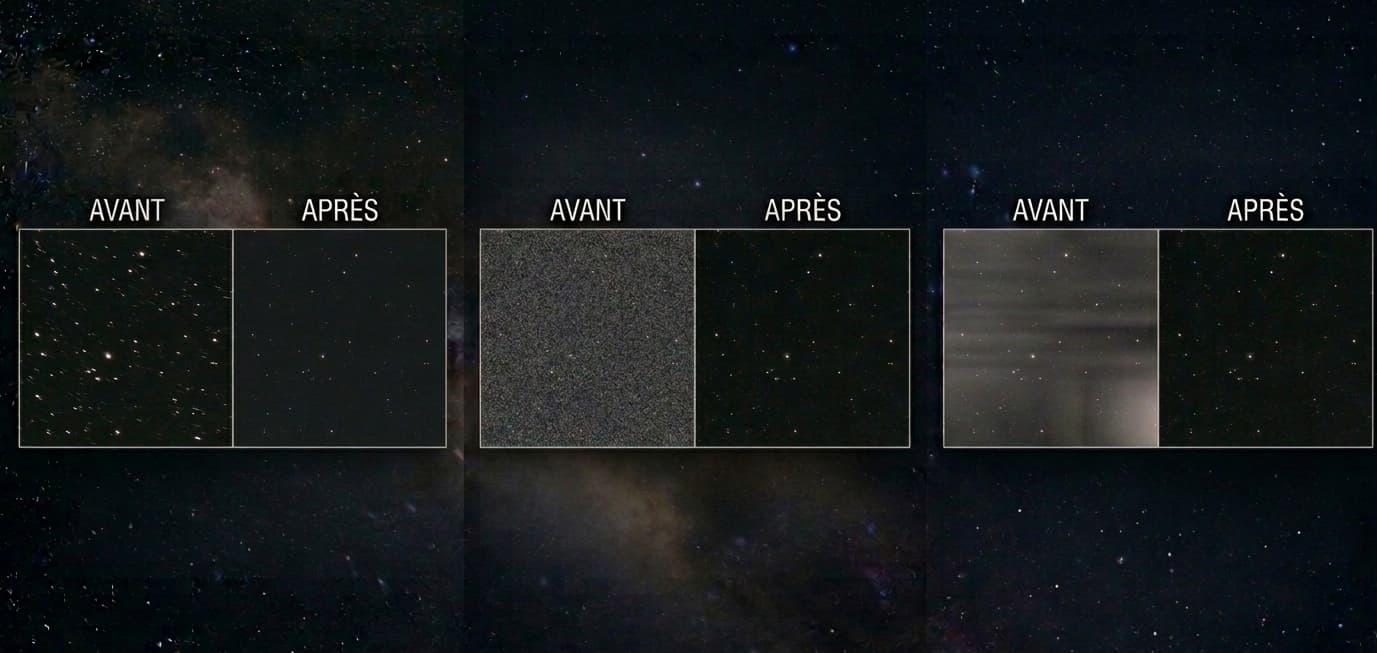
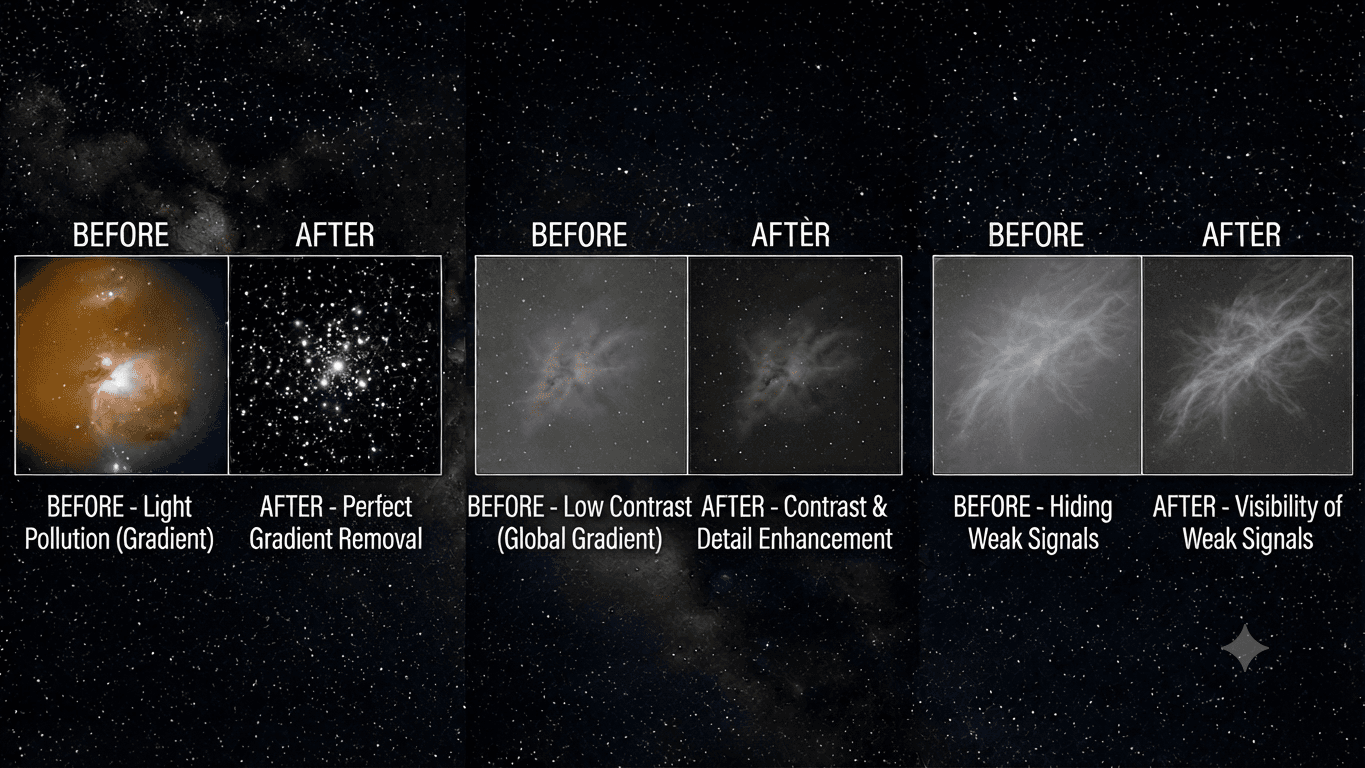
On the sky background, the map measures a dominant planar gradient oriented downward. Note however: the DSS comparison shows the Pelican nebulosity truly fills the whole field (bright lower/left, dark upper/right), so a significant part of what the algorithm reads as gradient is legitimate astronomical signal. The correction must therefore be gentle and selective, or it will erase the gas wisps.
Priority actions
- Diagnose and correct the sensor tilt with an adjustable tilt plate until opposite-corner FWHM is even
- Redo the gradient extraction (GraXpert/DBE) sampling only true sky background to preserve the DSS-confirmed Pelican nebulosity
- Keep favoring narrowband Ha on emission targets while the Moon is strong