Astrophotography diagnosis of M57: Sensor tilt, tracking drift and 1 other
Processedircut1880x10s
The Doc examined this image of M57 (processed, ircut, 1880x10s). Estimated overall technical quality: 5/10. 3 defects found: Sensor tilt (severity 3/5), Tracking drift (severity 3/5), Light pollution gradient (severity 3/5).
&w=1920&q=75)
Info
- Cible
- M57
- Site
- Bortle 5 · banlieue résidentielle (VIIRS)
- Position
- 18h53m35s · +33°01'44"
Average conditions for a bright planetary nebula: the Bortle 5 sky and especially the 70% Moon load the background, hence the measured 76% gradient. Being very bright and compact, M57 tolerates this better than a faint galaxy, but you still pay in background SNR and in the faint outer ring detail. An IRcut filter alone does not shield from the Moon: on this emission target a dual-band would have cleaned the background markedly. Otherwise, a moonless night or a higher target altitude would directly improve contrast.
Setup
- Type d'image
- Traitée
- Télescope
- C11
- Caméra
- Asi585mc
- Filtre
- ircut
- Monture
- EQ6r pro
- Exposition
- 1880x10s
- Phase de lune
- 70%
- Seeing
- 2,5
- Notes
- Focale=2800
- FOV
- 9.0'
The C11 at 2800mm with the ASI585mc gives very tight sampling (small pixels at f/10) and only a 0.15deg field, perfectly suited to a compact target like M57 that fills the frame. The downside is the extreme demand on tracking and optical orthogonality: at this focal length the slightest tilt or drift becomes visible, which the measurements confirm. The 10s exposures are a good choice to limit guiding and seeing impact, and the large sub count (1880) compensates. e_margin=1.77 shows a background not well lifted off the black point, but that is acceptable given the short sub and bright target.
The diagnosis in detail
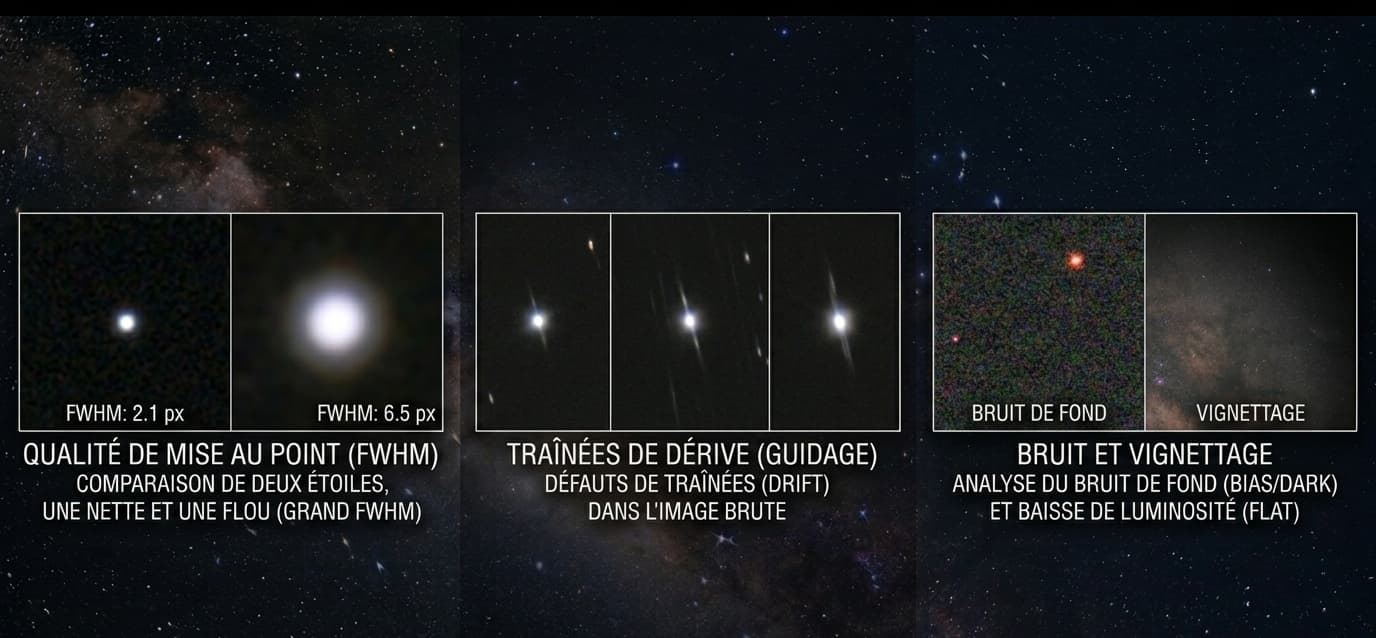
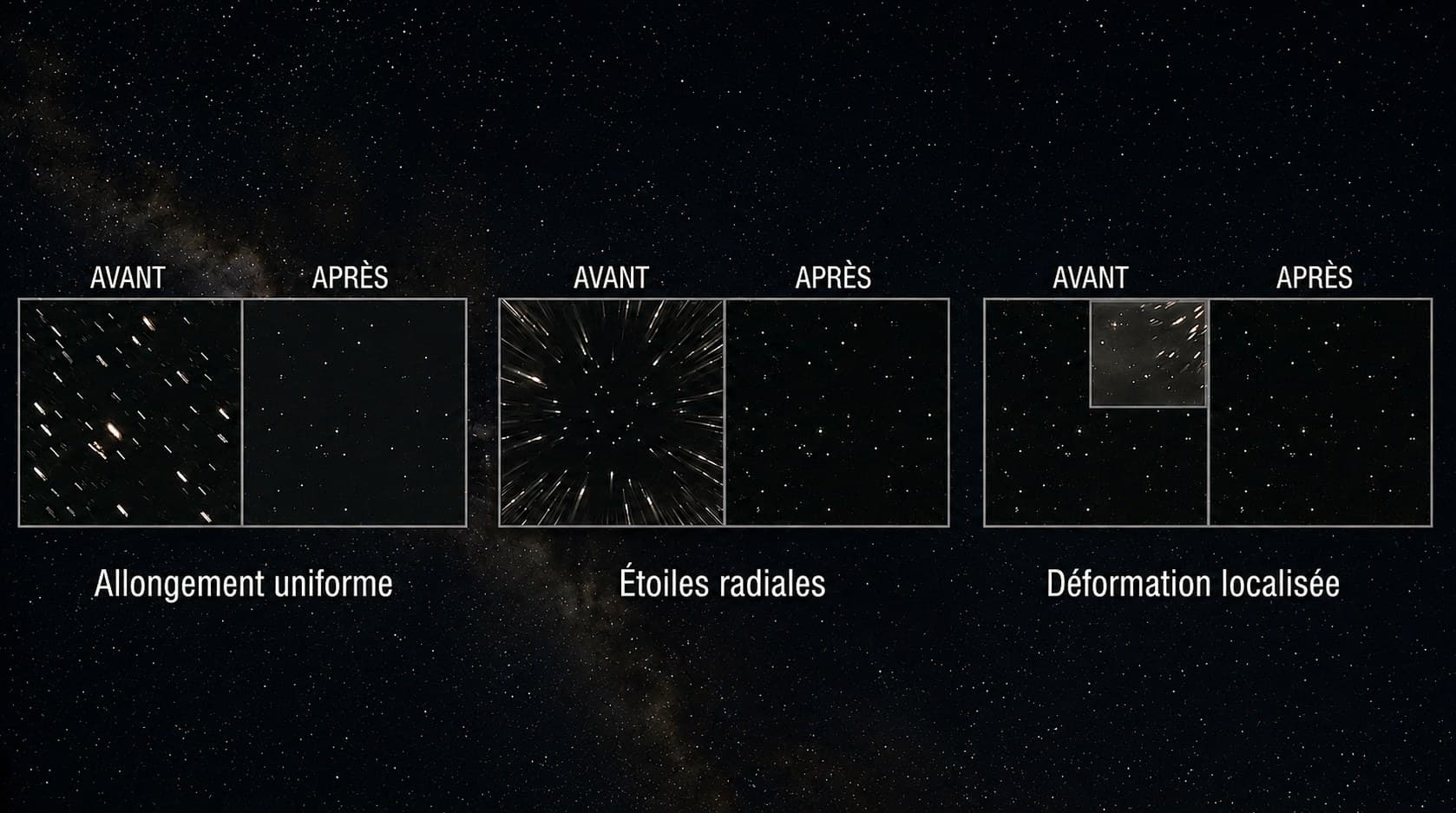
The main diagnosis reads on the PSF sheet, not the preview. The center C is slightly oval (elong 1.28 vs a field floor of 1.03) with a consistent elongation direction across zones (PA spread 25deg): the signature of residual tracking drift, expected at 2800mm on an EQ6R. Overlaid is clear sensor tilt: the asymmetry is horizontal (left edge elong 1.70, right edge 1.51) while the bottom corners stay round (BL 1.03, BR 1.04), and the corner/center FWHM ratio reaches 1.87. These two defects are distinct: tracking affects the whole field including the center, tilt degrades one axis and opposite edges preferentially.
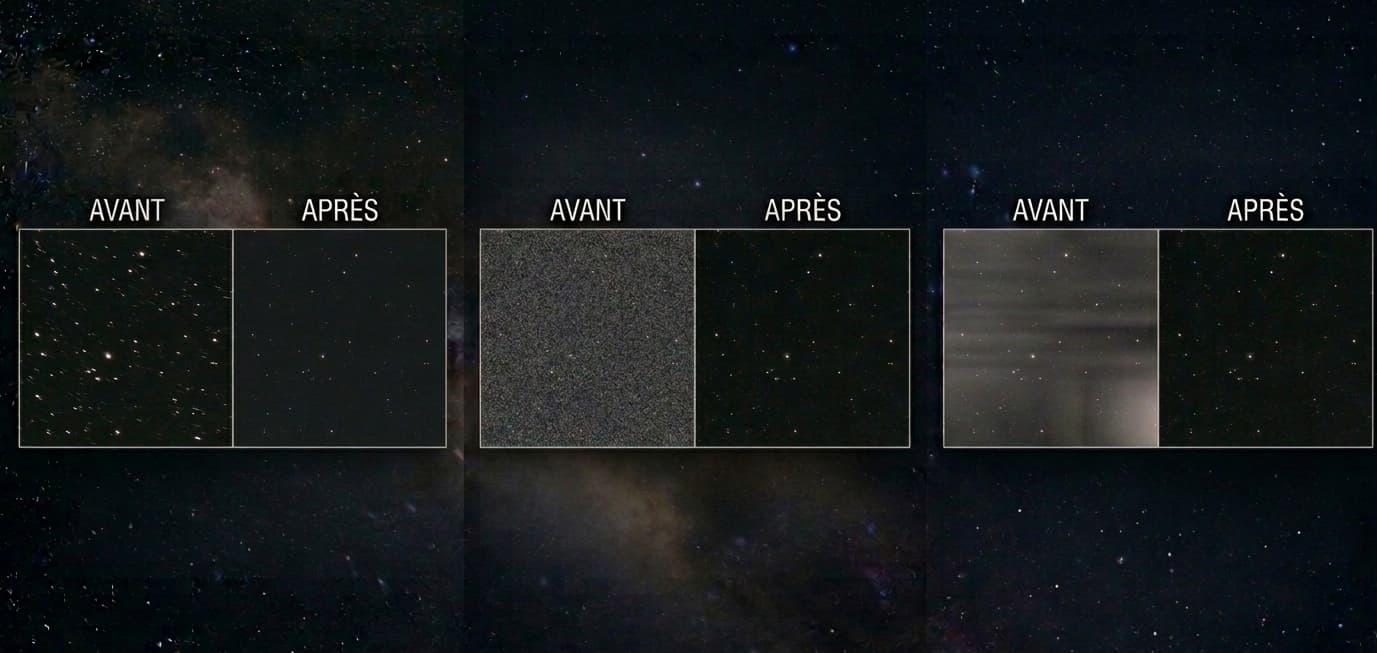
On the sky background, the map confirms a planar gradient of 76% oriented at 134deg, dominating the radial profile by 2.4x, consistent with the Bortle 5 sky and 70% Moon. The reference DSS shows no extended nebulosity here, ruling out confusion with IFN: this is genuine light pollution to remove in processing.
The rest is solid: the ring is well resolved, inner structure and Ha rim are present, framing is comfortable and the small galaxy IC 1296 appears. As a priority, fixing the tilt mechanically and refining guiding will do the most, while the gradient cleans up easily in post.
Priority actions
- Fix the sensor tilt: retighten/adjust the optical train until left and right edge FWHM match
- Refine guiding and polar alignment to remove the central drift at 2800mm
- Remove the background gradient with GraXpert or DBE before stretching
- Prefer a moonless night, or switch to a dual-band on this emission target