Astrophotography diagnosis of Hidden Gems: Tracking drift and sensor tilt
ProcessedAucun59×120s24 sept. 2025
The Doc examined this image of Hidden Gems (processed, Aucun, 59×120s). Estimated overall technical quality: 7/10. 2 defects found: Tracking drift (severity 2/5), Sensor tilt (severity 2/5).
&w=1920&q=75)
Info
- Cible
- Hidden Gems
- Date
- 24 sept. 2025, 00:00
- Position
- 3h46m60s · +24°07'12"
The Moon at 7% is negligible, ideal photometric conditions for a faint target like the M45 reflection nebulosity. The background stays dark and clean, with no sign of lunar pollution. On this kind of blue reflection target, sky transparency matters more than the lunar phase, and the image shows credible nebula signal down into the lower wisps, suggesting a decent sky and sufficient total integration (59x120s about 2h). You can push total time further to dig out the faint nebula extensions.
Setup
- Type d'image
- Traitée
- Télescope
- Fujinon XF50-140mmF2.8 R LM OIS WR
- Caméra
- Fujifilm X-T30 II
- Filtre
- Aucun
- Monture
- Sky-Watcher Star Adventurer 2i - WiFi
- Exposition
- 59×120s
- Phase de lune
- 7%
- Notes
- Logiciels : Ubuntu, Image Manipulation Program (GIMP), Siril
- FOV
- 2.50°
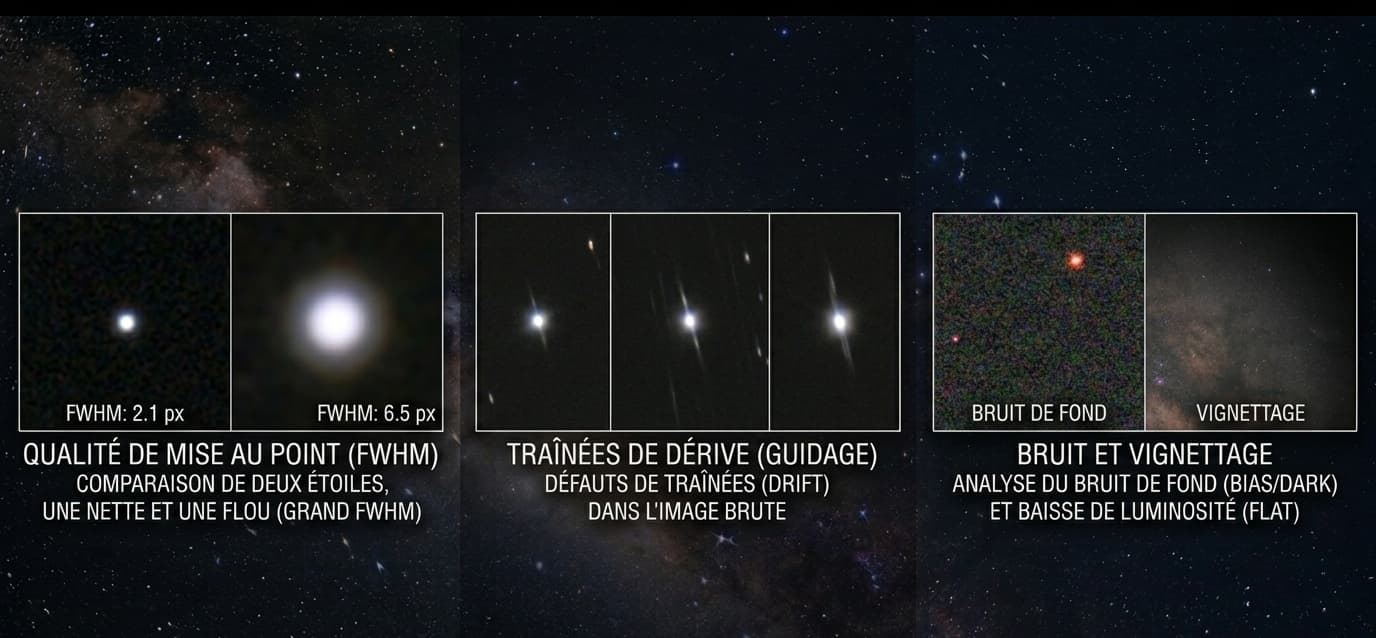
The Fujinon 50-140mm on X-T30 II combo gives a 2.5deg field that frames M45 comfortably with its extended nebulosity, a very fitting choice for this open cluster. Sampling of an APS-C sensor behind a telephoto is generous, which explains fairly wide FWHM in pixels without resolution being at fault. The unguided Star Adventurer 2i requires short exposures: 120s is ambitious, the slight measured drift confirms it. Stopping down to f/4 and aiming for 60-90s exposures would give finer stars, at the cost of more subs.
The diagnosis in detail
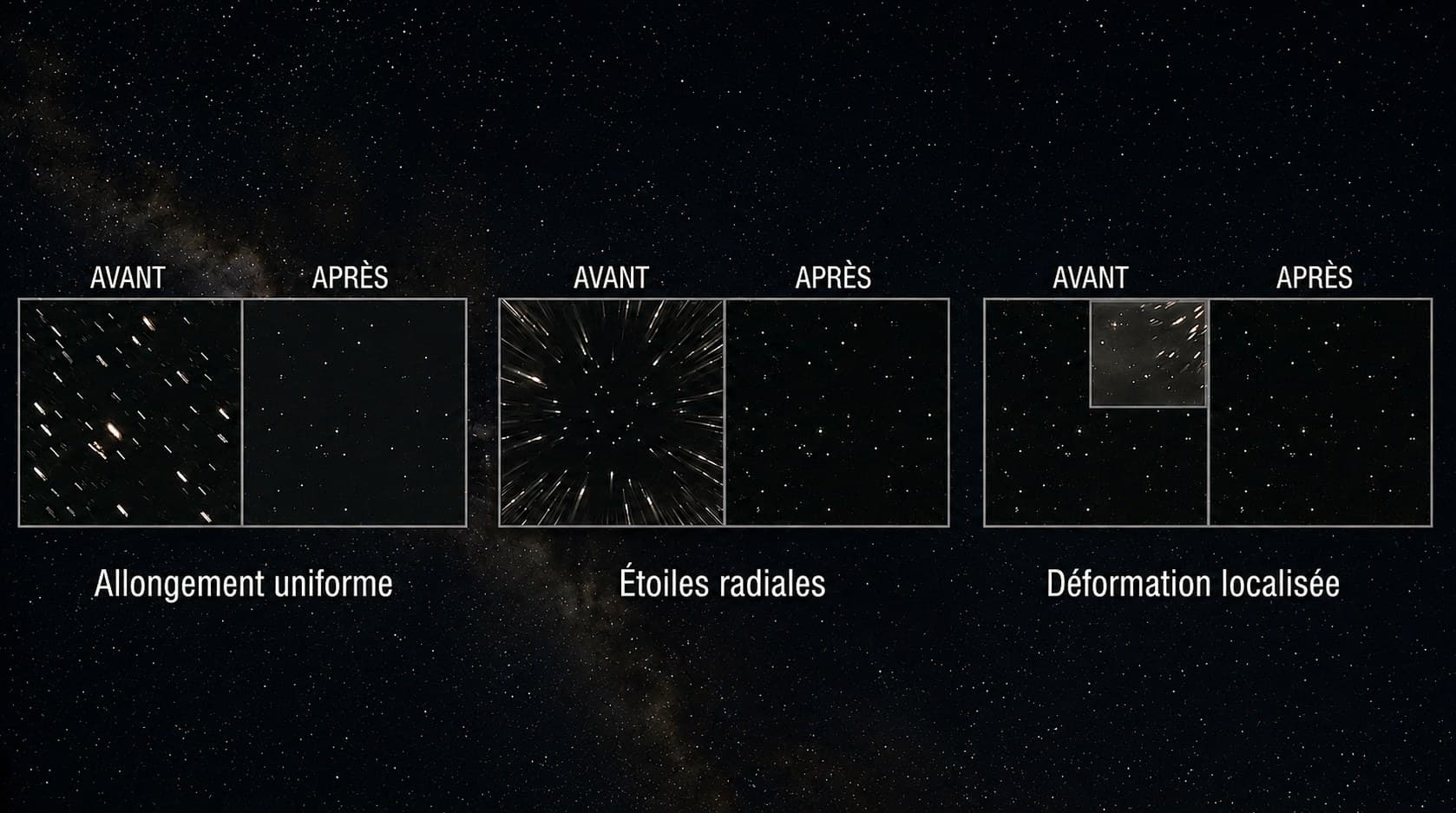
The PSF panel is the decisive element here. Elongation is already present at the center (elong 1.18 vs a field floor of 1.09) with a consistent PA across the whole field (spread 17.4deg): this is the signature of a global tracking drift, no surprise on an unguided Star Adventurer 2i pushed to 120s with a telephoto. It is the main contributor to star elongation and the priority target.
A field component overlaps: the FWHM asymmetry is strong on the vertical axis (0.197 vs 0.029 horizontal) and the corner/center ratio reaches 1.377. The distribution is diagonal, the bottom-left corner being the most degraded (elong 1.46) while bottom-right stays round, pointing to a slight tilt of the sensor/optics plane rather than symmetric curvature. The zoom lens and the body mount are the natural suspects.
Otherwise the image is clean: well-rendered reflection nebulosity consistent with the DSS (no artifact to mistake for a gradient), dark sky background, correct color, no notable processing defect. The two points raised are moderate and the image remains fully usable.
Priority actions
- Refine polar alignment and reduce sub exposure to 60-90s to limit tracking drift
- Check the tightness and flatness of the lens/body mount to reduce corner tilt
- Stop down slightly (f/4) to tighten edge stars
- Increase total integration time to dig out the faint nebula wisps