Astrophotography diagnosis of NGC 6992_biss: Sensor tilt and tracking drift
Raw300s11 juil. 2026
The Doc examined this image of NGC 6992_biss (raw, 300s). Estimated overall technical quality: 7/10. 2 defects found: Sensor tilt (severity 2/5), Tracking drift (severity 2/5).
&w=1920&q=75)
Info
- Cible
- NGC 6992_biss
- Date
- 11 juil. 2026, 22:38
- Lune
- Gibbeuse croissante 91% (sous l'horizon)
- Site
- Bortle 2 · rural typique (VIIRS)
- Position
- 20h56m03s · +30°47'20"
Excellent conditions: Bortle 2 gives a very dark background, ideal for capturing the faint filaments of the Veil. The Moon (waxing gibbous 91%) is below the horizon and 98° from the target, so has no impact. The background map confirms a clean sky (azimuthal anisotropy 0.01, negligible plane gradient at 3%). On an emission target like the Cygnus remnant, these conditions are optimal, you can chain long exposures without compromising background SNR.
Setup
- Type d'image
- Brut
- Télescope
- EQMod Mount
- Caméra
- ZWO ASI585MM Pro
- Exposition
- 300s
- Phase de lune
- Dernier croissant (8 %)
- FOV
- 1.70°
Coherent setup for the target. At 375mm focal length, the 1.70° field frames the Eastern Veil well, with margin around the filaments. Sampling of 1.595"/px is comfortable and well matched to current seeing (center FWHM ~2.26px, ~3.6", fine). Gain 220 on the ASI585MM and cooling to -10.5°C are healthy. The background/black-point margin (e_margin 1.85) looks low but that is NORMAL in narrowband at 300s: the filter cuts most of the background flux, this is not underexposure. Nothing to change on the settings side.
The diagnosis in detail
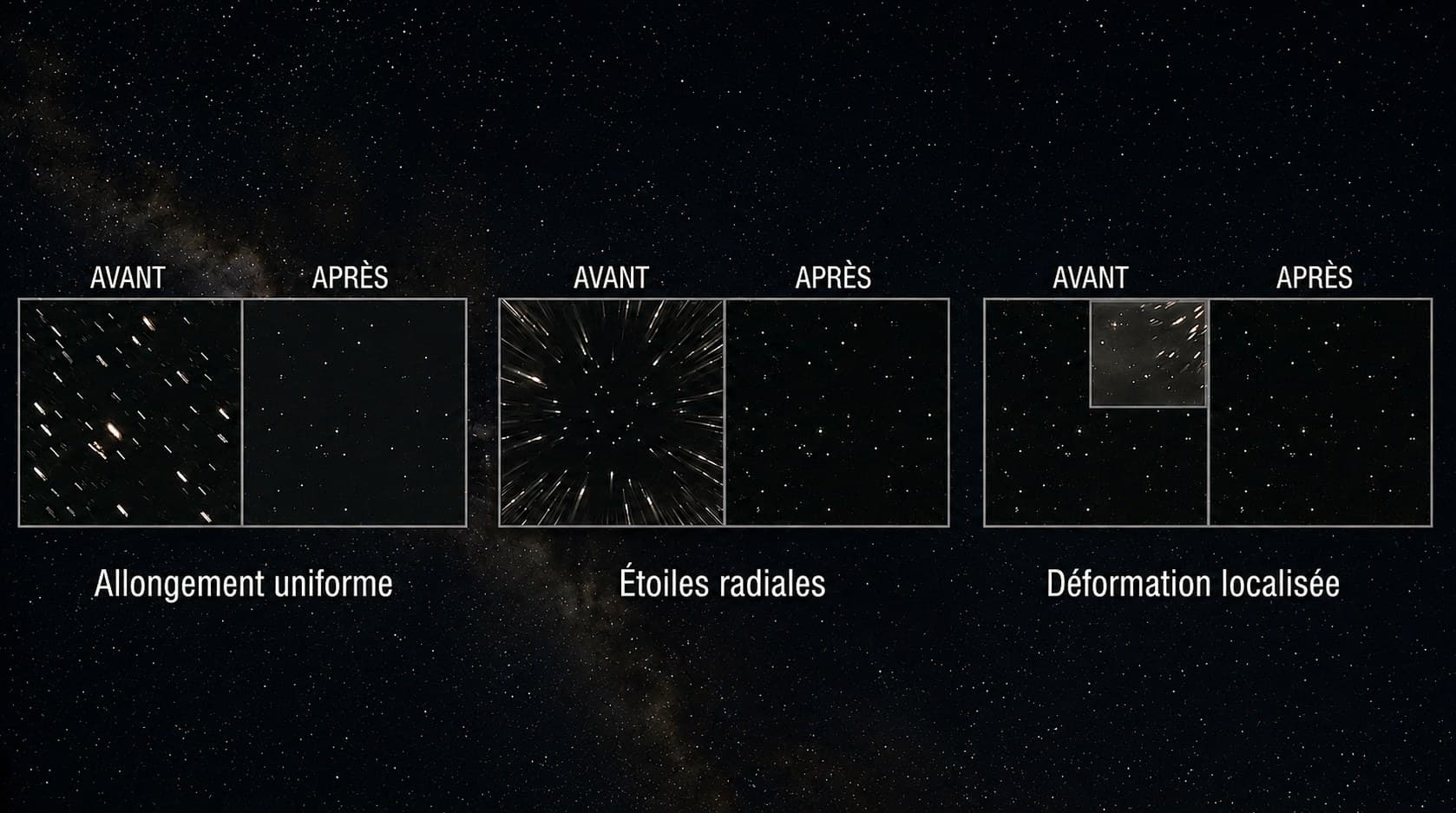
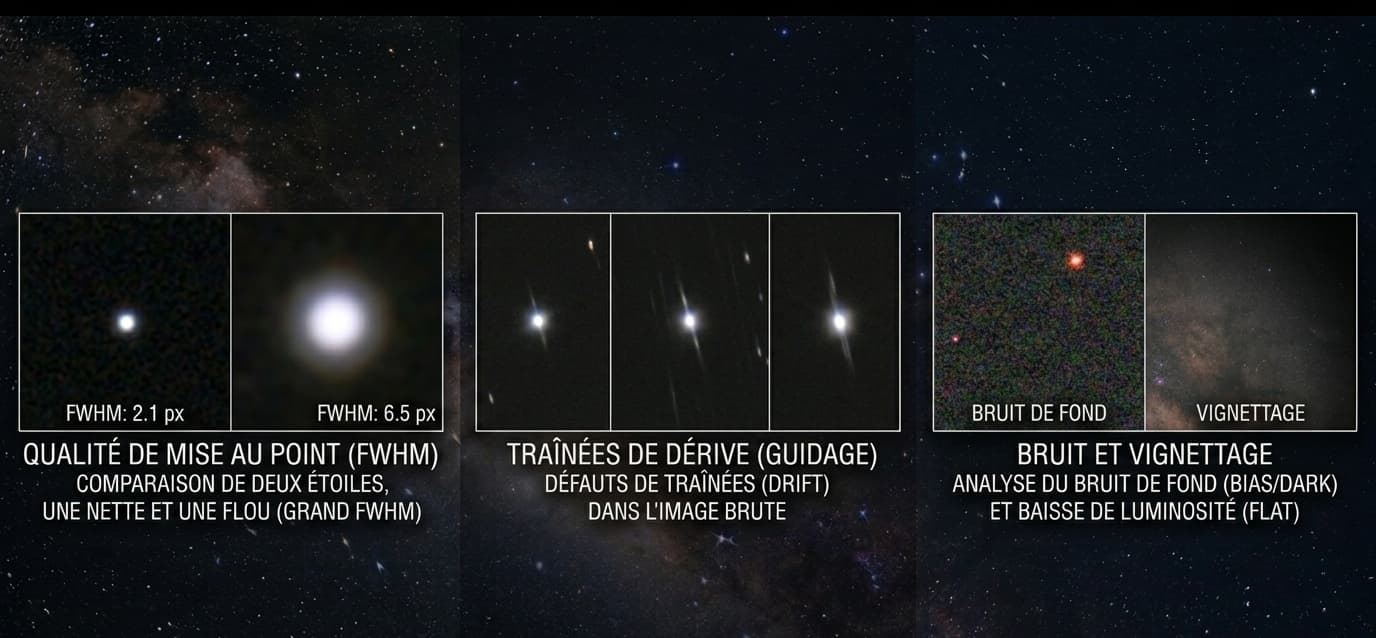
This single sub is well made. The field core is sharp (FWHM 2.26/1.96px at center) and the PSF inspection reveals two faint but measurable signatures to be linked. First, elongation does not vanish at the center (C elong 1.15 vs a field floor of 1.07) with position angles coherent from zone to zone (dispersion 24.4°): elongation persisting at center is not attributable to field optics, it betrays a slow tracking/guiding drift over the 300s exposure. Second, superimposed on this, a single-axis FWHM asymmetry (corner/center ratio 1.3, horizontal asymmetry 0.145) shows the bottom of the field is more spread than the top, the signature of a slight focal-plane tilt.
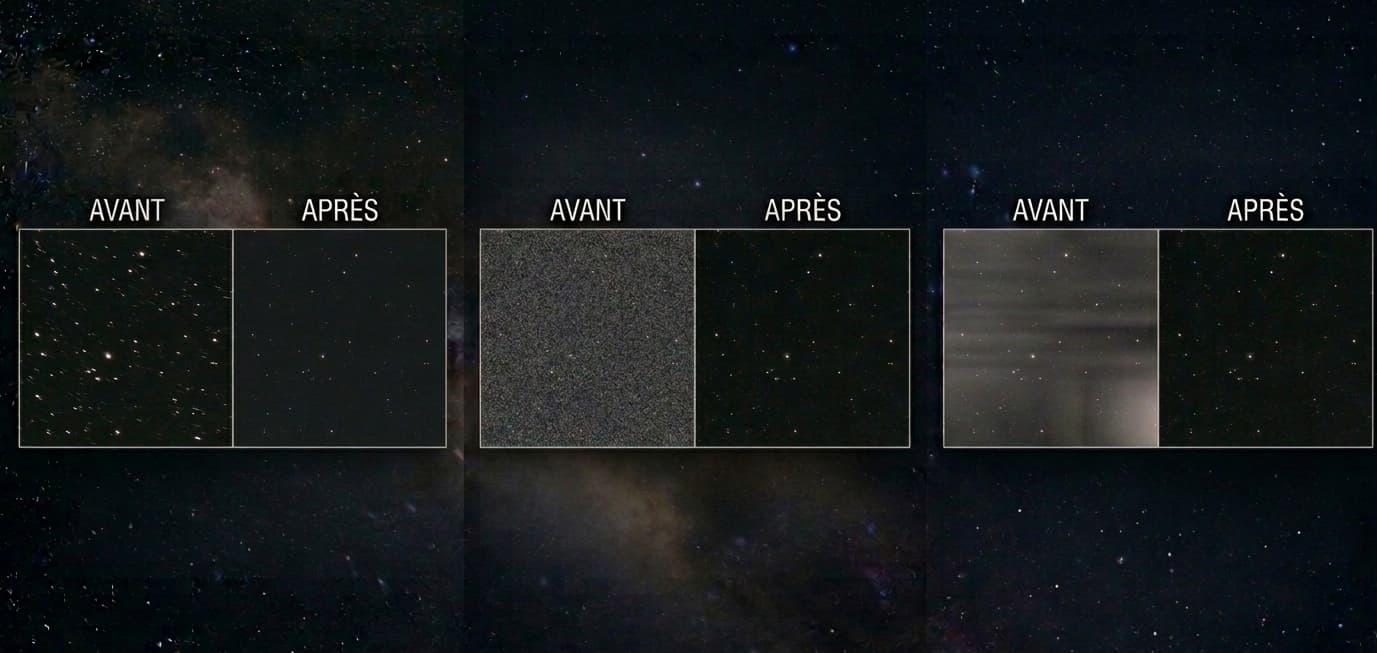
Both defects are low amplitude here and in no way prevent stacking; they combine to give slightly oval and non-uniform stars. The sky background is excellent (Bortle 2, no Moon, radial symmetry, a slight 4% edge darkening typical of optical vignetting to be corrected with flats, of no consequence on a raw sub).
As a priority, address tracking (polar alignment, guiding) since it affects the whole field; tilt adjustment then fine-tunes corner uniformity.
Priority actions
- Refine polar alignment and guiding to remove the tracking drift visible to the center over 300s
- Correct the slight focal-plane tilt (tilt plate or re-tightening the imaging train) to equalize FWHM between top and bottom of the field
- Apply flats to compensate the optical vignetting (edges ~4% darker) during calibration