Astrophotography diagnosis of HIP 106890_Bissask50: Astigmatism
Raw300s17 août 2026
The Doc examined this image of HIP 106890_Bissask50 (raw, 300s). Estimated overall technical quality: 7/10. 1 defect found: Astigmatism (severity 2/5).
&w=1920&q=75)
Info
- Cible
- HIP 106890_Bissask50
- Date
- 17 août 2026, 20:32
- Lune
- Gibbeuse décroissante 71.7% (sous l'horizon)
- Site
- Bortle 2 · rural typique (VIIRS)
- Position
- 21h42m20s · +58°09'60"
Excellent conditions: Bortle 2 with the Moon below the horizon, so no lunar contribution is possible and the sky background is intrinsically very dark. This is exactly the context where faint extended nebulosity like this field can come out. Under these conditions the limit is no longer the sky but exposure and total integration: the measured background to black point margin of 1.69 shows a background sitting close to the black point, expected in narrowband but leaving little signal per sub. Stack more 300s subs rather than chasing a gradient that does not exist here.
Setup
- Type d'image
- Brut
- Télescope
- EQMod Mount
- Caméra
- ZWO ASI585MM Pro
- Exposition
- 300s
- Phase de lune
- Premier croissant (22 %)
- FOV
- 3.36°
Coherent wide-field setup: 190 mm of focal length with a 3840x2160 sensor gives 3.36 degrees across, framing this extended nebulosity comfortably with margin on every side. Sampling at 3.148 arcsec/px is clearly undersampled though: stars fit in 1.3 px FWHM, so resolution is pixel-limited rather than seeing-limited, which makes shape diagnostics delicate and PSF fits fragile. Gain 180 on the ASI585MM at 300s saturates nothing (0% clipped) and the sensor at -13.5C is properly cooled. Offset 15 is sufficient, with no dark clipping measured.
The diagnosis in detail
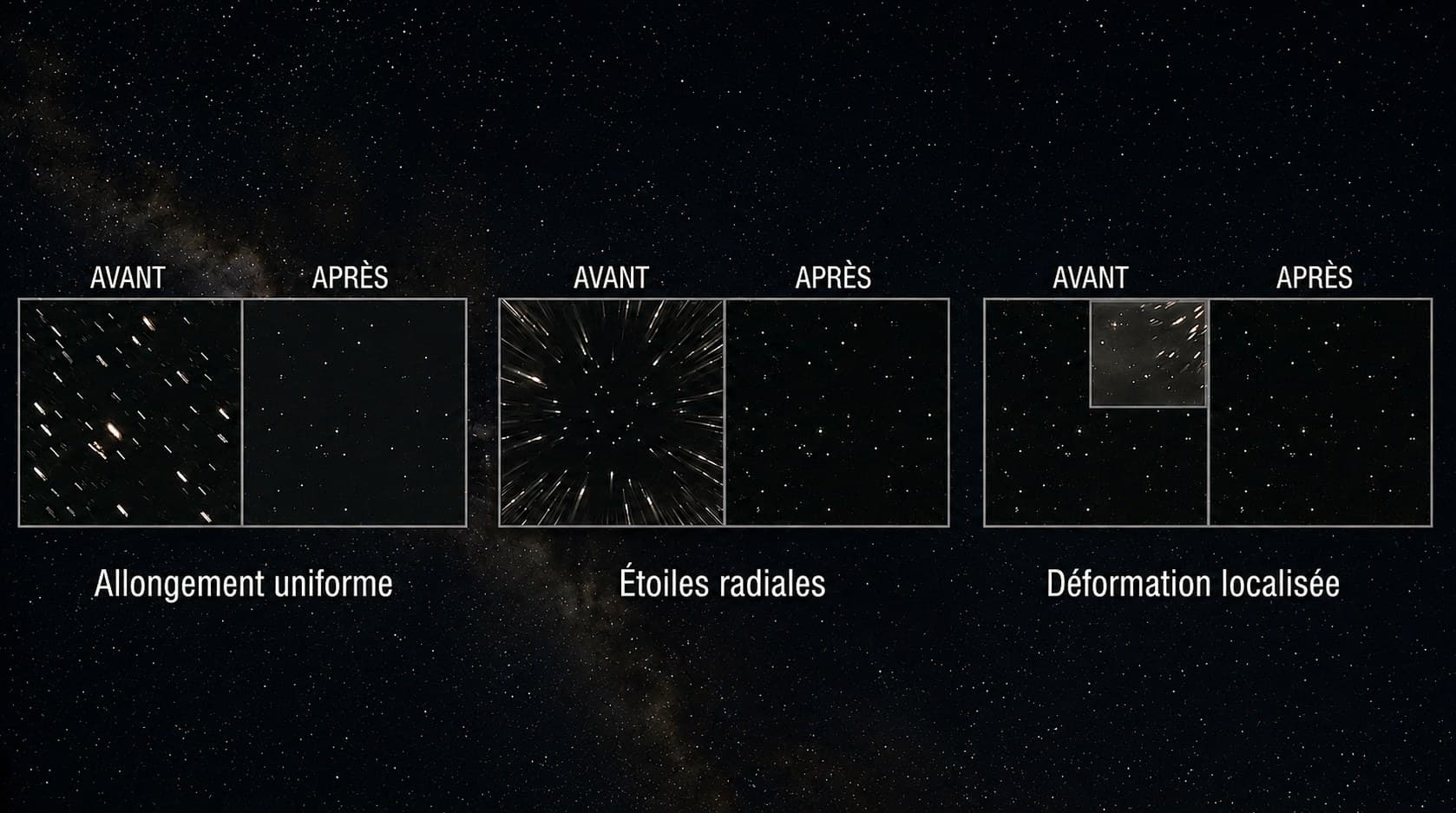
The frame is fundamentally healthy. Moffat measurements give 1.30/1.11 px at center for an elongation of 1.17, very close to the field floor of 1.10: stars are round at center and tracking poses no problem over this 300s exposure. The 25.9 degree PA dispersion confirms there is no coherent directional elongation, so no tracking drift, no periodic error, no guiding oscillation.
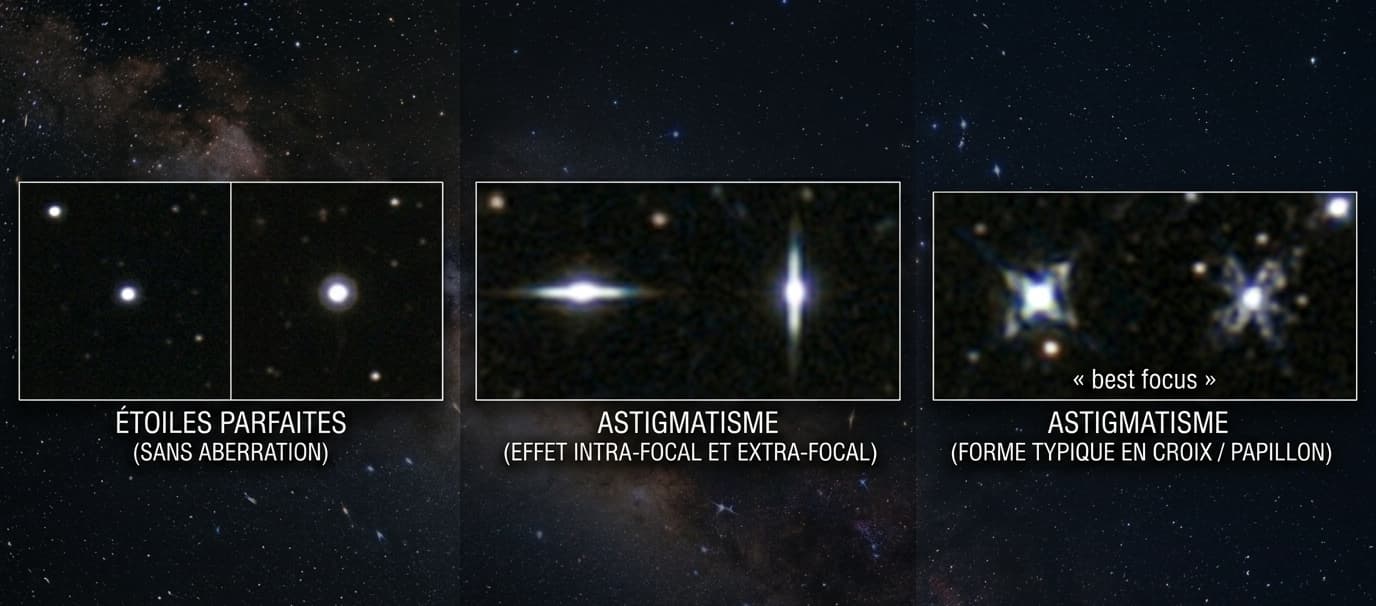
The only real deviation is at the field edge. Elongation rises to 1.44 in the top-right corner and 1.24 along the right edge, while the corner/center FWHM ratio stays at 1.13: stars are not growing, they are stretching. That is the signature of field astigmatism, not a backfocus error which would bloat all four corners symmetrically, nor tilt which would produce a clear diagonal asymmetry. One caveat: at 3.15 arcsec/px on a single sub, fitting 1.3 px PSFs remains fragile, hence the moderate severity.
On the background side, the +17% radial falloff toward the edges with R2 of 0.48 and near-zero anisotropy mostly reflects the nebular structure of the field, confirmed by the DSS which shows the same nebulosity at the same positions. Nothing to correct there.
Priority actions
- Check backfocus and imaging train tightness to reduce right-edge elongation
- Rotate the sensor 90 degrees on a test frame to separate optical astigmatism from sensor strain
- Stack a large number of 300s subs: under Bortle 2 the limiting factor is integration time, not the sky