Astrophotography diagnosis of HIP 106890_Bissask50: Astigmatism
Raw300s17 août 2026
The Doc examined this image of HIP 106890_Bissask50 (raw, 300s). Estimated overall technical quality: 7/10. 1 defect found: Astigmatism (severity 2/5).
&w=1920&q=75)
Info
- Cible
- HIP 106890_Bissask50
- Date
- 17 août 2026, 20:18
- Lune
- Gibbeuse décroissante 71.8% (1.4° d'alt., 119.8° de la cible)
- Site
- Bortle 2 · rural typique (VIIRS)
- Position
- 21h42m20s · +58°09'60"
Excellent conditions. Bortle 2 and a gibbous Moon only 1.4 deg above the horizon at 119.8 deg from the target: its contribution to sky background is negligible, which the background map confirms (plane gradient of only 8%, R2=0.07, hence unstructured). On an emission target like this nebulous Cygnus-region field, you are in a near-ideal case. The one thing to note is the background-to-black-point margin e_margin=1.8, below the 5-10 sky-limited benchmark, but that is normal under a very dark sky with a narrow filter: do not lengthen the exposure to raise it, the sky is dark, the sub is not short.
Setup
- Type d'image
- Brut
- Télescope
- EQMod Mount
- Caméra
- ZWO ASI585MM Pro
- Exposition
- 300s
- Phase de lune
- Premier croissant (22 %)
- FOV
- 3.36°
The setup fits the target. At 190mm focal length, the 3.36 deg field comfortably contains the nebular complex and the composition lets the structures breathe, no reframing needed. Sampling at 3.15"/px is clearly undersampled, which explains FWHM values of only 1.3 px: you lose stellar detail, but you gain signal per pixel and make tracking very forgiving, an acceptable tradeoff in wide field. On settings, gain 180 on the ASI585MM is above unity but stays safe with 0% measured saturation, offset 15 causes no dark clipping, and -13C sensor temperature is decent cooling. Nothing to change.
The diagnosis in detail
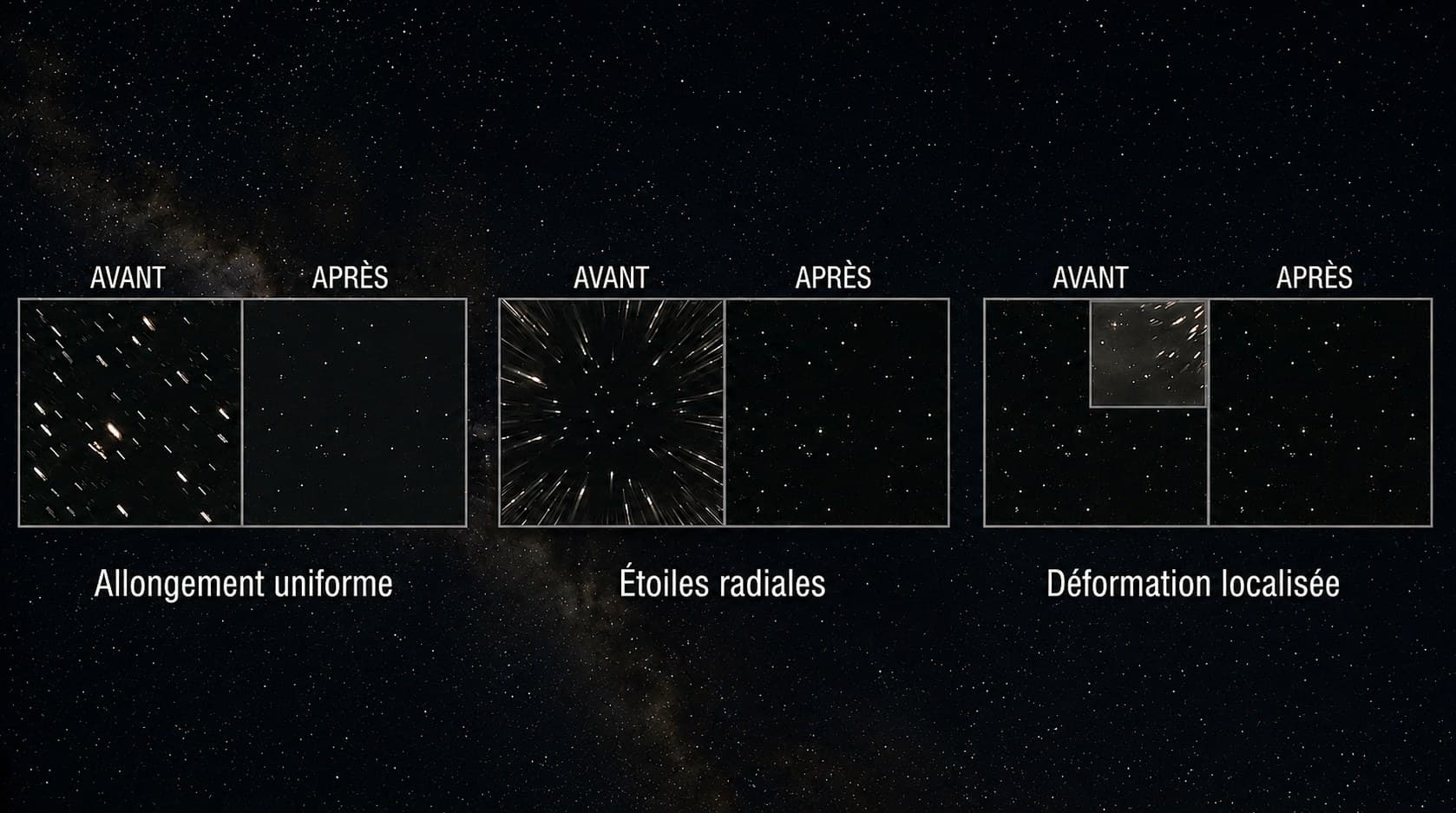
This 300s sub is well executed. The PSF panel shows compact stars well fitted by the Moffat ellipse, with FWHM between 1.30 and 1.46 px across zones, a corner/center ratio of just 1.112. In other words, sharpness is nearly uniform across the field: no backfocus error, no marked curvature, no focus miss. PA dispersion between zones reaches 57 deg, which rules out a coherent mount-driven elongation: no tracking drift or periodic error visible on this exposure.
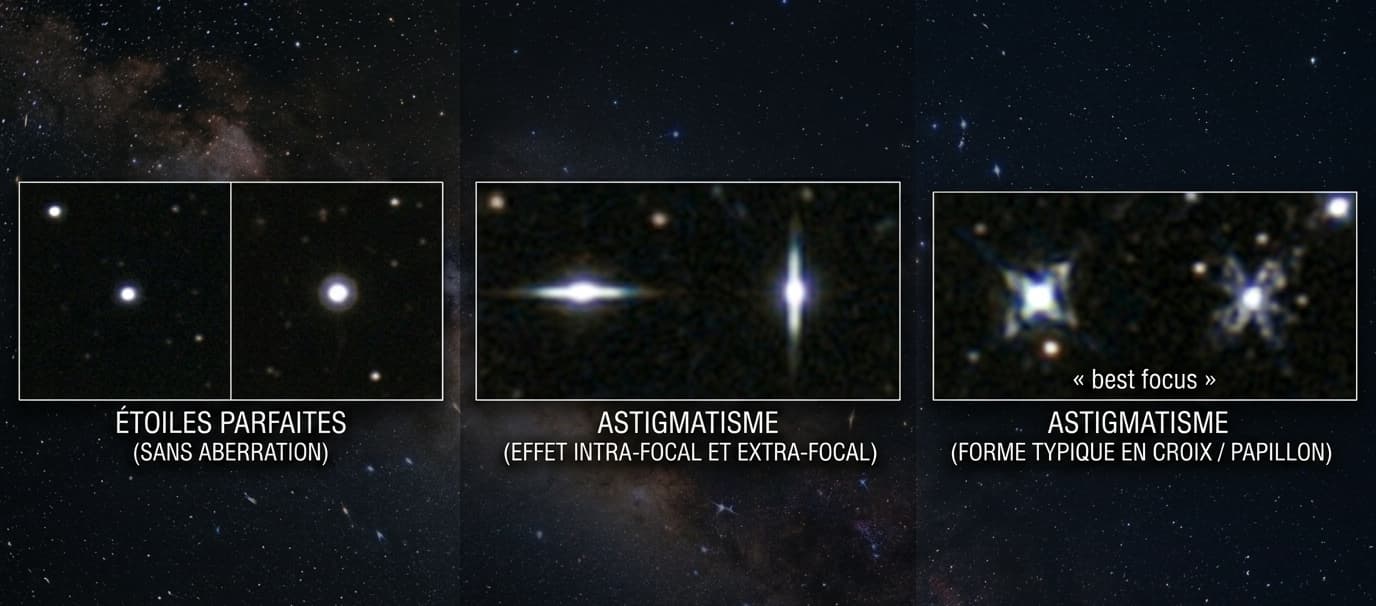
The only shape defect retained is moderate field astigmatism, measured by elongation rising to 1.31 on the right edge and 1.27 in the top-right corner while the field floor sits at 1.14 and FWHM barely moves. That is the classic signature: stars stretch without growing. The lower half of the sensor stays at the floor, suggesting a local mechanical contribution rather than a perfectly symmetric optical flaw. At 3.15"/px, the visual impact after stacking will stay subtle.
On the background, the illumination map gives a 19% radial falloff with rotational symmetry and no preferred orientation. That is ordinary instrumental vignetting at this focal length, which will vanish with a good flat series. The nebulosity and dark globules in the field match the DSS reference well, so nothing here should be mistaken for a stray gradient.
Priority actions
- Shoot a flat and dark-flat series in the exact session configuration to correct the 19% radial falloff
- Check ring and focuser tightness to relieve any mechanical stress behind the right-edge astigmatism
- Run a star test either side of focus, center then edge, to confirm and quantify the astigmatism
- Keep acquiring without changing settings: gain 180, offset 15, 300s and -13C suit this Bortle 2 sky