Astrophotography diagnosis of IC 1848: Astigmatism
Raw420s25 sept. 2026
The Doc examined this image of IC 1848 (raw, 420s). Estimated overall technical quality: 7/10. 1 defect found: Astigmatism (severity 2/5).

Info
- Cible
- IC 1848
- Date
- 25 sept. 2026, 22:03
- Lune
- Nouvelle lune 0.8% (38.4° d'alt., 72.8° de la cible)
- Site
- Bortle 2 · rural typique (VIIRS)
- Position
- 2h48m46s · +60°19'24"
Excellent conditions, well used. The actual context gives a moon at 0.8% illumination, so new moon, 72.8 deg from the target: no lunar contribution is possible, the form's "full moon" label needs fixing. Combined with Bortle 2, the sky background is as clean as it gets, which the background map confirms: a plane gradient of only 1% amplitude with R2=0.01, so no significant oriented gradient. On an emission nebula like IC 1848, these conditions allow long exposures without an aggressive filter and deep stacking. Nothing to change on the sky side, capitalize on total integration time instead.
Setup
- Type d'image
- Brut
- Télescope
- EQMod Mount
- Caméra
- ZWO ASI585MM Pro
- Exposition
- 420s
- Phase de lune
- Pleine lune (100 %)
- FOV
- 3.36°
Setup is coherent for the target. At 190mm focal length, the 3.36 deg field frames the whole Soul Nebula with margin, western extensions included, that is the right call. Sampling at 3.148 arcsec/px is clearly undersampled (measured FWHM of 1.3px means stars limited by the grid, not by seeing), which costs detail but maximizes SNR per pixel, a defensible trade on an extended nebula. On settings: gain 160 on the ASI585MM, 420s, -20C, no saturated pixel and no dark clipping, all healthy. The sky/black-point margin of 1.8 is low but that is normal in narrowband under Bortle 2, do not shorten the exposure because of it.
The diagnosis in detail
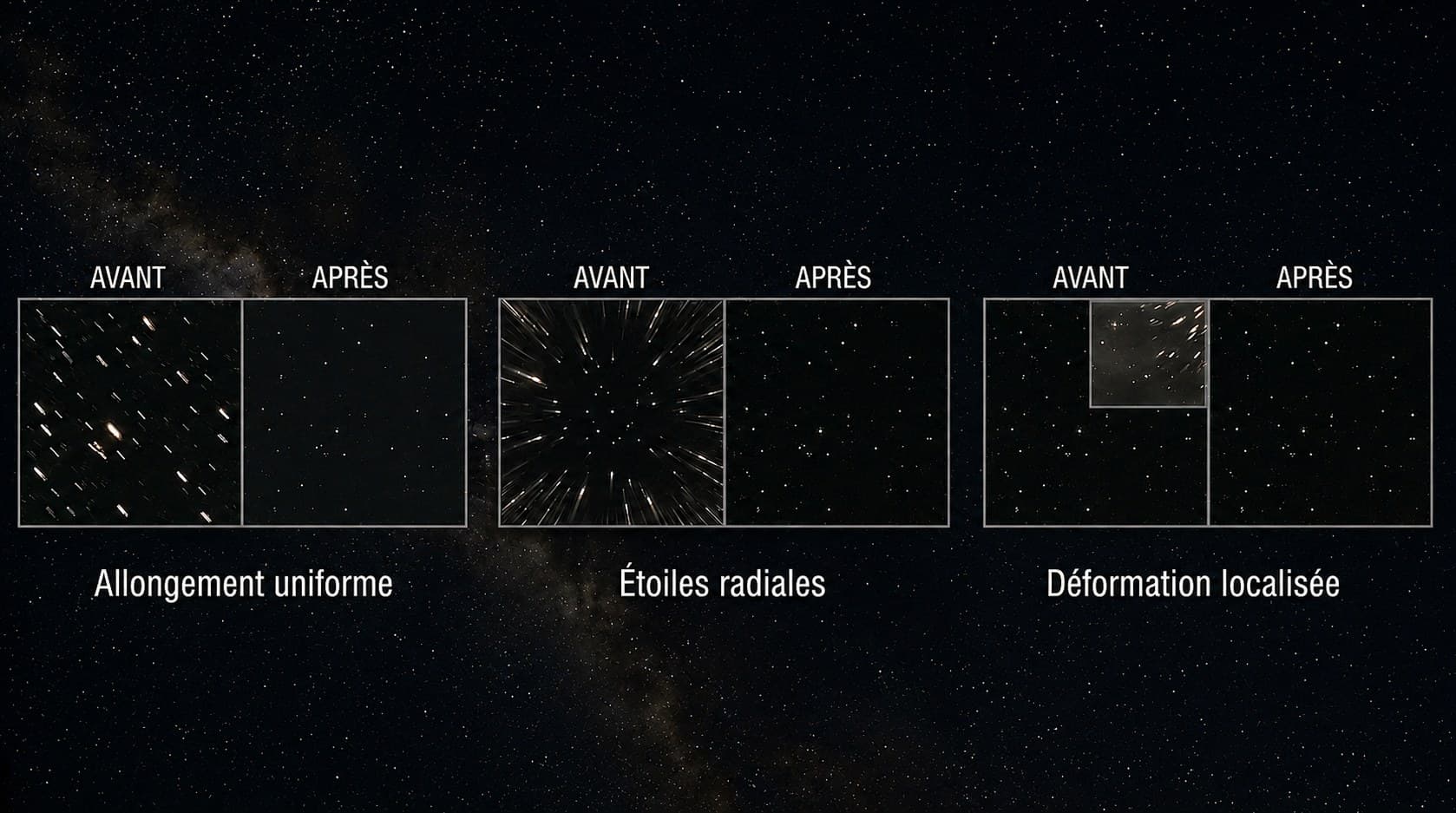
This sub is well executed and the diagnosis comes down to a single point. The Moffat measurements show a perfectly round center (elong 1.06 against a field floor of 1.05) and a uniform FWHM around 1.3px, which immediately rules out any tracking component: no drift, no periodic error, no guiding oscillation, otherwise the elongation would show at center with a coherent PA.
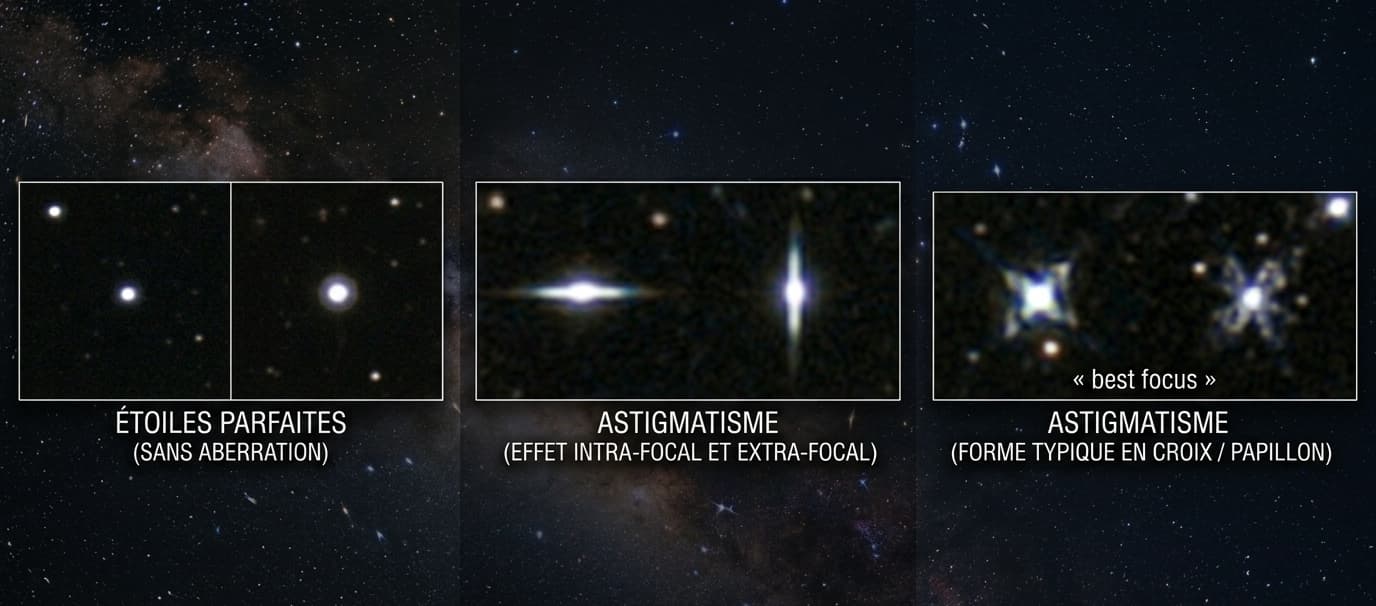
The only measured deviation is peripheral: elongation reaches 1.38 top-right and 1.37 bottom-left, while the corner/center FWHM ratio stays at 1.119, below the threshold that would signal field curvature or a backfocus error. Stars that stretch without widening, with angles flipping from one side of the field to the other, is the classic signature of field astigmatism. On the panel the lobes stay oval rather than radial commas, which also rules out coma.
On the background side, the map confirms rotational symmetry (plane/radial dominance 0.01, zero anisotropy) with a simple 9% darkening toward the edges: that is the normal optical vignetting of an uncalibrated sub, to be handled by flats, not a defect. The DSS comparison validates every nebula structure, no background artifact.
Priority actions
- Check the imaging train tightness and centering, then reshoot an aberration panel to confirm the origin of the field astigmatism
- Acquire a proper flat series to correct the measured 9% radial darkening
- Fix the moon label in the form: the session was shot at new moon, not full moon
- Capitalize on these Bortle 2 conditions by accumulating as many 420s subs as possible, the single sub is usable as is