Astrophotography diagnosis of IC 1848: Tracking drift
Raw300s16 sept. 2026
The Doc examined this image of IC 1848 (raw, 300s). Estimated overall technical quality: 8/10. 1 defect found: Tracking drift (severity 2/5).

Info
- Cible
- IC 1848
- Date
- 16 sept. 2026, 23:26
- Lune
- Gibbeuse décroissante 68% (sous l'horizon)
- Site
- Bortle 2 · rural typique (VIIRS)
- Position
- 2h48m46s · +60°19'24"
Near ideal conditions for this target. Bortle 2 gives an extremely dark sky background, which allows long exposures without saturating the background, and the 68% waning gibbous Moon was below the horizon during acquisition: no lunar contribution is possible, so no gradient can be blamed on it. For an emission nebula like IC 1848 this is the best case scenario, even in narrowband where light pollution matters little. The measured background stays very low (median 0.01, background to black point margin of 1.85), which is normal in Hα under a dark sky: you are not sky-limited, but that is not a defect here, it is the signature of a narrow filter under a very dark sky.
Setup
- Type d'image
- Brut
- Télescope
- EQMod Mount
- Caméra
- ZWO ASI585MM Pro
- Exposition
- 300s
- Phase de lune
- Premier croissant (28 %)
- FOV
- 3.36°
The setup is well matched to the target. At 190mm focal length, the 3.36° field comfortably contains IC 1848 with margin on both sides, a comfortable framing with the nebulosity fully inside the frame. Sampling at 3.148″/px is clearly undersampled relative to the seeing, which is a deliberate wide-field choice: stars are 1.3 to 1.7 px, right at the sensor resolution limit, but it also makes the setup very tolerant of tracking errors. On settings, gain 200 on the ASI585MM is high but consistent for narrowband to lift the signal above read noise, with no dark clipping or saturation measured, offset 15 is sufficient, and the sensor at -20°C is properly cooled.
The diagnosis in detail
This 300s sub is technically strong. The Moffat measurements show FWHM between 1.29 and 1.67 px across the nine zones, with a corner/center ratio of 0.915: the corners are even slightly tighter than the center, which formally rules out tilt, backfocus, coma and field curvature. The optics and imaging train are therefore properly set up across this 3.36° field.
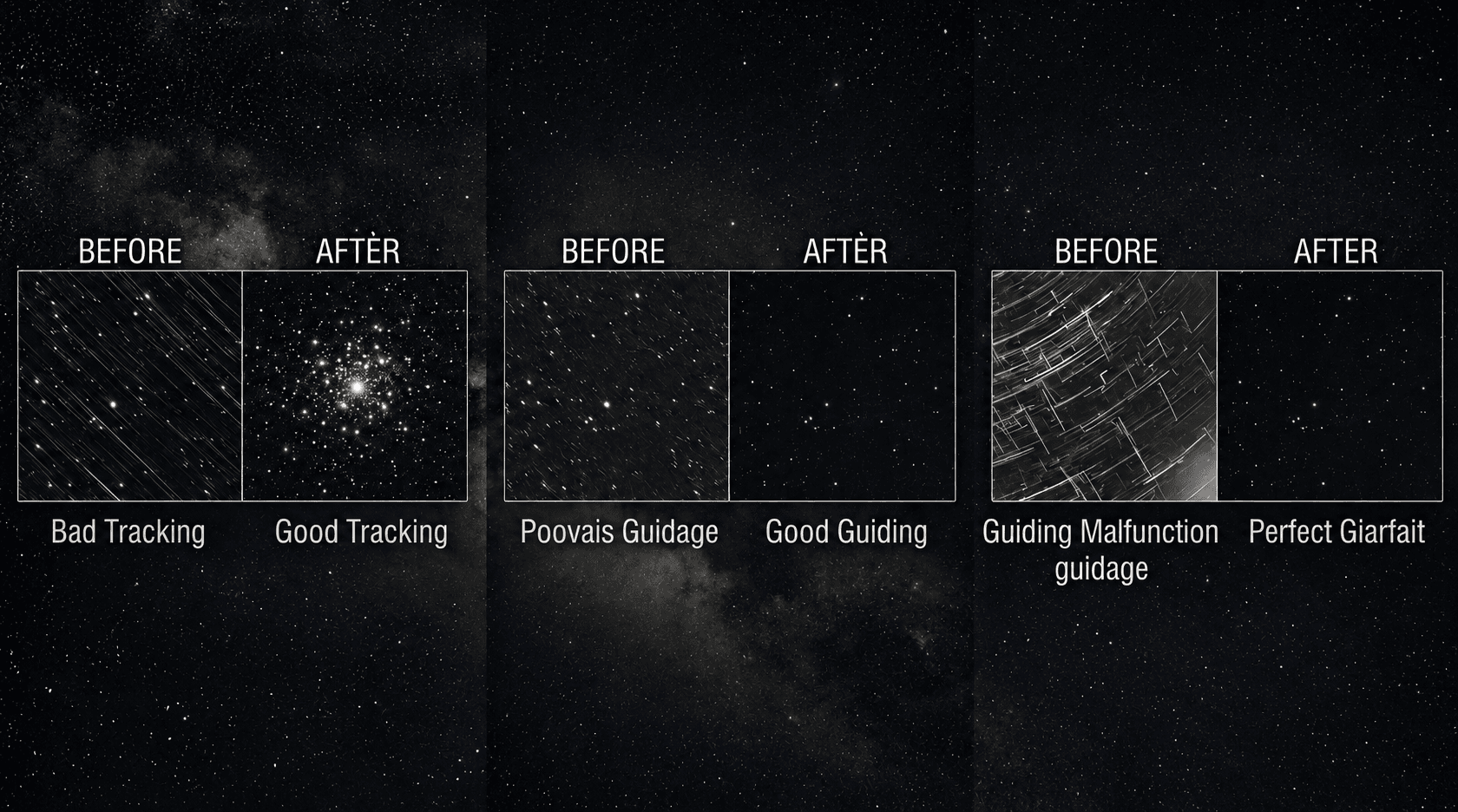
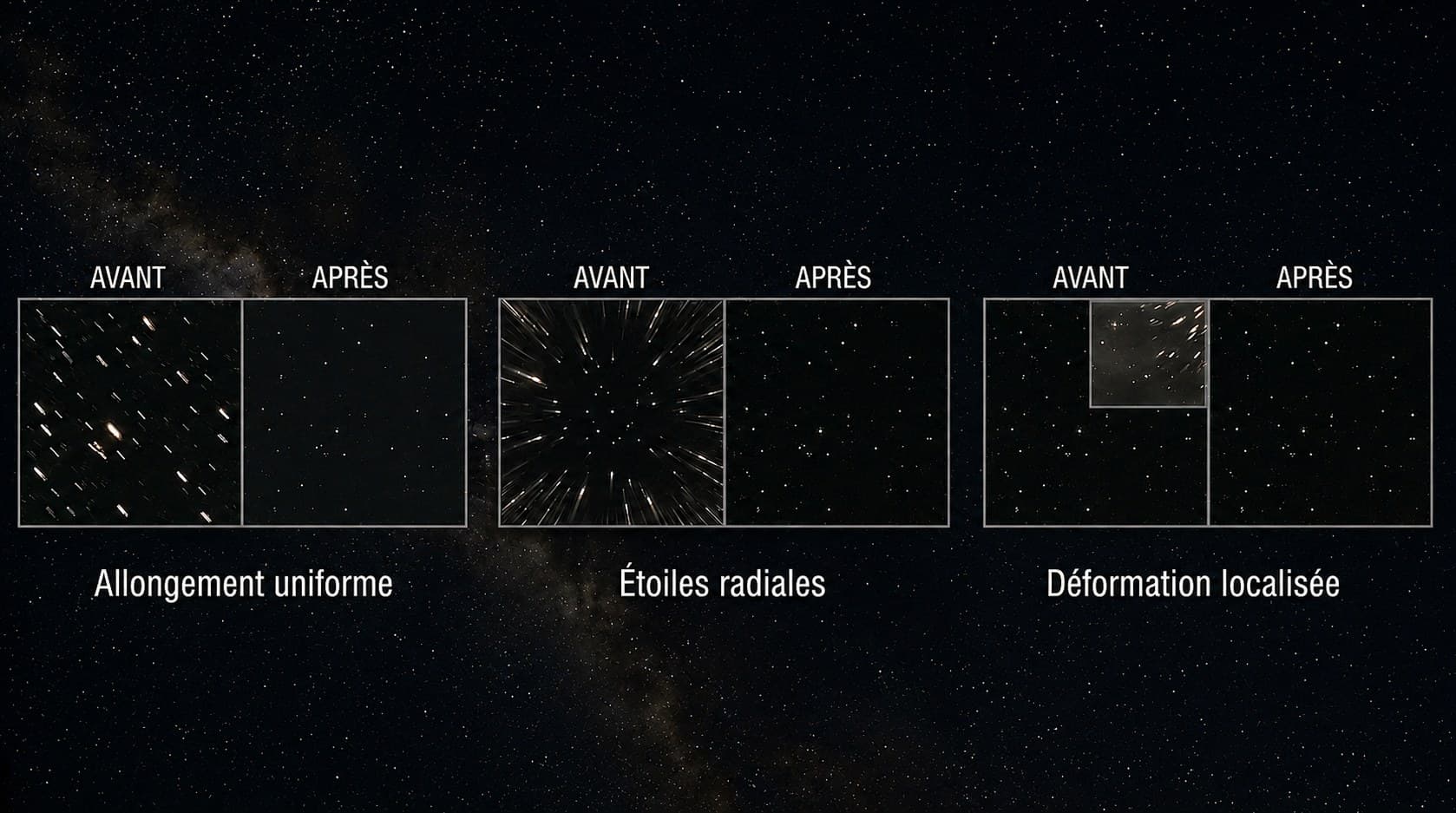
The only usable signal is a moderate elongation that is already present at the center: 1.18 against a field floor of 1.07, with position angles grouped around 56 to 72° at the center, right, bottom and bottom-right corner. This directional consistency across the field, combined with its presence at the center, points to a mechanical rather than optical cause: a small tracking drift during the exposure. At 3.148″/px the offset stays below the useful pixel, so the visual impact is nearly nil, but over a long integration it will slightly bloat the stars in the master.
The background shows a 23% radial falloff from center to edges with rotational symmetry (plane/radial dominance 0.24, anisotropy 0.03): this is raw optical vignetting, perfectly normal before flats are applied on an uncalibrated sub, nothing to diagnose. The nebulosity matches the DSS reference structure for structure, including the dark globules and the filaments along the southern edge, with no orphan structure and therefore no background artifact.
Priority actions
- Review this session's guiding log and identify the drifting axis (likely DEC) to bring the central elongation back down to the field floor
- Redo a careful polar alignment at the start of the session, it is the main lever on a slow directional drift
- Keep the 300s exposures, gain 200 and -20°C, these settings are appropriate and free of clipping