Astrophotography diagnosis of IC 1848: Sensor tilt and tracking drift
Raw420s25 sept. 2026
The Doc examined this image of IC 1848 (raw, 420s). Estimated overall technical quality: 7/10. 2 defects found: Sensor tilt (severity 3/5), Tracking drift (severity 2/5).

Info
- Cible
- IC 1848
- Date
- 25 sept. 2026, 20:12
- Lune
- Nouvelle lune 0.9% (27.7° d'alt., 73.5° de la cible)
- Site
- Bortle 2 · rural typique (VIIRS)
- Position
- 2h48m46s · +60°19'24"
Near ideal conditions for this target. Bortle 2 with a moon at 0.9% illumination, even 27.7 deg above the horizon and 73.5 deg from the target, amounts to a dark night: no meaningful stray light, confirmed by a very low sky background (median 0.02) and a negligible oriented gradient (5% amplitude, R2 0.15). On IC 1848, an emission nebula, this is the best time to stack deep subs, in broadband as well as Ha. Use this sky to accumulate exposure time rather than to test gear: the conditions explain none of the defects found here, they are all instrumental.
Setup
- Type d'image
- Brut
- Télescope
- EQMod Mount
- Caméra
- ZWO ASI585MM Pro
- Exposition
- 420s
- Phase de lune
- Pleine lune (99 %)
- FOV
- 3.36°
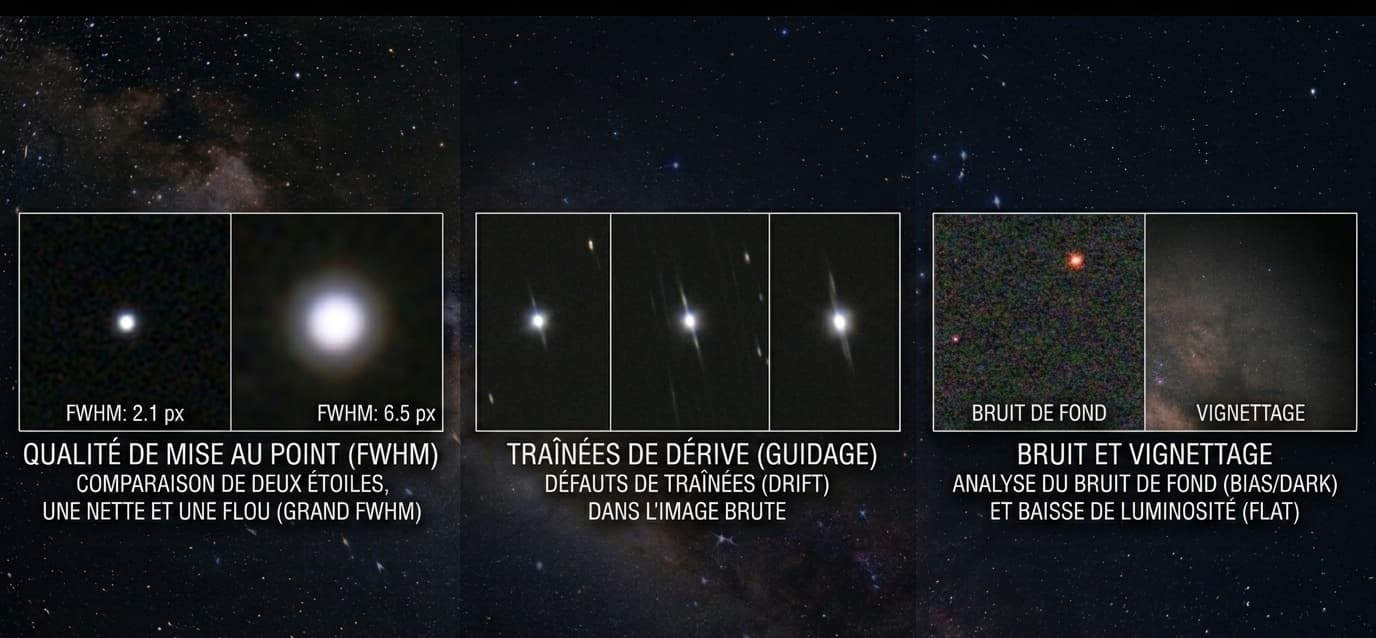
Setup well matched to the target but clearly undersampled. At 190 mm focal length and 2.9 um you are at 3.148 arcsec/px over a 3.36 deg field: IC 1848 fits comfortably in frame with margin, a good framing compromise. However at 3.15 arcsec/px stars are only 1.5 px FWHM at center, right at the measurement limit: any shape defect immediately hurts, and the measured tilt translates directly into resolution loss on the right half. As for settings, gain 160 on an ASI585MM and -20C are healthy, offset 15 clips nothing (0% dark clipping). The e_margin of 2.02 shows a background barely lifted, which is normal in narrowband under this very dark sky, not a sign of underexposure.
The diagnosis in detail
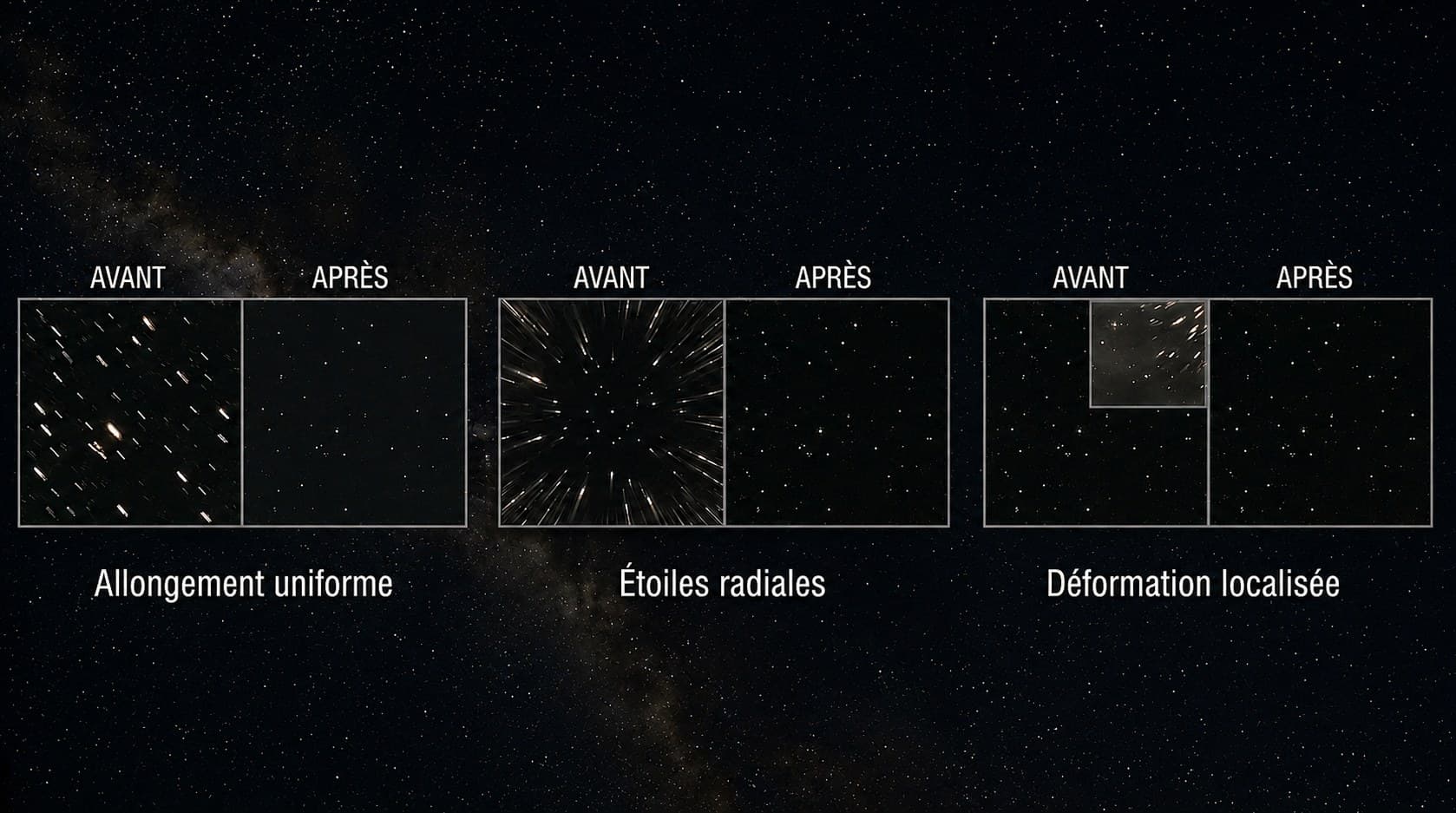
The hard issue in this sub is mechanical. The field center is excellent (FWHM 1.46 px), but the corner/center FWHM ratio reaches 1.51 with an asymmetry that exists only on the horizontal axis (0.168 against 0.065 vertical). Concretely, the left corners stay around 1.8 to 2.0 px while TR and BR climb to 2.4 px, with elongations of 1.40 and 1.56. This is neither coma (which would be symmetric and radial) nor backfocus (all four corners would be affected evenly): it is a tilt of the sensor plane about a vertical axis.
A tracking component sits on top, subtler but real: the center itself is at 1.21 elongation while the field floor is 1.13, and position angles are very consistent across zones (10.4 deg spread). Over a 420 s exposure this points to slow drift rather than guiding oscillation. Part of the right corner elongation is therefore the sum of both effects.
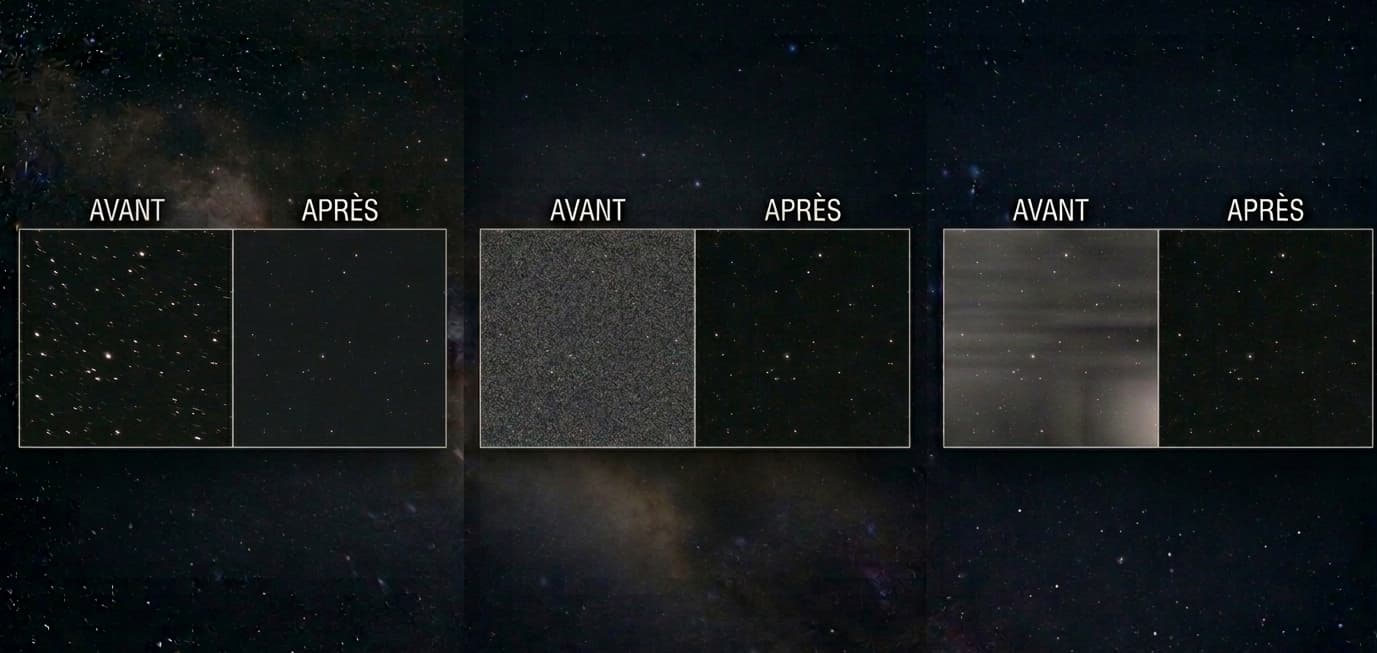
The rest is healthy: very dark sky background, nebulosity matching the DSS structure for structure, no satellite trail or visible thermal residue. The 10% vignetting is normal behavior for an uncalibrated sub and will be removed by flats.
Priority actions
- Fix the sensor tilt: evenly tighten the imaging train, then iterate with a tilt adjuster until the corner/center FWHM ratio drops below 1.2
- Refine polar alignment and guiding to bring central elongation back to the field floor (1.13) on 420 s subs
- Shoot flats for the session to correct the 10% illumination falloff
- Re-run an aberration inspector check after adjustment, before launching a long integration