Astrophotography diagnosis of IC 1848: Tracking drift
Raw300s16 sept. 2026
The Doc examined this image of IC 1848 (raw, 300s). Estimated overall technical quality: 8/10. 1 defect found: Tracking drift (severity 2/5).

Info
- Cible
- IC 1848
- Date
- 16 sept. 2026, 22:54
- Lune
- Gibbeuse décroissante 68.2% (sous l'horizon)
- Site
- Bortle 2 · rural typique (VIIRS)
- Position
- 2h48m46s · +60°19'24"
Very favorable conditions. The Bortle 2 sky is a major asset: the background stays dark with no marked light-pollution gradient, confirmed by the background map where the plane amplitude is only 7% with an R² of 0.14 (so no real oriented gradient). The Moon, 68% waning gibbous but below the horizon and 144° from the target, contributes nothing: lunar pollution ruled out outright. On an emission nebula like IC 1848, this context allows long subs with no compromise, and the low background-to-black-point margin (e_margin 1.85) is normal behavior for a narrowband filter under such a dark sky, not a sign of underexposure.
Setup
- Type d'image
- Brut
- Télescope
- EQMod Mount
- Caméra
- ZWO ASI585MM Pro
- Exposition
- 300s
- Phase de lune
- Premier croissant (27 %)
- FOV
- 3.36°
A coherent setup for this target. At 190mm focal length, the 3.36° field comfortably frames IC 1848 with margin at the edges, a good fit for the Soul Nebula. The 3.15"/px image scale is strictly undersampled, but that is a deliberate choice on a wide nebular field: the measured FWHM of 1.3-1.8 px confirms stars sit right at the sampling limit. For diffuse Ha nebulosity this is not a penalty. On settings, gain 200 on the ASI585MM remains reasonable with 0% saturated pixels, offset 15 produces no dark clipping, and the sensor at -20°C is properly cooled. Nothing to change there.
The diagnosis in detail
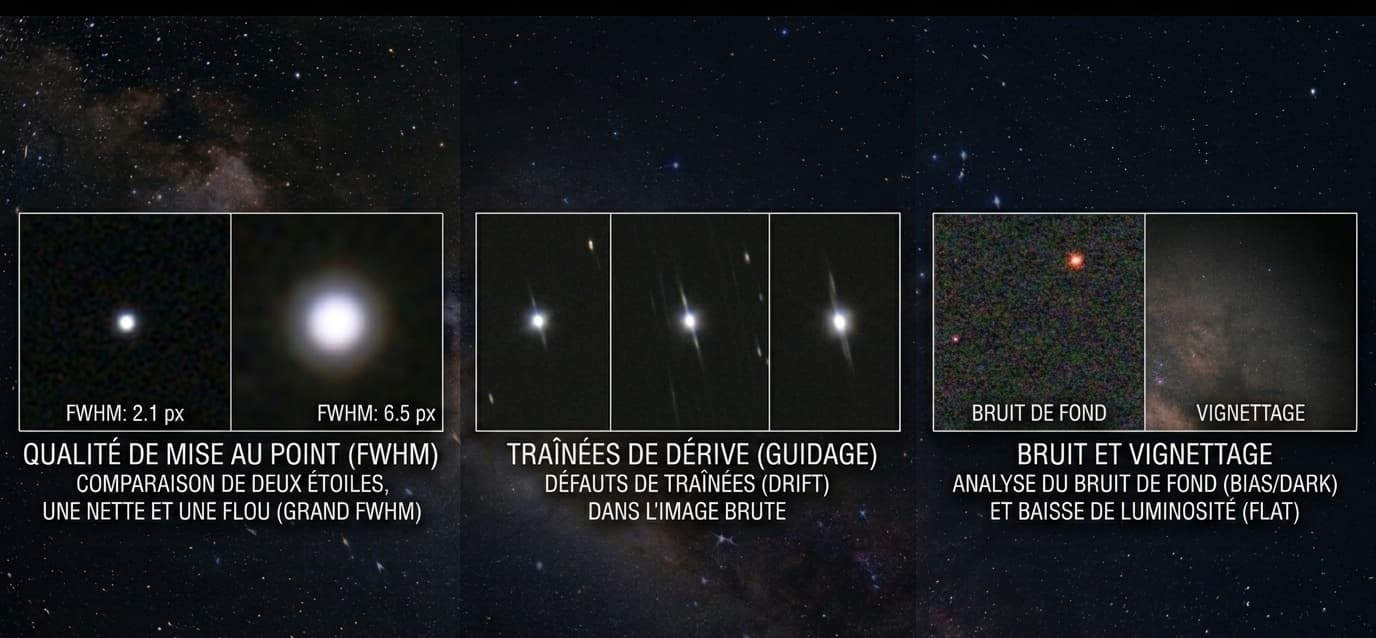
This is an excellent 300s Ha sub. The PSF panel reads unambiguously: the corner/center FWHM ratio is 0.856, meaning corners are actually tighter than the center, which formally rules out tilt, backfocus error, coma and astigmatism. Horizontal (0.06) and vertical (0.058) asymmetries are below threshold. The optics are clean, nothing to correct there.
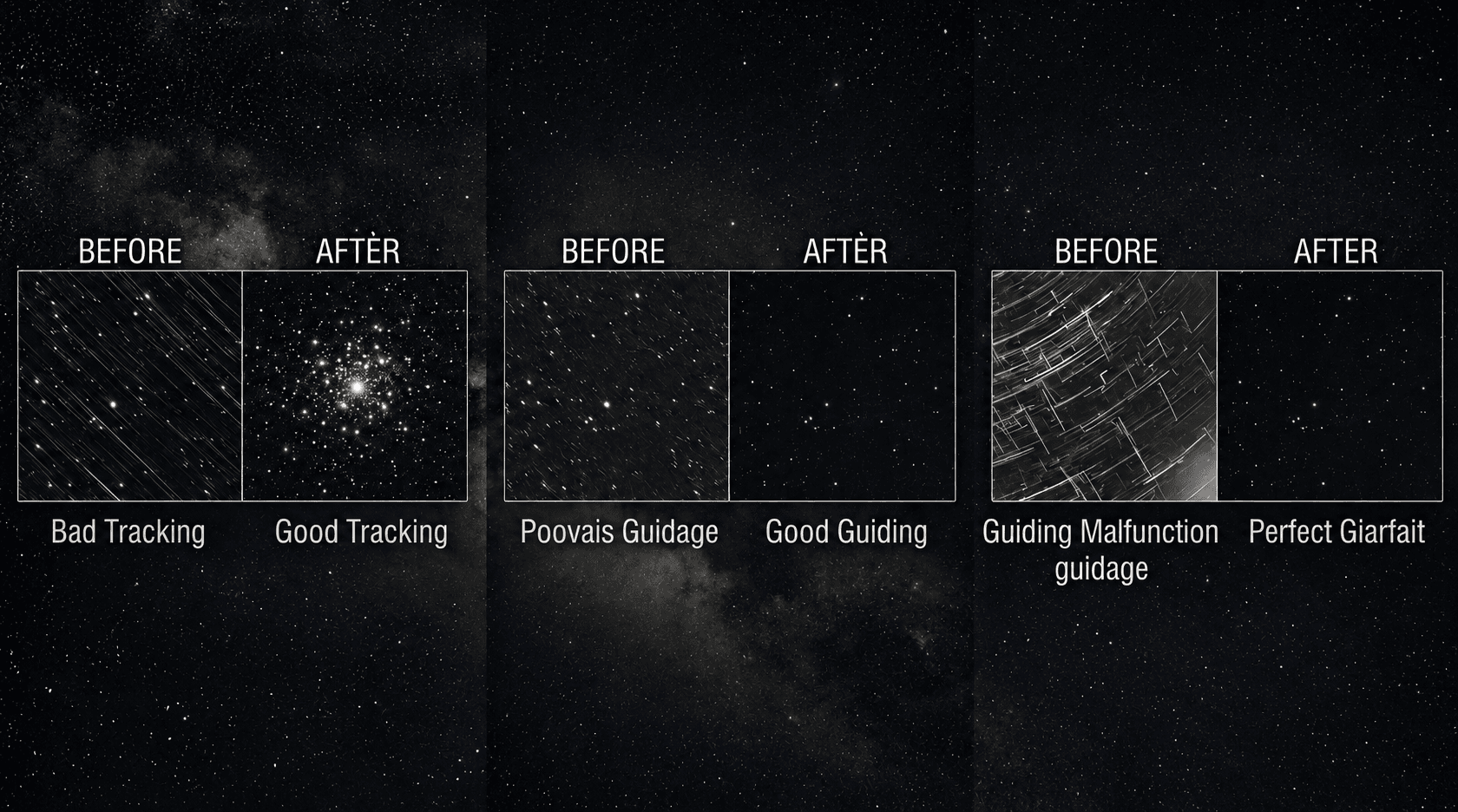
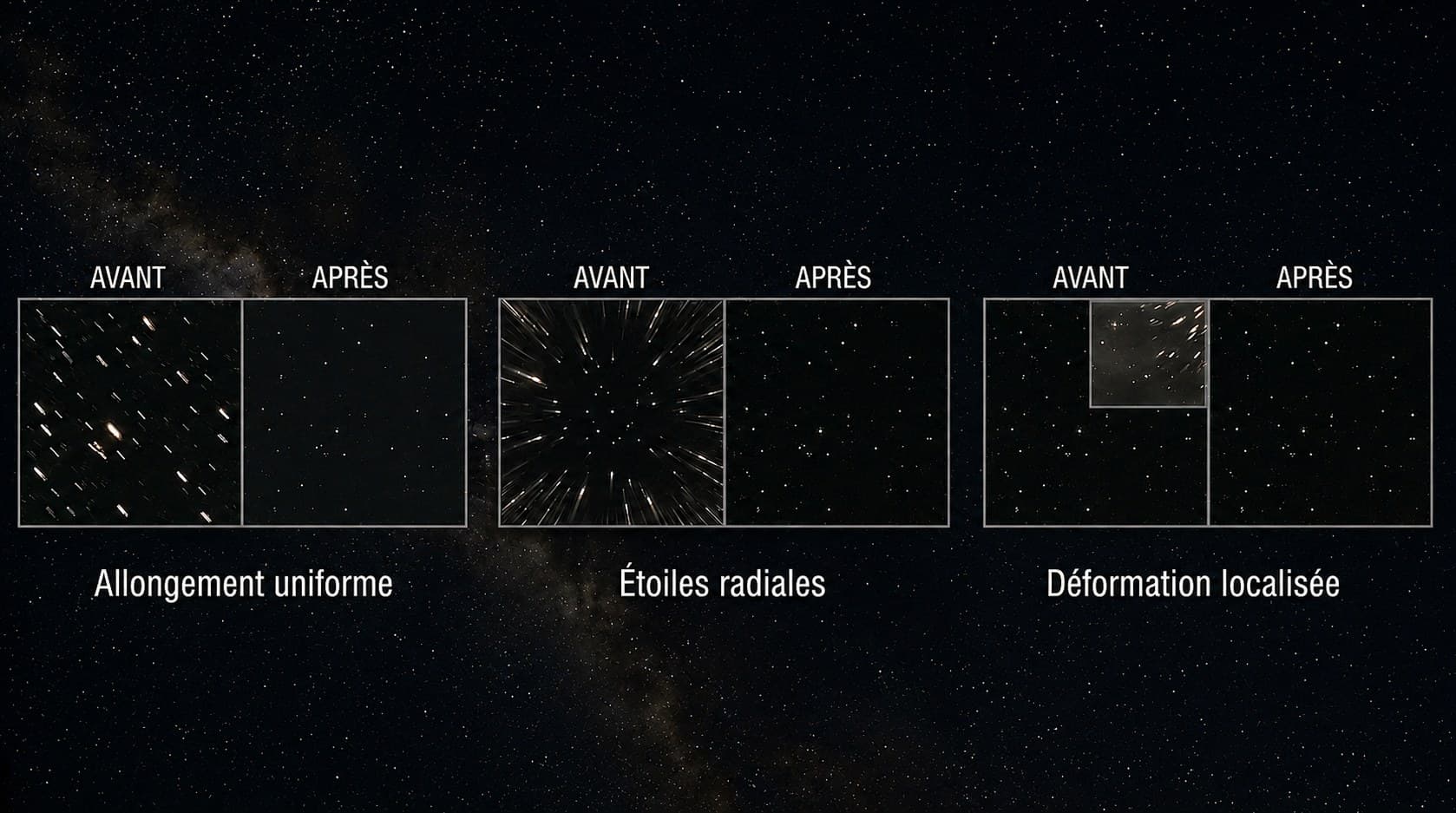
The only actionable signal is the central elongation at 1.13 against a field floor of 1.06, with position angles grouped around 80-89° and only 15° of dispersion between zones. An elongation present at the center with a constant direction cannot come from field optics: it comes from the mount. The amplitude stays low, roughly 7% of stretch above the floor, so this is slow drift rather than a guiding failure.
On the background side, the map shows a 17% radial falloff toward the edges with a plane/radial dominance of 0.16, i.e. rotational symmetry: perfectly normal optical vignetting on an uncalibrated sub that flats will remove. No real oriented gradient, no amp glow, no trail. Comparison with the DSS confirms every visible nebular structure is real.
Priority actions
- Redo polar alignment with the polar align routine before the next session to clear the 300s drift
- Check guiding RMS in PHD2 over a full sub and adjust aggressiveness if needed
- Enable dithering between subs so stacking smooths the residual elongation
- Shoot a flat series to correct the 17% optical vignetting measured toward the edges