Astrophotography diagnosis of IC 1848_Octobre26: Sensor tilt and satellite trail
Raw420s02 oct. 2026
The Doc examined this image of IC 1848_Octobre26 (raw, 420s). Estimated overall technical quality: 7/10. 2 defects found: Sensor tilt (severity 2/5), Satellite trail (severity 1/5).

Info
- Cible
- IC 1848_Octobre26
- Date
- 02 oct. 2026, 19:01
- Lune
- Croissant croissant 41.5% (sous l'horizon)
- Site
- Bortle 2 · rural typique (VIIRS)
- Position
- 2h59m52s · +60°18'50"
Near ideal conditions for this target. Bortle 2 and Moon below the horizon: no lunar pollution is possible, and the measured sky background confirms it (gradient plane at only 1% amplitude, R2 0.02, so no meaningful oriented gradient). On an emission nebula like IC 1848 this is the best case: you can push integration in narrowband without worrying about gradients to remove, and even consider broadband or RGB stars the same night. The measured sky-to-black-point margin of 2.02 is low, but under such a dark sky and behind a narrow filter that is expected at 420s, it is not underexposure in the classic sense.
Setup
- Type d'image
- Brut
- Télescope
- EQMod Mount
- Caméra
- ZWO ASI585MM Pro
- Exposition
- 420s
- Phase de lune
- Gibbeuse décroissante (62 %)
- FOV
- 3.36°
Coherent setup for the target. At 190mm focal length the 3.36 degree field comfortably frames IC 1848 with margin on the edges, and the nebula is not clipped anywhere. The 3.15 arcsec/px sampling is clearly undersampled for the ASI585MM: you lose stellar detail, but for a large emission nebula it is a deliberate and sensible tradeoff, and it actually hides part of the tilt. On the settings side, gain 160 on this sensor is above unity but reasonable for narrowband, offset 15 produces no dark clipping (0%), and cooling at -20C is healthy. No measured saturation (0%): the 420s exposure burns nothing out.
The diagnosis in detail
The image is well executed and the diagnosis comes down to two points, only one of them instrumental. The Moffat measurement gives a very clean center at 1.70/1.58 px for an elongation of 1.07, exactly the field floor: stars at center are perfectly round and focus is spot on. Tracking causes no issue over 420s, which is notable, and no signature of drift, periodic error or guiding oscillation appears on the inspector panel.
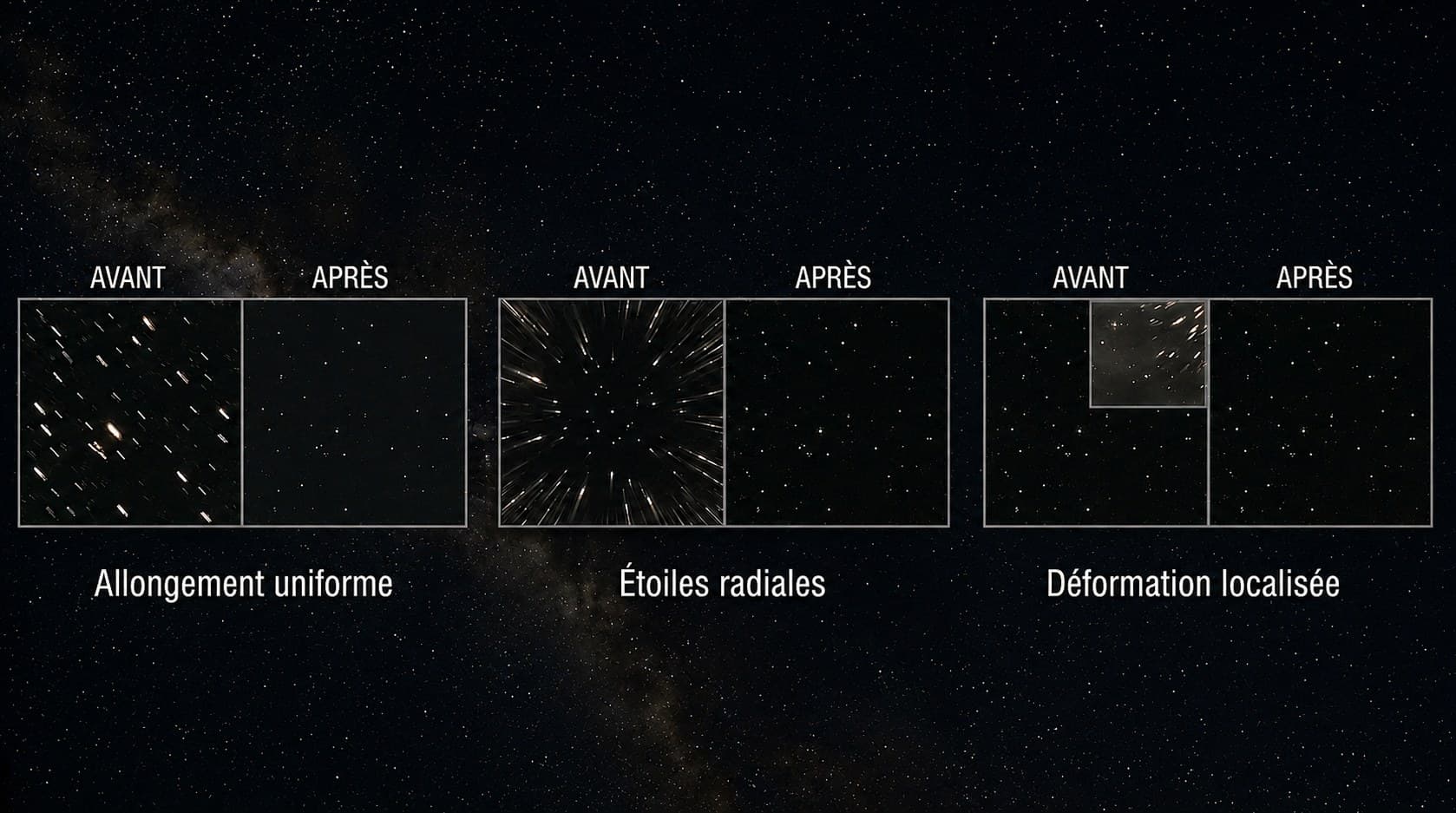
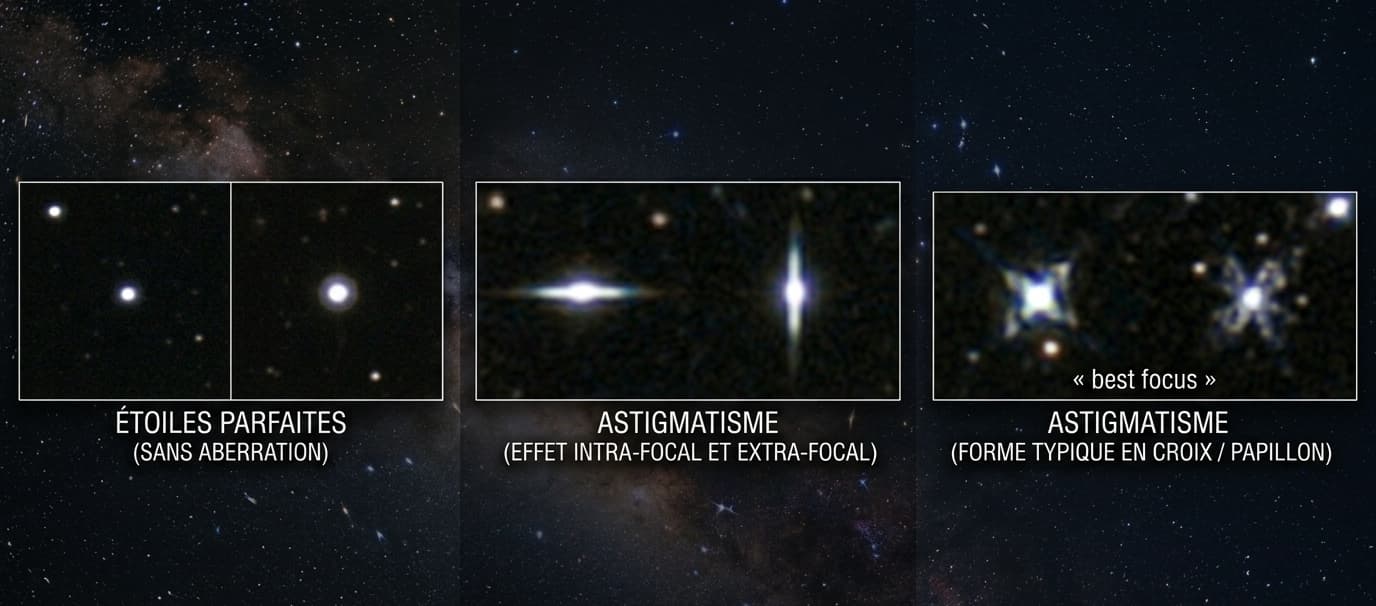
The degradation is purely peripheral. The 1.23 corner/center FWHM ratio and the single-axis asymmetry between opposite corners point to residual tilt of the sensor or imaging train: the bottom-right corner reaches 2.40 px on the major axis and 1.42 elongation while the top and bottom edges cap at 1.65 px. The effect stays moderate and, at 3.15 arcsec/px, is partly buried in the sampling, hence the contained severity. A tilter adjustment or a simple check of the imaging train tightness should clear it.
The diagonal satellite trail is a non-event on a single sub: it is exactly what sigma rejection removes. The measured sky background is rotationally symmetric with an 8% falloff from center to edges, which is the normal optical vignetting of an uncalibrated sub, and flats will handle it.
Priority actions
- Fix the imaging train tilt (ring tightness, tilt adapter adjustment) aiming for even FWHM across the 4 corners
- Stack at least 10 to 15 frames with sigma rejection to remove the satellite trail
- Apply session flats to correct the 8% illumination falloff at the field edges
- Keep these settings (gain 160, offset 15, -20C, 420s) which produce neither dark clipping nor saturation