Astrophotography diagnosis of NGC 6888: Sensor tilt and bad seeing
RawL30s28 oct. 2026
The Doc examined this image of NGC 6888 (raw, L, 30s). Estimated overall technical quality: 5/10. 2 defects found: Sensor tilt (severity 3/5), Bad seeing (severity 2/5).

Info
- Cible
- NGC 6888
- Date
- 28 oct. 2026, 18:28
- Lune
- Croissant croissant 9.6% (5.4° d'alt., 97.9° de la cible)
- Site
- Bortle 4 · transition rural/banlieue (VIIRS)
- Position
- 20h12m07s · +38°21'24"
Broadly favourable conditions. The Moon is at 9.6% illumination, only 5.4° above the horizon and 97.9° from NGC 6888: its contribution to sky background is negligible, and no lunar gradient is expected or measured. Bortle 4 is a good sky for broadband work, confirmed here by a clean background free of instrumental gradient. The real limiting factor of the night is not the sky but turbulence, visible in the 6.1 px central FWHM. On NGC 6888, an emission nebula very faint in luminance, Bortle 4 remains workable, but a narrowband Ha or OIII filter would deliver far more useful signal on the shell than the L filter used here.
Setup
- Type d'image
- Brut
- Télescope
- Celestron C11 2800@F\10.0
- Caméra
- PlayerOne CCD Poseidon-M PRO
- Filtre
- L
- Exposition
- 30s
- Phase de lune
- Gibbeuse décroissante (92 %)
- FOV
- 45.8'
A powerful but demanding setup for this target. At 2800mm and F/10 the field is 0.76° wide while NGC 6888 spans roughly 18x12 arcminutes: the nebula barely fits, with no composition margin, confirmed by the image where the shell is cut at top and left. Sampling at 0.44"/px is heavily oversampled, well beyond the measured seeing: 2x2 binning or an F/6.3 reducer would be far more appropriate, both for field and SNR. On settings, gain 125 and -10°C are healthy, though offset 30 still leaves 1.88% dark clipping to watch. A 30s exposure is short at F/10 on a faint target: 120 to 180s guided would suit better.
The diagnosis in detail
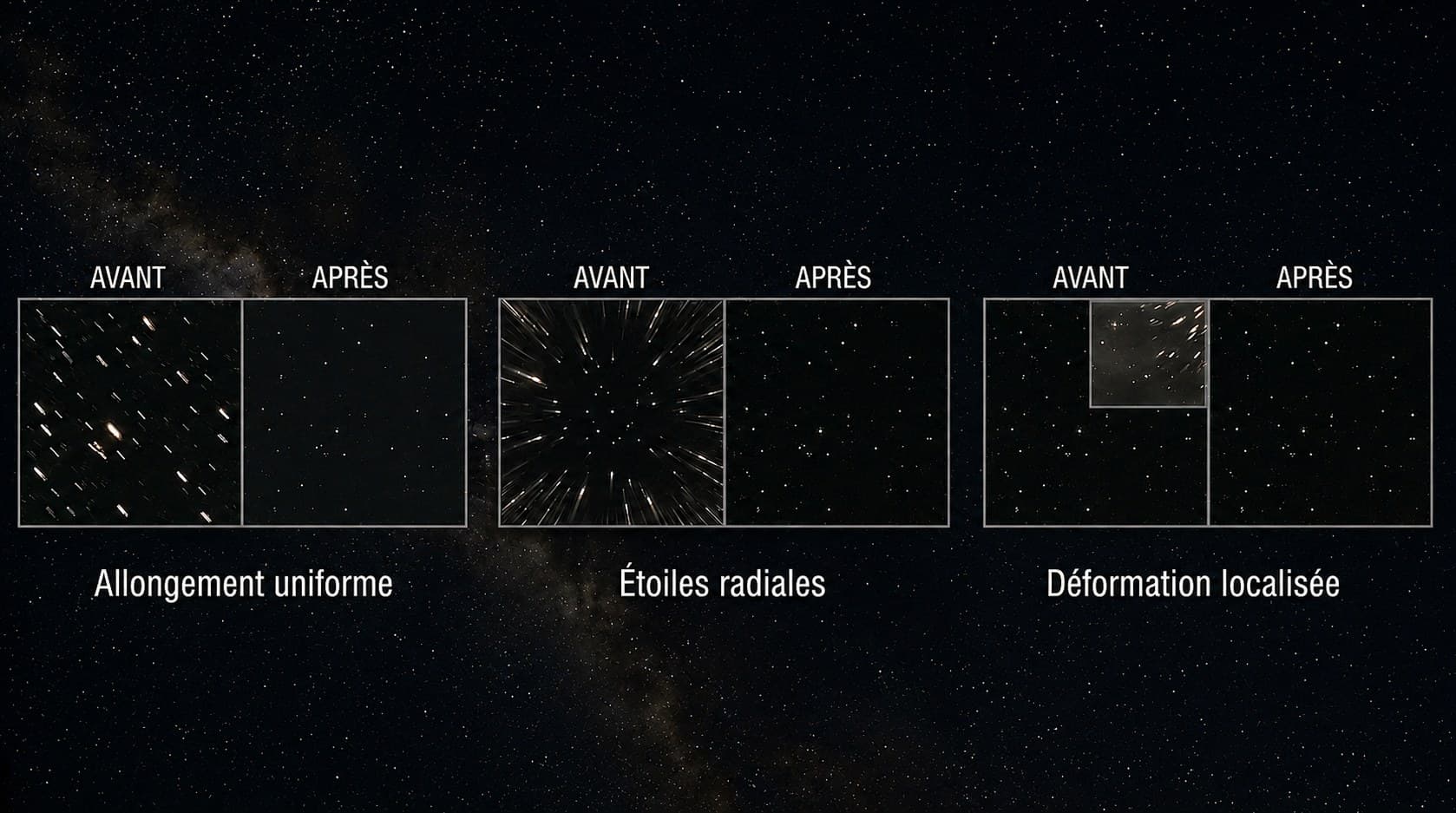
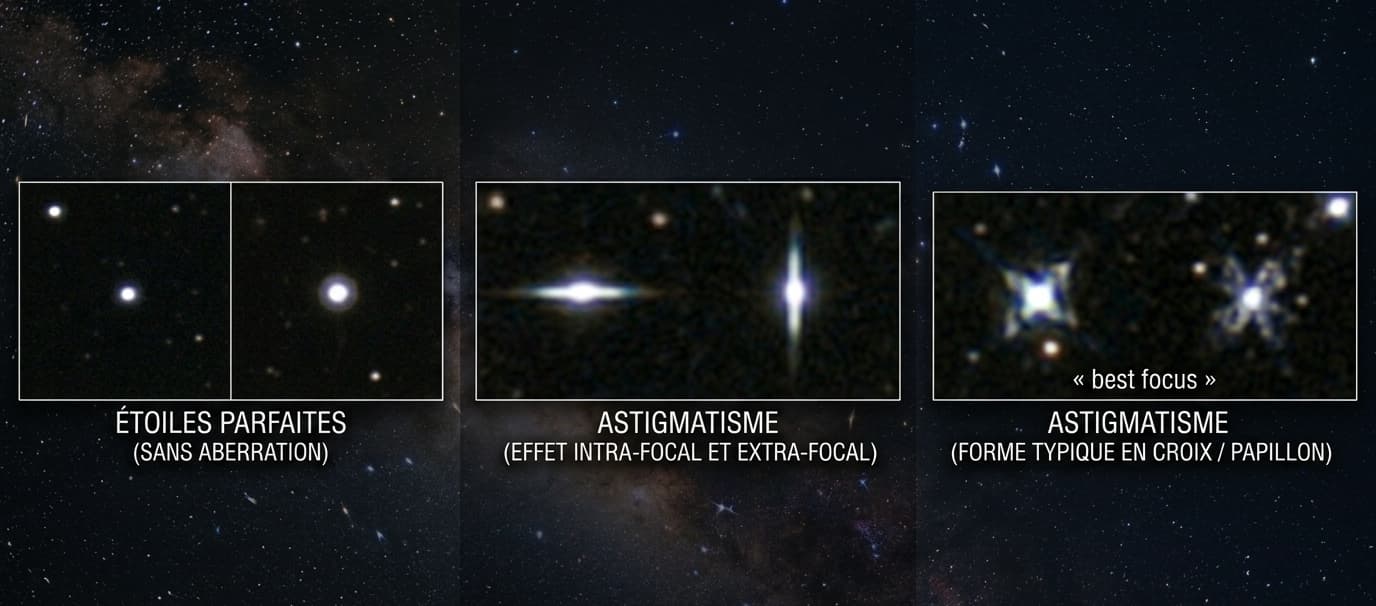
The aberration inspector reads clearly: the centre is by far the best zone of the field (FWHM 6.1/4.9), and the degradation is not symmetric. The bottom-right corner reaches 10.4/6.1 px with elongation 1.70 oriented at -45°, while the opposite bottom-left corner stays at 1.18 and the bottom edge at 1.06. This single-axis asymmetry, with a corner/centre ratio of 1.46 and vertical asymmetry of 0.21, is the signature of sensor or imaging-train tilt, not of a backfocus error, which would have degraded all four corners evenly.
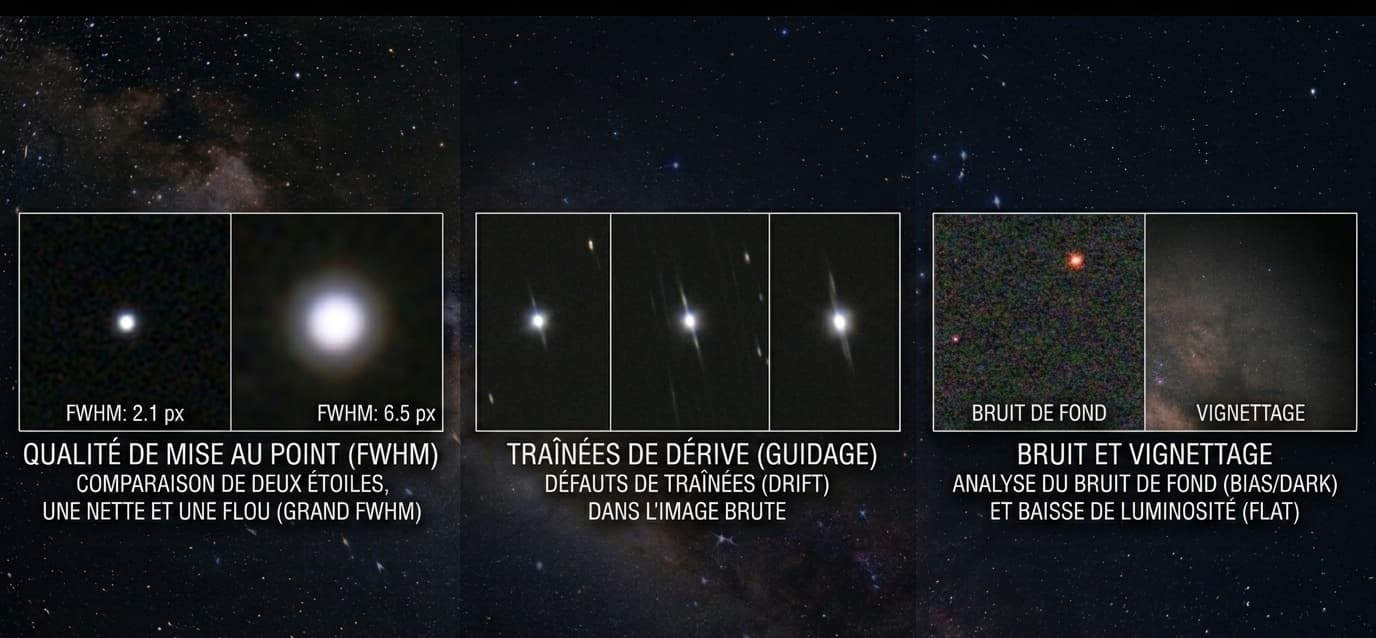
The second finding is independent: even in the healthy zone, stars measure 6.1 px, roughly 2.7 arcseconds. On a closed C11 at 2800mm, that width comes from turbulence and most likely from incomplete thermal settling of the tube, not from a focus error (the profile stays round and symmetric). Tracking is cleared: a PA dispersion of 33.9° and the absence of coherent field-wide elongation rule out drift or periodic error.
Finally, the histogram confirms a short sub for this focal ratio: background/black-point margin of 2.63 and 1.88% dark clipping. Sky background is not yet driving the noise, so read noise weighs more than necessary. The measured background variation corresponds to the nebula itself, not to an instrumental defect, and no background correction should be sought here.
Priority actions
- Correct the optical train tilt targeting the bottom-right corner, using a tilt plate and short test series measured per corner
- Let the C11 cool for 60 to 90 minutes before the session to reduce central FWHM
- Lengthen the sub exposure to 120 or 180s with guiding, to become sky-limited at F/10
- Consider 2x2 binning or an F/6.3 reducer, 0.44"/px sampling being pointless under this seeing
- Use an Ha filter rather than luminance to bring out the shell of NGC 6888