Astrophotography diagnosis of M 27: Sensor tilt and tracking drift
RawL60s28 oct. 2026
The Doc examined this image of M 27 (raw, L, 60s). Estimated overall technical quality: 5/10. 2 defects found: Sensor tilt (severity 4/5), Tracking drift (severity 3/5).

Info
- Cible
- M 27
- Date
- 28 oct. 2026, 18:57
- Lune
- Croissant croissant 9.8% (9.7° d'alt., 110.6° de la cible)
- Site
- Bortle 4 · transition rural/banlieue (VIIRS)
- Position
- 19h59m36s · +22°43'31"
Very favorable conditions. The lunar context gives a crescent at 9.8 percent illumination, only 9.7 degrees above the horizon and 110.6 degrees from the target: negligible light contribution, no lunar gradient expected, and that is exactly what the image shows. Bortle 4 is comfortable for a bright planetary nebula like M27, even in broadband luminance. The sky background stays dark and clean, with no marked urban gradient. Nothing in the conditions explains the defects found: they are instrumental. With this sky you can safely lengthen exposures without saturating the background, and that is precisely what is missing here.
Setup
- Type d'image
- Brut
- Télescope
- Celestron C11 2800@F\10.0
- Caméra
- PlayerOne CCD Poseidon-M PRO
- Filtre
- L
- Exposition
- 60s
- Phase de lune
- Gibbeuse décroissante (92 %)
- FOV
- 45.8'
Coherent but demanding setup. At 1764 mm and F/10, the 0.76 degree field leaves M27 (about 8 arcminutes) comfortably centered with plenty of margin: you could crop tighter or use a reducer to gain flux. The sampling of 0.879 arcsecond per pixel is oversampled for typical seeing, which is exactly why the tilt and drift stand out: at this resolution the slightest mechanical error shows. On the settings side, gain 125 and offset 30 are sound, no highlight clipping, sensor temperature at -10C is fine. However the 60 s luminance exposure at F/10 leaves the background too close to the black point (margin 4.8, dark clipping 1.6 percent): move to 120 or 180 s, the Bortle 4 sky allows it easily.
The diagnosis in detail
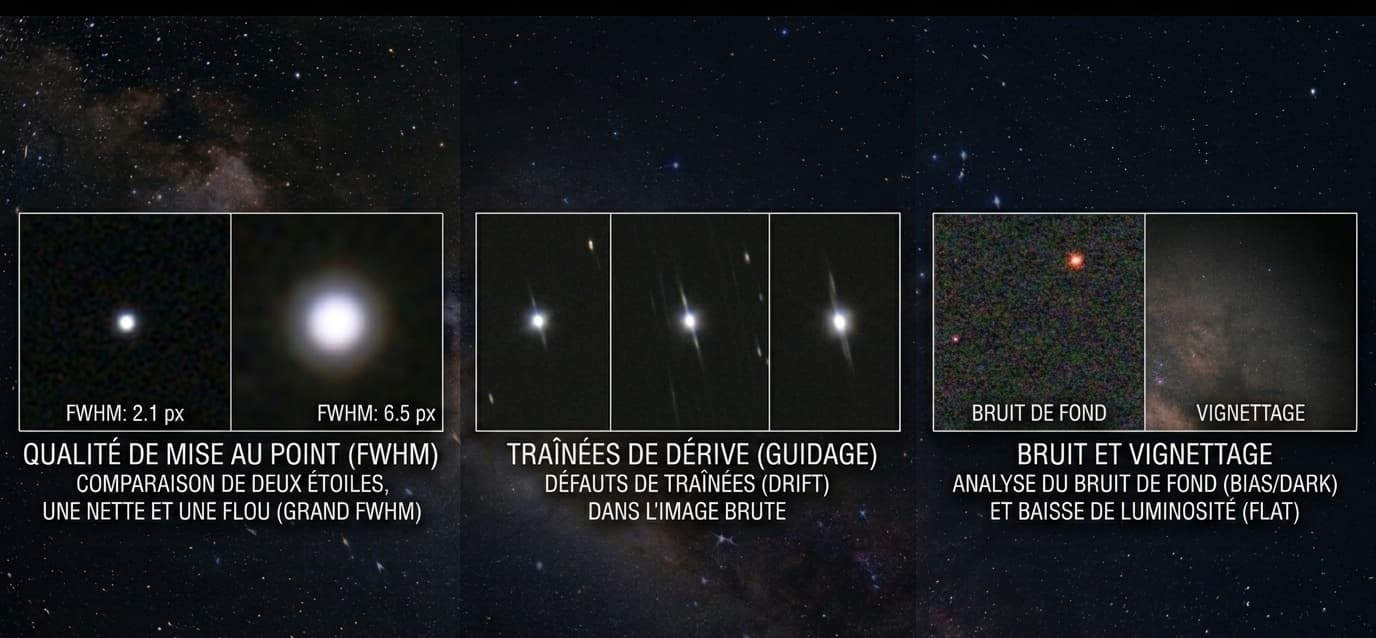
The two retained defects are independent and stack on star shape, which explains a fairly heterogeneous PSF panel. The most structural one is tilt: the field center is excellent at FWHM 4.2 px, but the left flank collapses to 7.4 px at edge L and 8.5 px in corner TL, while the bottom edge stays at 4.0 px. Such asymmetric degradation along a single axis, with vertical asymmetry of 0.57 against 0.016 horizontally, cannot be plain field curvature. This is a non-orthogonal focal plane, classic on a C11 with a compression-ring train and a heavy camera cantilevered out.
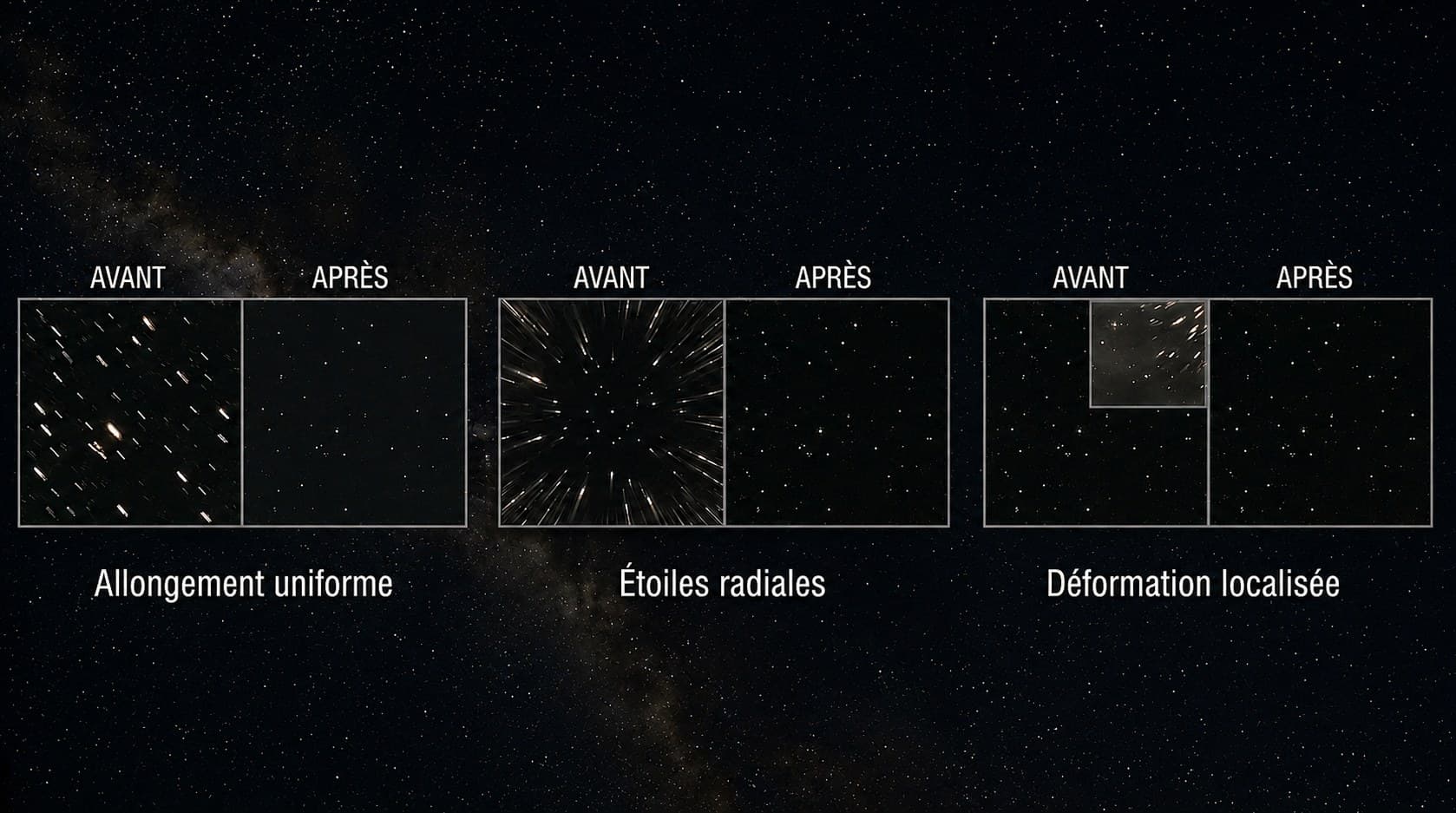
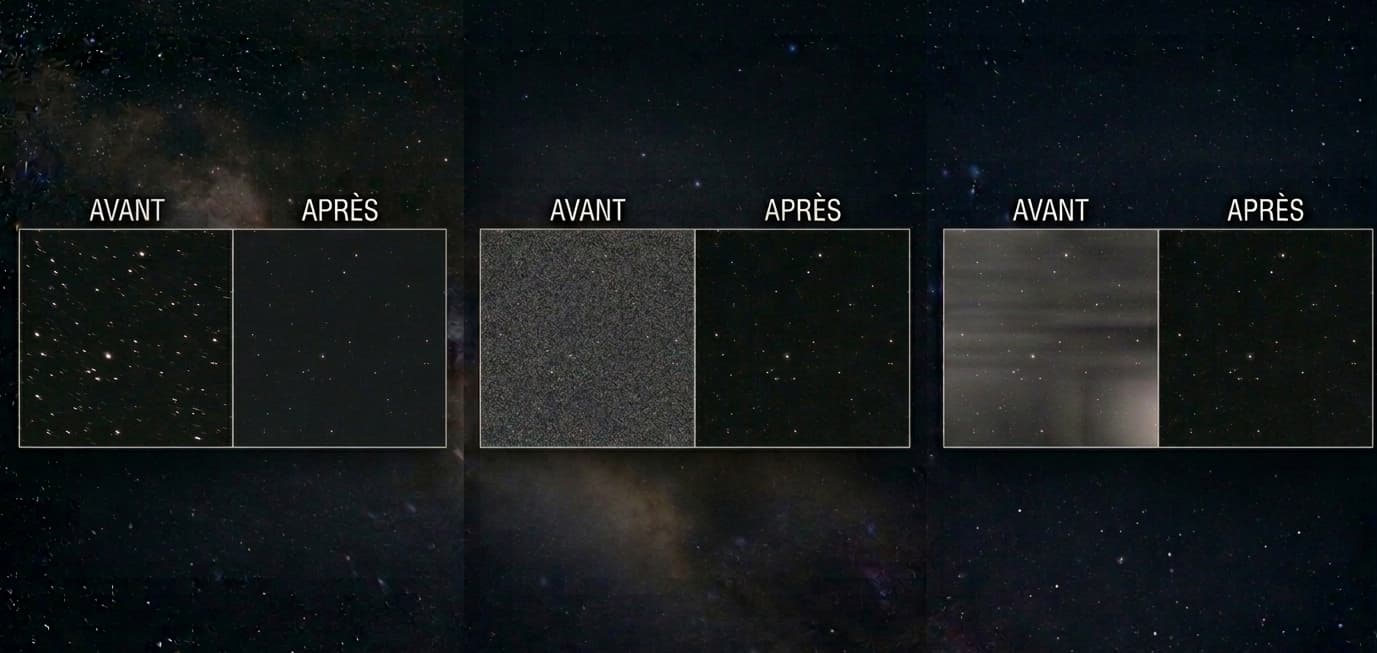
Layered on top is a light but real tracking drift: the 1.19 elongation at center exceeds the field floor of 1.11, and the consistency of position angles (9.5 degree dispersion) signals overall field motion during the exposure. At 0.879 arcsecond per pixel this is inevitably visible: a tracking error of a single arcsecond already spreads more than one pixel.
Finally, without being a listed defect, the exposure is short: the background-to-black-point margin of 4.82 and the 1.58 percent of clipped dark pixels show you are not yet sky-noise limited. Under Bortle 4, doubling or tripling the sub length is risk-free and will directly improve signal to noise on M27's faint outer halo.
Priority actions
- Fix the optical train tilt: switch to threaded M48/M54 couplings and adjust a tilt plate until the corner/center FWHM ratio drops below 1.3
- Improve tracking: redo polar alignment with drift align and guide via OAG targeting RMS below 0.5 arcsecond
- Lengthen sub exposure to 120-180 s to lift the background off the black point (target margin above 10) and remove dark clipping
- Run a new PSF analysis panel after correction to verify field uniformity before launching a real session