Astrophotography diagnosis of Ic 63: Flat frame mismatch
MasterRVB 2 Ultra - Antlia55×120s30 oct. 2026
The Doc examined this image of Ic 63 (master, RVB 2 Ultra - Antlia, 55×120s). Estimated overall technical quality: 7/10. 1 defect found: Flat frame mismatch (severity 3/5).

Info
- Cible
- Ic 63
- Date
- 30 oct. 2026, 22:16
- Lune
- Croissant croissant 29.2% (16.3° d'alt., 67.3° de la cible)
- Site
- Bortle 1 · ciel pristine (VIIRS)
- Position
- 0h58m43s · +61°04'20"
Very favourable conditions. Under a Bortle 1 sky with a crescent Moon at only 29%, 16° above the horizon and 67° from the target, parasitic sky contribution is minimal: the measured background confirms the absence of a light pollution gradient. This is exactly the kind of night IC 63 needs, a low surface brightness nebula drowned in the glare of Gamma Cassiopeiae. The illumination residual visible here is therefore not the sky's doing but the optical train's. With a sky like this, it is worth extending total integration substantially rather than reaching for filters.
Setup
- Type d'image
- Master
- Télescope
- C11+Hyper+Poseidon
- Caméra
- Poseidon-C PRO
- Filtre
- RVB 2 Ultra - Antlia
- Monture
- AZ EQ6
- Exposition
- 55×120s
- Phase de lune
- Gibbeuse décroissante (75 %)
- Seeing
- 2.5
- FOV
- 2.49°
Coherent setup. At 540 mm reduced focal length, the 2.49° field leaves IC 63 and IC 59 comfortably framed, with Gamma Cas placed without crowding the nebula. Sampling at 1.436"/px suits a stated 2.5" seeing, and the measured 3.4 px FWHM (about 4.9") shows neither optics nor tracking are the limit: a healthy regime, not oversampled. On settings, gain 125, offset 50 with no dark clipping and sensor at -20°C are sound. The background-to-black-point margin of 1.45 is low though: in broadband under Bortle 1, that signals 120 s subs are short, and 180-300 s would pay off.
The diagnosis in detail
The diagnosis is easy to rank: everything optical and mechanical is good, the only problem is calibration. The PSF panel gives FWHM between 3.25 and 3.53 px across the nine zones, a corner/centre ratio of 1.034, horizontal asymmetry 0.002 and vertical 0.041. In other words, corners are as sharp as the centre: no sensor tilt, no backfocus error on the Hyperstar reducer, no residual coma. Elongation peaks at 1.18 in the bottom-right against a field floor of 1.03, which stays within measurement noise, and the AZ-EQ6's tracking leaves no directional trail.
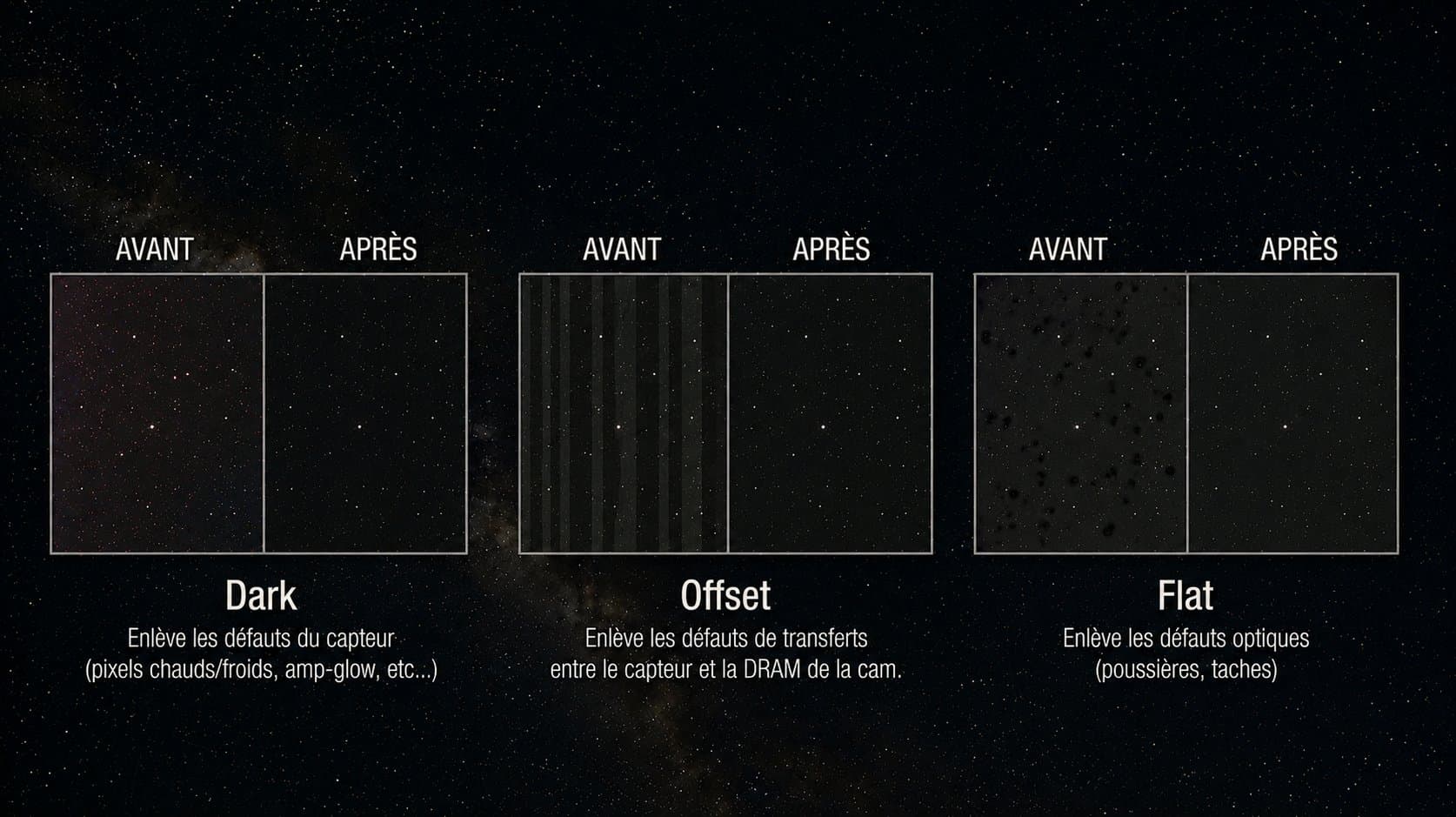
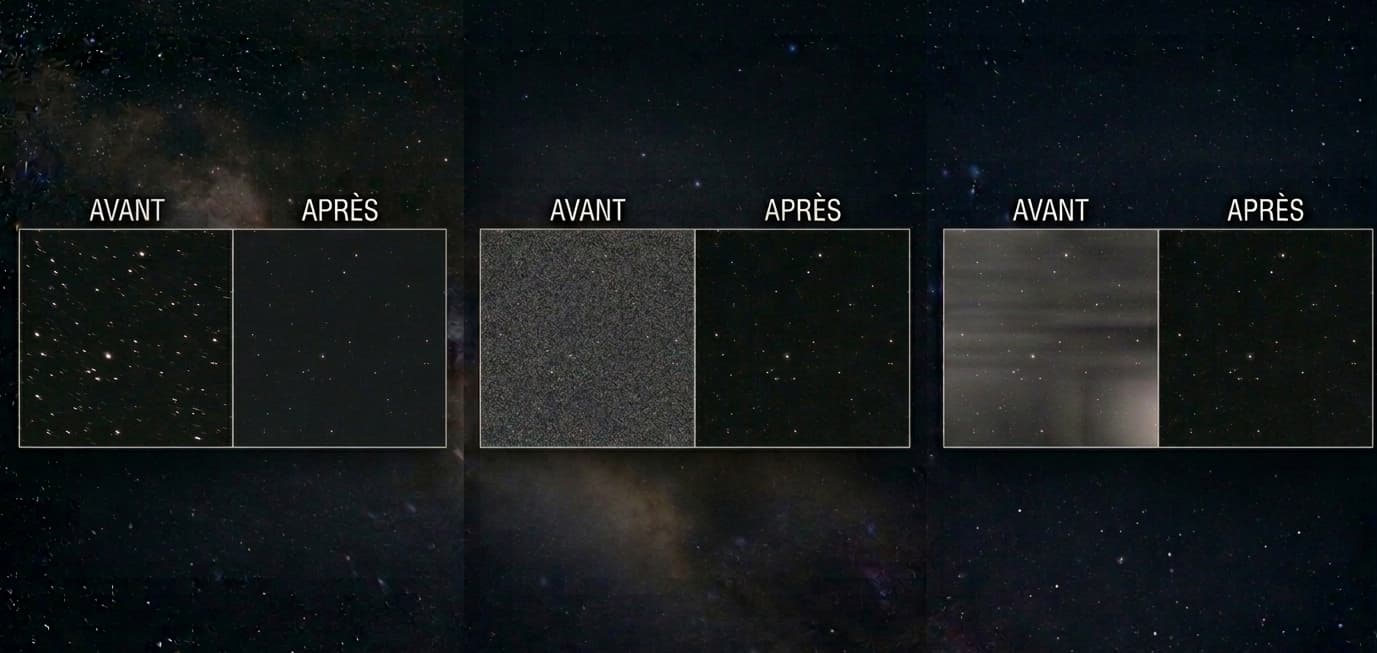
The illumination residual is therefore instrumental, not celestial. The measured profile contradicts classic vignetting: edges are 6% brighter than the centre, with a marked dipole along the lower-left to upper-right diagonal. That is the typical signature of a flat that does not match the geometry of the lights, through rotation of the optical train, a filter change, or stray light while shooting flats. On a C11 with corrector and filter holder, the slightest rotation is enough.
Second, less serious point: the background-to-black-point margin of 1.45 shows the sky background is not clearly lifted. Under Bortle 1 that is expected at 120 s, but it leaves the image dominated by read noise rather than sky photon noise. Lengthening the sub would gain more than any processing step.
Priority actions
- Reshoot a flat set in the exact optical configuration of the lights, without dismounting or rotating anything, and restack the master
- Check for light leaks at the rear of the tube and around the filter holder while shooting flats
- Lengthen subs to 180-300 s to escape the read-noise-limited regime under this Bortle 1 sky
- Pending new flats, apply a GraXpert or DBE degree 1-2 background extraction to neutralise the illumination residual
- Capitalise on the sky quality by increasing total integration, IC 63 deserving several nights