Astrophotography diagnosis of ic1805: Tracking drift and backfocus error
Raw300
The Doc examined this image of ic1805 (raw, 300). Estimated overall technical quality: 6/10. 2 defects found: Tracking drift (severity 3/5), Backfocus error (severity 2/5).

Info
- Cible
- ic1805
- Site
- Bortle 4 · transition rural/banlieue (saisi)
Favorable conditions for this target. Moon as a waxing crescent at 8 percent: negligible light contribution, no lunar gradient expected. Bortle 4 sky: reasonably dark background, comfortable for an emission nebula like IC 1805 even in broadband, and very permissive in Ha. The reported 2.8 arcsec seeing is average and explains part of the measured FWHM (about 5.8 px minor axis at center), but it does not explain the directional elongation, which is mechanical. The 300 s subs are consistent with this sky; the limiting factor here is not the sky, it is the mount.
Setup
- Type d'image
- Brut
- Exposition
- 300
- Phase de lune
- Premier croissant (8 %)
- Seeing
- 2,8
The histogram shows a background at 0.18 against a black point at 0.1, with an e_margin of 1.93 and a Bowley skew of 0.19: the background stays fairly close to the black point. In narrowband that is normal at 300 s and needs no correction. No dark clipping (0 percent), so offset is sufficient, and no global saturation (0 percent). Monochrome camera, framing a portion of the Heart region with the nebulosity and cluster on the left side: a plausible deliberate composition, nothing is awkwardly cut. The weak point of this setup is not optical but mechanical, on the tracking side.
The diagnosis in detail
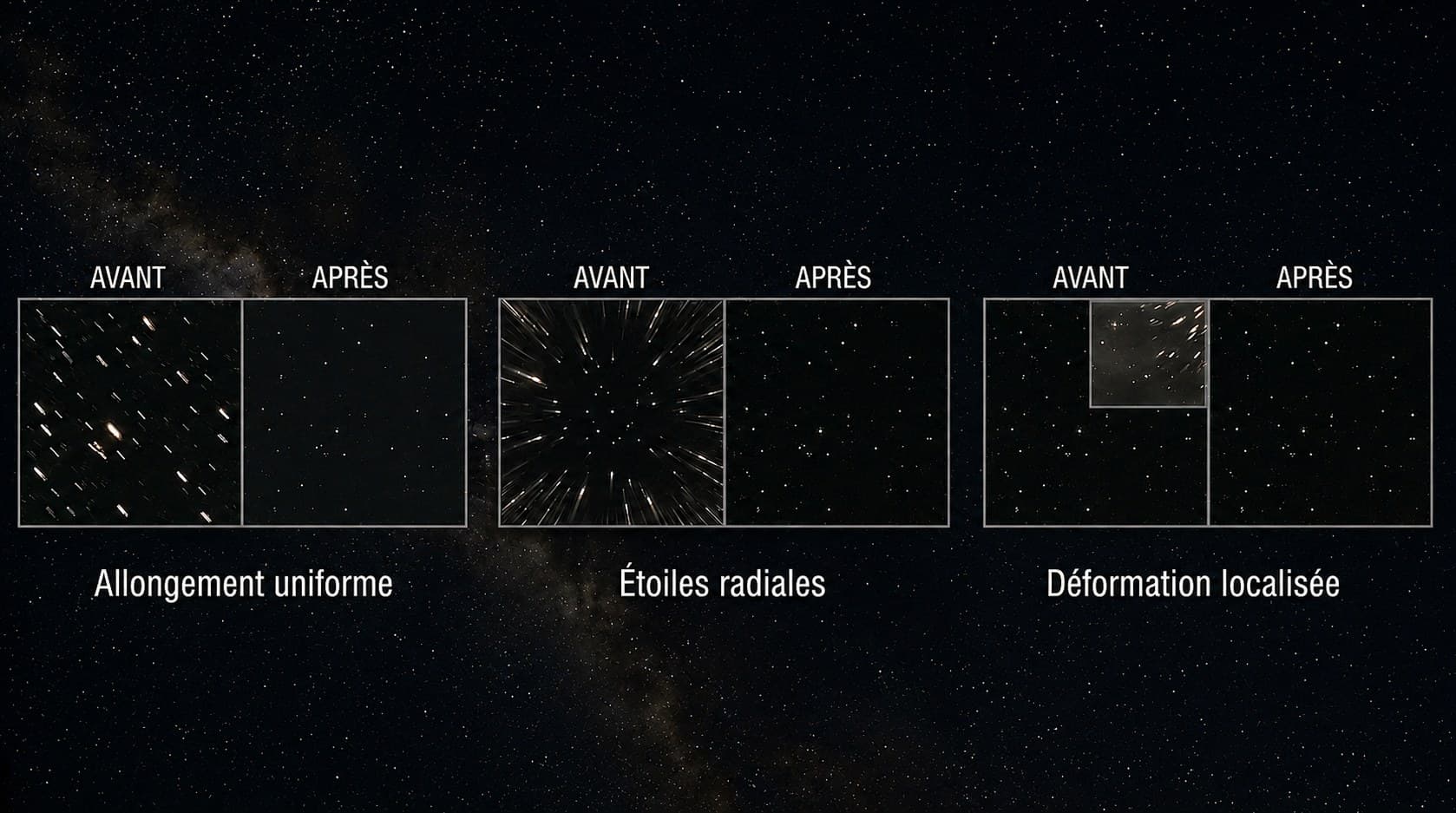
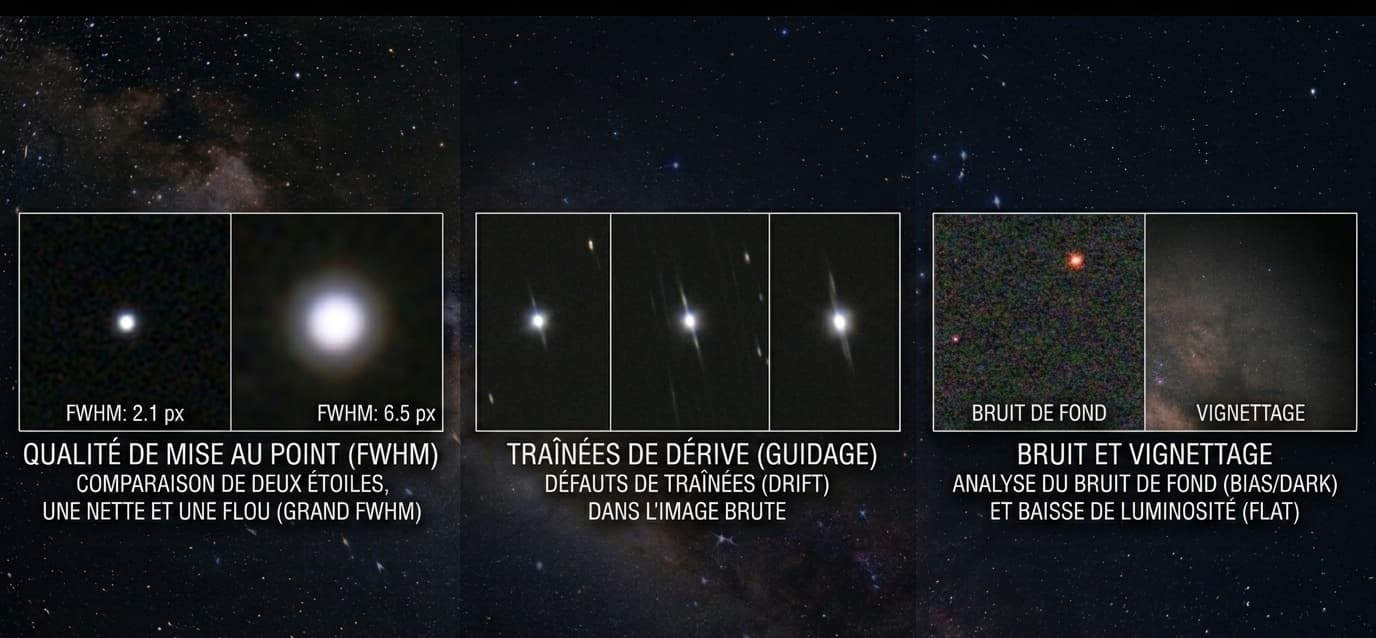
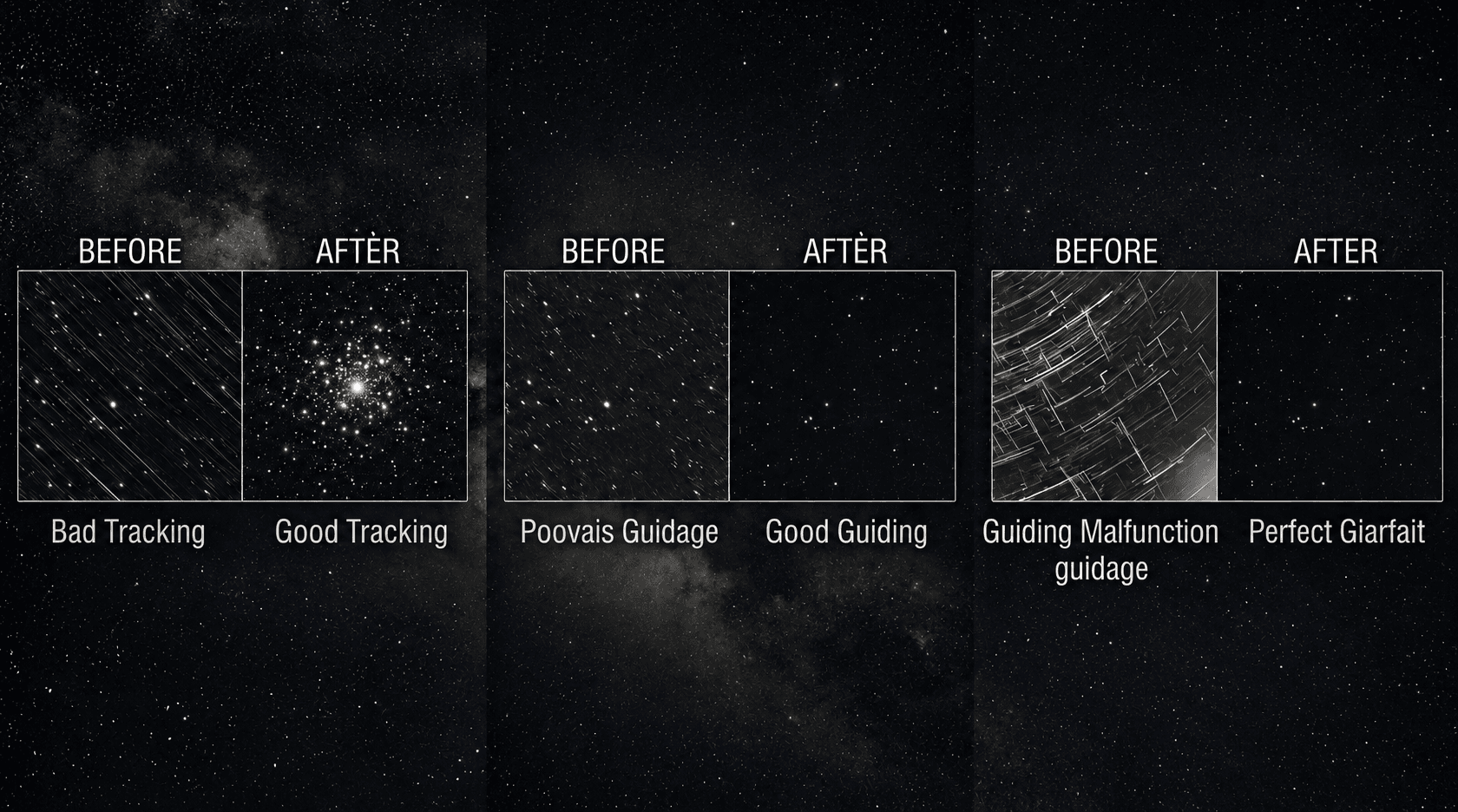
The diagnosis is dominated by a single problem, and it is mechanical. The aberration inspector measures an elongation of 1.64 at field center while the measured floor is 1.28, with position angles clustered between 65 and 86 degrees across eight of nine zones. A field optical aberration always leaves the center clean and degrades radially; here the center is already the most elongated part of the frame. So this is drift during the 300 s exposure, either unguided or poorly corrected by guiding.
Secondly, mean FWHM rises about 13 percent from center to corners, roughly symmetrically across the four angles, with ovoid stars rather than radial comets. That is consistent with a slight backfocus error or residual field curvature, but the signal is weak and contaminated by the drift: as long as stars move during the exposure, the field measurement stays unreliable. This point therefore warrants a check, not a teardown.
The sky background is healthy: the measured 16 percent variation matches the real nebulosity of the region, not vignetting or a gradient, and the non optical radial profile confirms it. Nothing to criticize on illumination or light pollution in this sub.
Priority actions
- Fix tracking first: refine polar alignment then retune autoguiding in PHD2
- Shoot a test series at 120-180 s to check whether central elongation disappears
- Once tracking is clean, re-measure center vs corner FWHM to confirm or rule out the backfocus error
- Keep 300 s subs only if guiding holds a stable RMS