Astrophotography diagnosis of IC410Tadpole: Astigmatism
RawHa300s22 nov. 2023
The Doc examined this image of IC410Tadpole (raw, Ha, 300s). Estimated overall technical quality: 7/10. 1 defect found: Astigmatism (severity 2/5).
&w=1920&q=75)
Info
- Cible
- IC410Tadpole
- Date
- 22 nov. 2023, 07:32
- Position
- 5h22m31s · +33°20'57"
Not enough information for an opinion from the Doc.
Setup
- Type d'image
- Brut
- Télescope
- Moana
- Caméra
- ASI Camera (1) (ASCOM)
- Filtre
- Ha
- Exposition
- 300s
- FOV
- 45.9'
The 0.77 deg field frames IC410 and its cluster NGC 1893 comfortably, with room for the surrounding Ha streamers, a good choice. The 3.5px center FWHM reflects correct sampling and seeing for this kind of wide target. Gain 90 and 300s in Ha are consistent: the background/black-point margin e_margin 1.69 looks low but that is NORMAL in narrowband, the Ha background is intrinsically dark at 300s, no underexposure to worry about. No dark clipping, offset sufficient. Sensor temperature of -20 deg C is healthy. The slight edge elongation suggests rechecking the corrector backfocus.
The diagnosis in detail
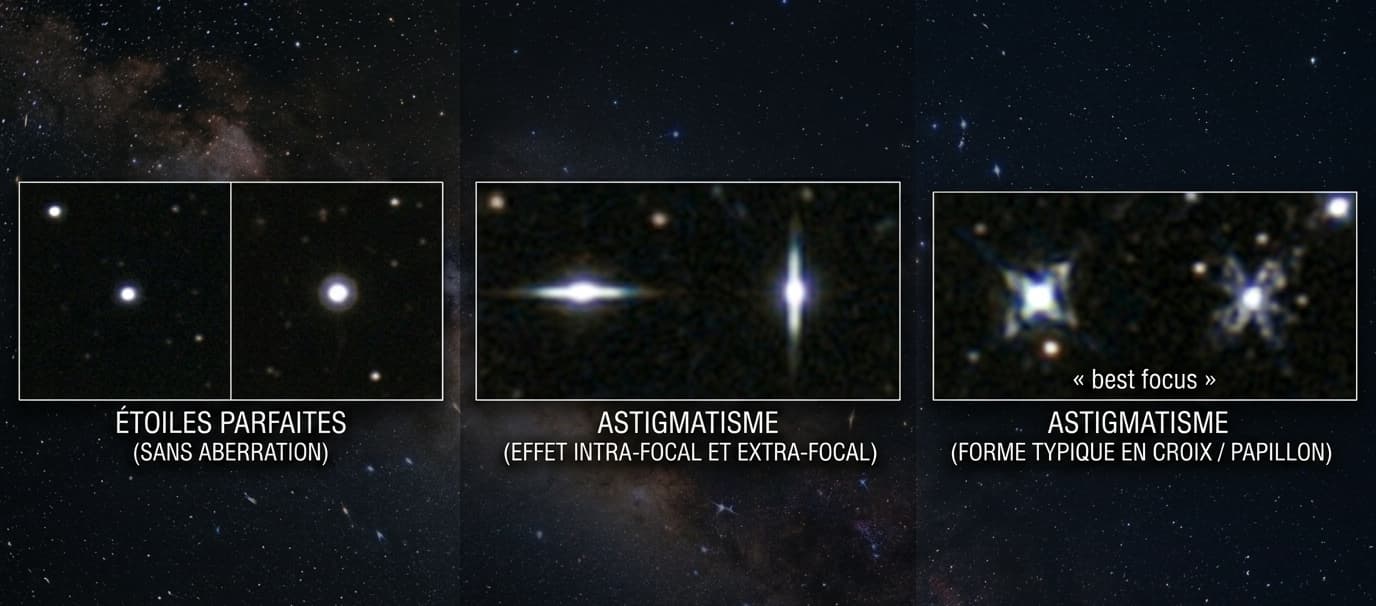
This 300s Ha sub is well made. The PSF panel is reassuring: round center at elong 1.09 (which is the field floor), tight FWHM around 3.5px, and an elongation rise that is purely peripheral (BR 1.31, R 1.22) without a parallel FWHM increase (corner/center ratio 1.14). This combination, thin stars stretched only far from the axis with consistent PA, indicates mild field astigmatism rather than a tracking fault (PA disperses little, 12.4 deg, and the center would be affected if it were the mount). It is minor and correctable by a backfocus adjustment or a slight crop.
On the background side, the measurement only shows a micro-gradient (5%, low R² 0.37) and near-radial symmetry without marked vignetting, nothing justifying a defect: what is seen is real Ha nebulosity, validated by the identical structure in the DSS. The only point feature is a short linear trace in the lower-center area, a satellite/aircraft signature, with no consequence on a properly stacked future master.
Acquisition settings are healthy (gain 90, -20 deg C, no clipping). The low background margin is expected in narrowband and does not indicate underexposure.
Priority actions
- Check the exact corrector backfocus and the centering of the optical train to reduce edge astigmatism
- Accumulate enough subs (>5) so sigma rejection removes the trail during stacking