Astrophotography diagnosis of ic5070: Light pollution gradient, clipped stars and 1 other
Processed
The Doc examined this image of ic5070 (processed). Estimated overall technical quality: 7/10. 3 defects found: Light pollution gradient (severity 3/5), Clipped stars (severity 2/5), Sensor tilt (severity 1/5).
&w=1920&q=75)
Info
- Cible
- ic5070
- Position
- 20h52m00s · +44°23'60"
The session was shot under a full moon (100%), which explains most of the measured background gradient. On an emission target like IC5070 imaged in monochrome Ha, this is a favorable case: the narrowband filter efficiently rejects the lunar background and allows working even in full moonlight, unlike broadband RGB which would be swamped. The residual gradient stays manageable in processing. To push fainter signal, moonless nights would still improve the contrast of the faintest clouds.
Setup
- Type d'image
- Traitée
- Phase de lune
- Pleine lune (100 %)
- FOV
- 1.00°
The 1.0°-wide field frames a tight portion of the Pelican Nebula: the framing is usable and nicely composed on the central pillars, but the object overflows widely, so it is a deliberate crop rather than full framing. The monochrome camera with an Ha filter is perfectly suited to this emission target under a full moon. Stars at FWHM ~3.5 px at center indicate correct focus and sampling. Without a focal length provided I cannot quantify the exact sampling, but the PSF panel is clean.
The diagnosis in detail
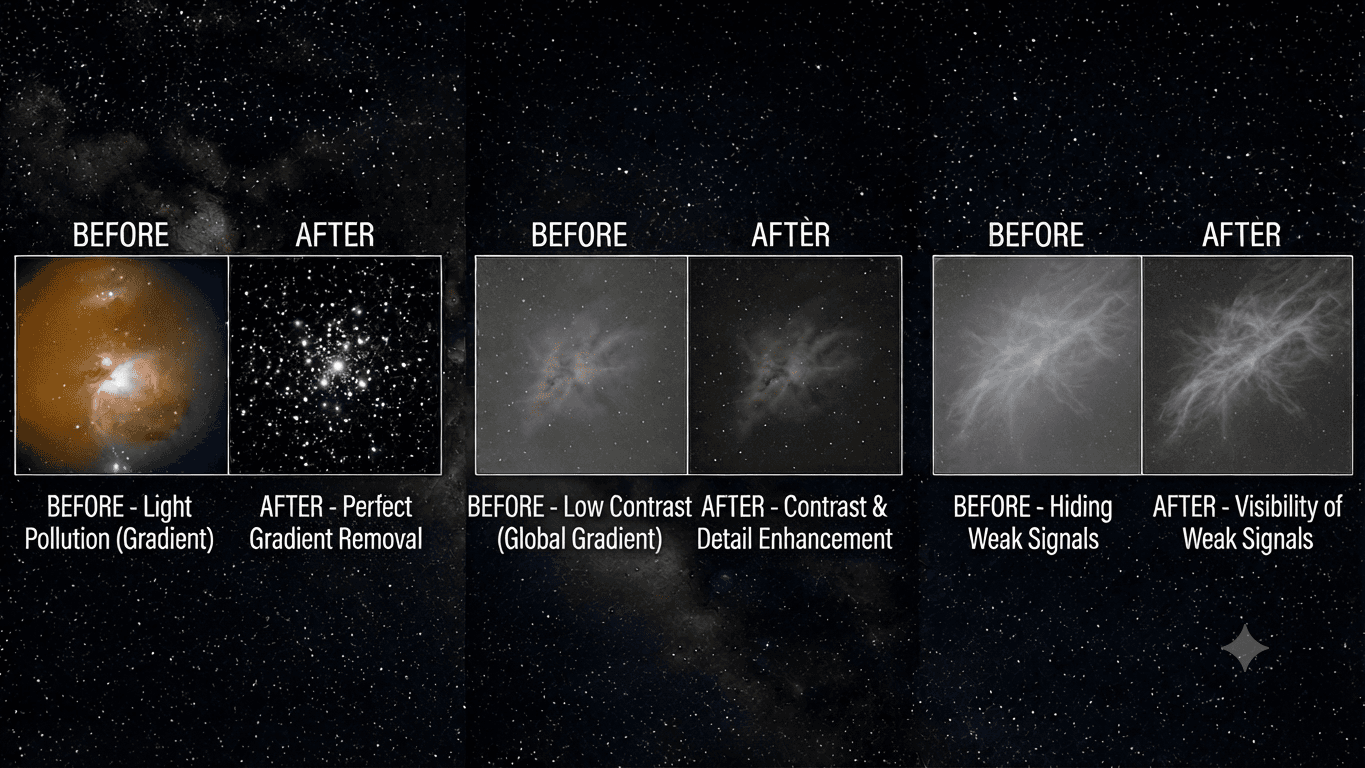
The acquisition is technically sound on the hardest axis, star shape: the PSF panel gives an elongation of 1.04 at center for a field floor of 1.02, and 1.04-1.06 everywhere else, all below the floor of a monochrome camera. The Moffat ellipses fit round disks well. The corner/center FWHM ratio of 1.19 and horizontal asymmetry of 0.06 stay under firm thresholds; the automatic tilt pre-verdict corresponds to a very slight peripheral degradation that I classify as a watch point, not a confirmed defect. Tracking and collimation are therefore good. The real subject is the sky background: a tilted plane of 96% amplitude oriented 209° dominates the radial term by a factor 2.8, the signature of a large-scale gradient. The full moon is the most likely cause. It must be distinguished from nebulosity: the DSS confirms the filamentary structures are real, so the gradient removal must sample off the clouds to avoid flattening them. Finally, a few bright stars show a clipped core, a minor stretch defect easily fixed with a star mask.
Priority actions
- Remove the background gradient (GraXpert or DBE/ABE) with samples placed off the nebulosity, using the DSS to preserve the Ha clouds
- Restretch the bright stars with a mask or via star separation to recover the clipped cores
- Monitor the slight peripheral FWHM imbalance over the next sessions before any tilt adjustment