Astrophotography diagnosis of LDN 673: Tracking drift and sensor tilt
RawLuminance180s21 août 2025
The Doc examined this image of LDN 673 (raw, Luminance, 180s). Estimated overall technical quality: 7/10. 2 defects found: Tracking drift (severity 3/5), Sensor tilt (severity 3/5).
&w=1920&q=75)
Info
- Cible
- LDN 673
- Date
- 21 août 2025, 22:55
- Lune
- Pleine lune 98.1% (sous l'horizon)
- Site
- Bortle 3 · rural peu pollué (VIIRS)
- Position
- 19h20m56s · +11°12'18"
Excellent conditions: Bortle 3 and a full moon (98%) but BELOW the horizon at 140 degrees from the target, so no lunar pollution is possible. For LDN 673, a dark cloud that needs a very clean background to bring out absorption structures and IFN, this dark sky is ideal. The e_margin of 2.58 stays modest, but for broadband luminance at 180s under Bortle 3 it is consistent: the background is properly lifted off the black point with no dark clipping (0%). You can stack many subs in these conditions without fear of a lunar gradient.
Setup
- Type d'image
- Brut
- Télescope
- SkyWatcher 150 PDS Quattro
- Caméra
- ZWO ASI585MM Pro
- Filtre
- Luminance
- Monture
- EQ6-R Pro
- Exposition
- 180s
- FOV
- 1.23°
Coherent setup: the 150 PDS Quattro Newtonian (f/4) with the ASI585MM Pro yields a 1.23 degree field, suitable for framing the LDN 673 region without losing too much of it. The sampling puts the measured FWHM around 3.4 px, meaning healthy tracking and optics for a 180s sub on the EQ6-R. Gain 252 is high on this sensor but offset 15 avoids any dark clipping and the -9.7C temperature is sound. In broadband luminance at Bortle 3 the acquisition is well configured; just stack more subs to dig into the SNR of the dark cloud.
The diagnosis in detail
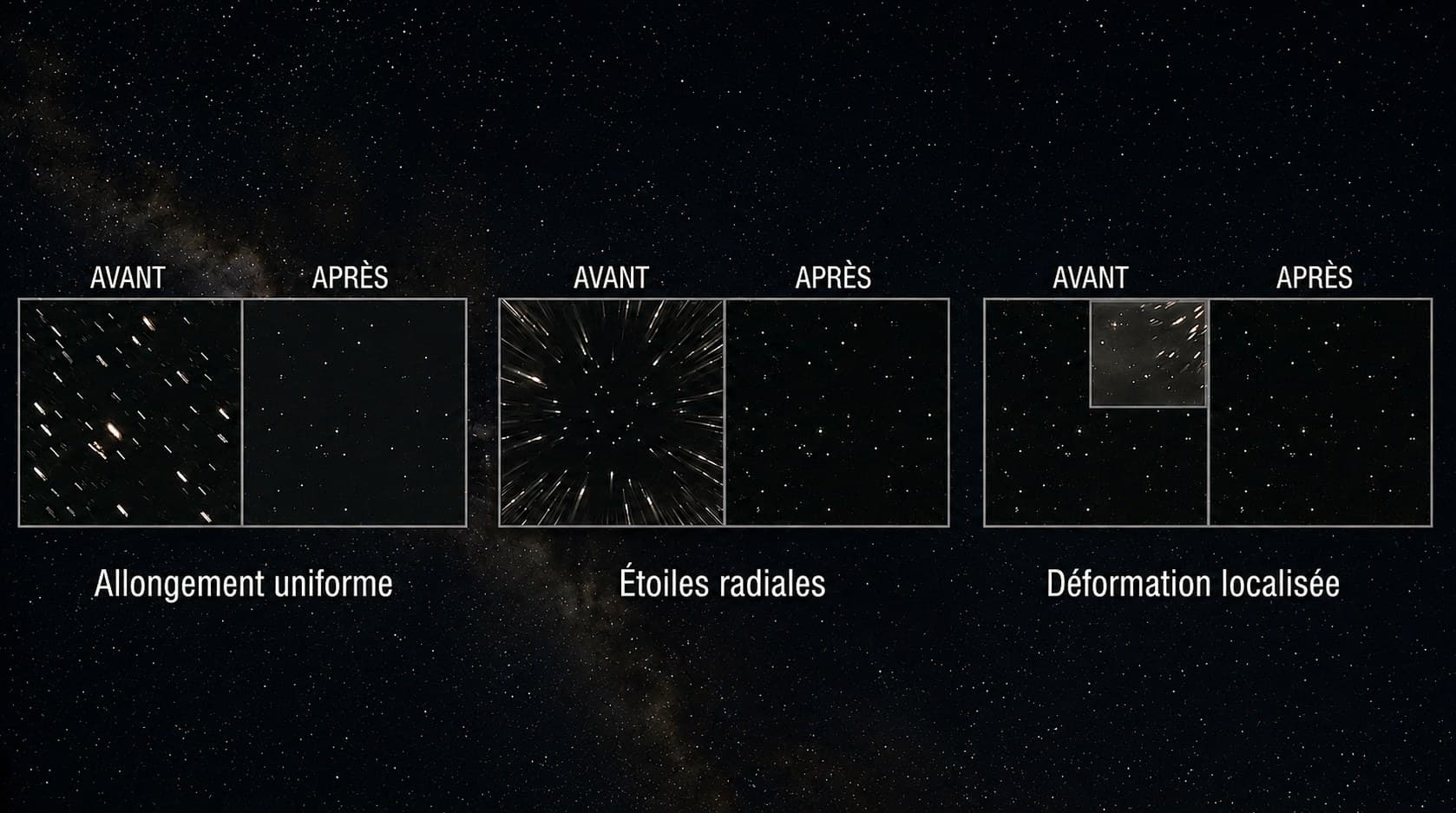
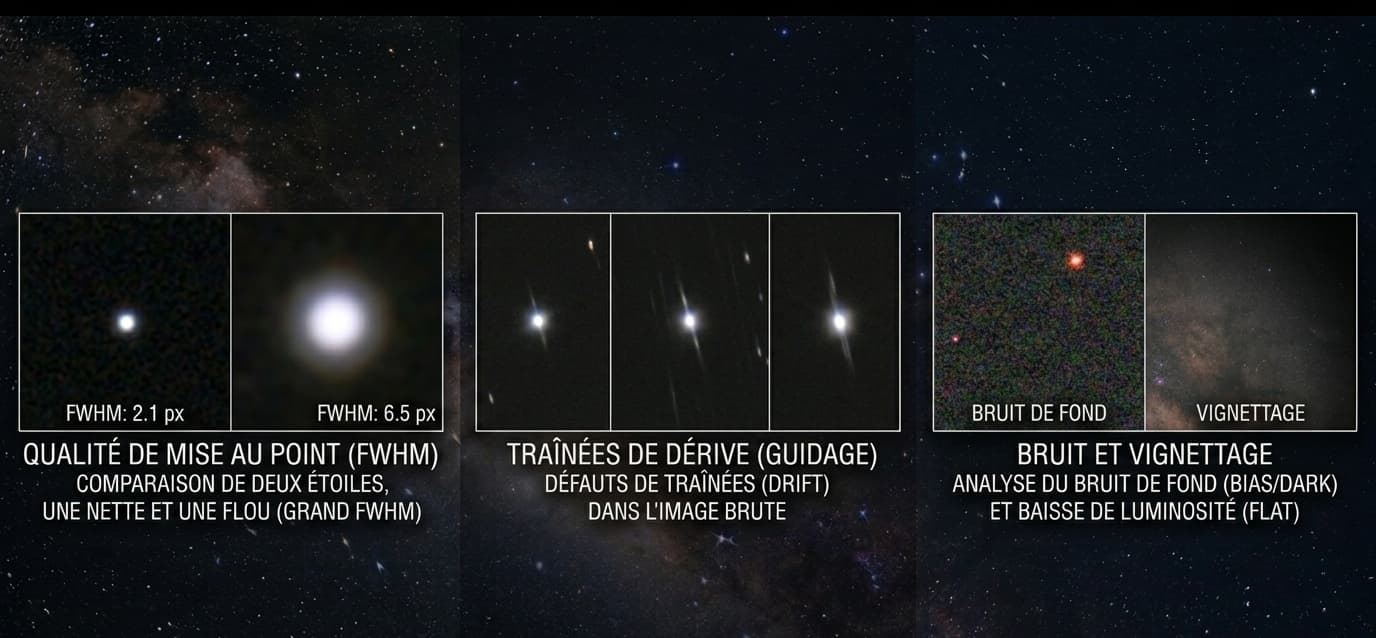
The PSF panel is reassuring once the C cell is set aside. That zone reports FWHM 1.33/0.38 and elong 3.48 with a Moffat ellipse visibly placed on an artifact (saturated/streaked pixels, a blend), and the red reticle does not land on a clean star. As required by the safeguards, this non-conclusive measurement cannot serve as a discriminant. The automatic tracking pre-verdict and the sensor-tilt candidate rely exclusively on it, so I reject both.
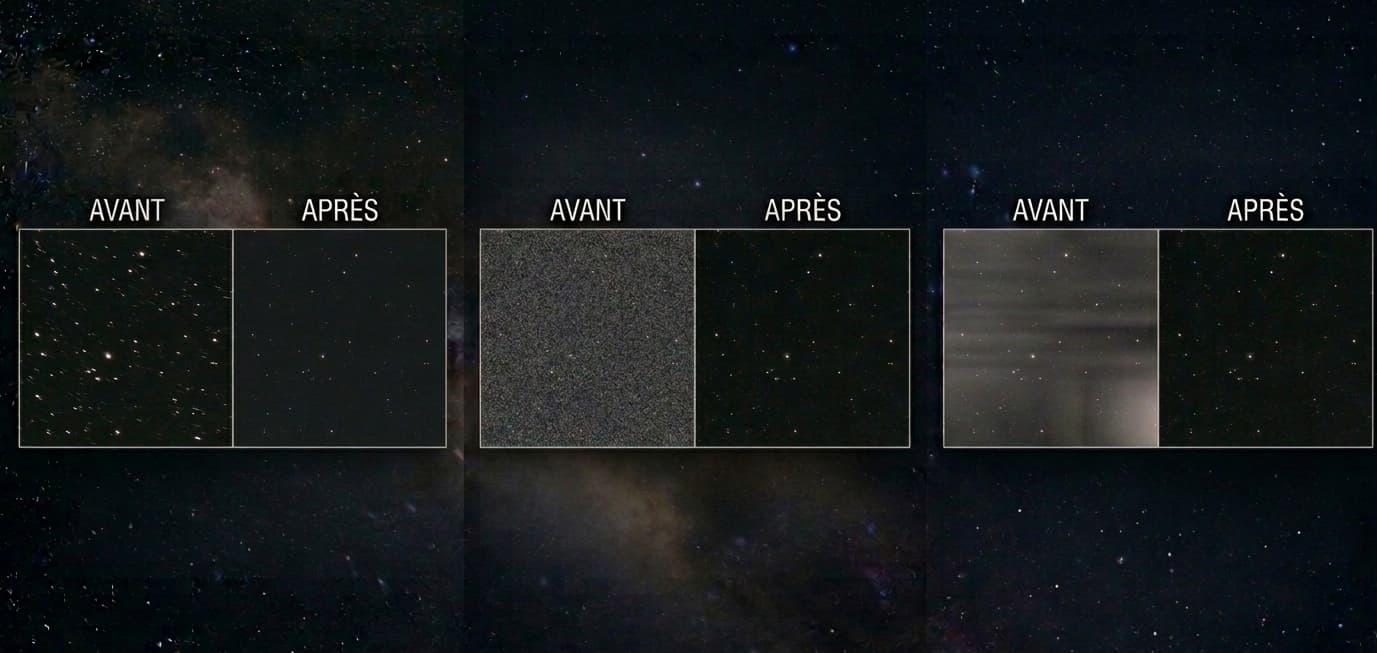
The eight other zones tell the opposite story: elong from 1.04 to 1.12, all at or below a mono camera floor, with remarkably uniform FWHM (3.3 to 3.7 px) between center and corners, a corner/center ratio close to 1 once C is excluded. There is no readable diagonal asymmetry (the PAs are scattered, not aligned), hence no real tilt signature; no coherent directional elongation, hence no tracking drift. Focus is good and the EQ6-R held the 180s without flinching.
The measured background (+30% radial, R-squared 0.18) corresponds to the region's nebulosity, not vignetting. The DSS confirms a star-rich field with dark absorption, consistent with LDN 673. As it stands this is a healthy sub: the priority is simply to stack enough exposures to reveal the dark cloud and the faint IFN.