Astrophotography diagnosis of M 16: Tracking drift
RawH300s18 juin 2026
The Doc examined this image of M 16 (raw, H, 300s). Estimated overall technical quality: 6/10. 1 defect found: Tracking drift (severity 3/5).
&w=1920&q=75)
Info
- Cible
- M 16
- Date
- 18 juin 2026, 22:14
- Lune
- Gibbeuse décroissante 80.5% (0.6° d'alt., 134.1° de la cible)
- Site
- Bortle 5 · banlieue résidentielle (saisi)
- Position
- 18h18m38s · -13°51'52"
Decent conditions for Ha on an emission target. Bortle 5 is irrelevant in narrowband: the Ha filter rejects light pollution, as confirmed by the clean background of the sub. The gibbous Moon (80.5%) is neutralized by two factors: it is only 0.6 deg above the horizon (so practically invisible to the field) and 134 deg from the target, far away angularly. In Ha its influence is negligible anyway. No lunar gradient is expected or seen: you can image M16 in these conditions with no notable penalty.
Setup
- Type d'image
- Brut
- Télescope
- SkyWatcher 150 PDS Quattro
- Caméra
- ZWO ASI585MM Pro
- Filtre
- H
- Monture
- TeSeek HM17
- Exposition
- 300s
- Phase de lune
- Premier croissant (15 %)
- FOV
- 1.23°
Coherent, well-sized setup for M16. The Quattro 150 at f/4 (520mm) with the ASI585MM yields 1.15"/px sampling, ideal for typical seeing and well suited to resolving the pillars. The 1.23 deg field frames the nebula comfortably and well centered (consistent with the DSS comparison). Gain 200 and offset 15 are healthy, with no dark clipping; -10C is fine. The background/black-point margin e_margin of 1.42 is low in absolute terms but NORMAL for Ha at 300s: the narrow filter passes little background, this is not underexposure. The only weak link is mount tracking, to be made reliable to fully exploit this fast optical train.
The diagnosis in detail
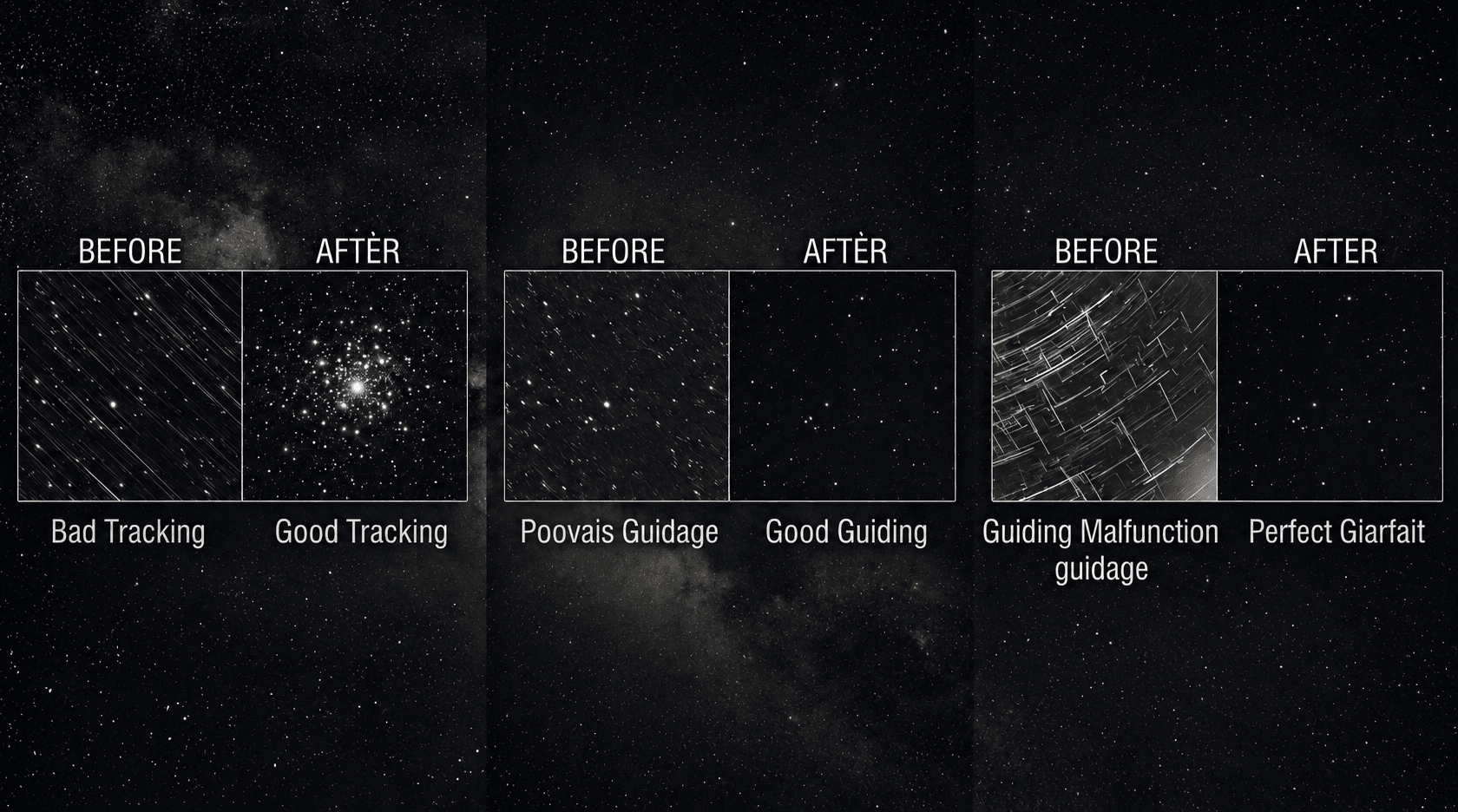
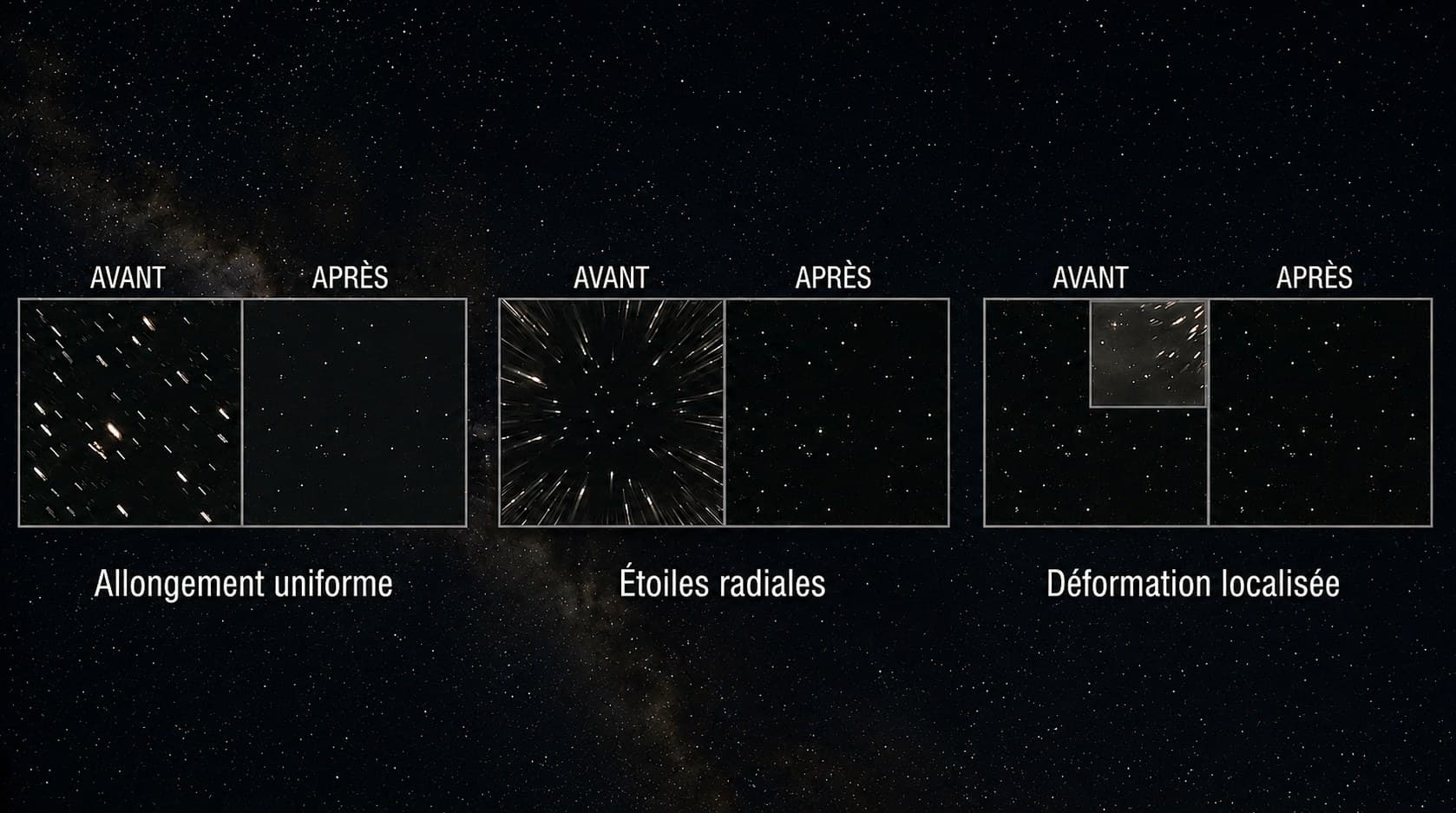
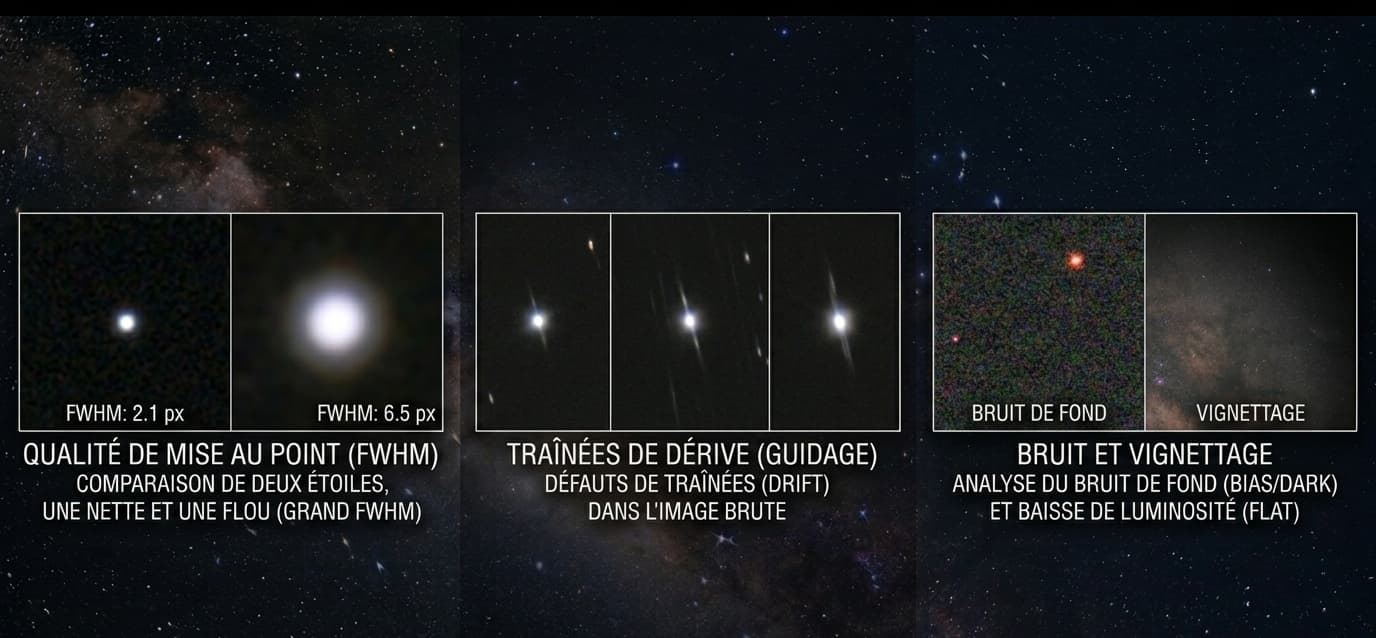
This Ha sub of M16 is technically sound with one exception. The PSF panel is clear: star shape does not depend on field position (corner/center FWHM 1.058, near-zero vertical asymmetry), which rules out tilt, backfocus, coma and astigmatism. Yet the elongation exists FROM the center (elong 1.43 vs a field floor of 1.32 and a mono floor of about 1.12) and points everywhere in the same direction (PA dispersion of only 3.7 deg). This signature, a global directional elongation independent of radius, is the mark of a tracking drift during the 300s exposure, not an optical issue.
The streak stays regular and barely curved, pointing to a slow drift (polar alignment or lack of guiding) rather than a guiding oscillation or periodic error. At f/4 and 1.15"/px the system is demanding: any drift shows up immediately. So this is the priority item.
Otherwise, nothing to report: the optics are well collimated and at correct backfocus, the sky background is clean and gradient-free (the measured +47% variation corresponds to the nebula, confirmed by the DSS), framing is good and exposure suited to narrowband. Once tracking is mastered, this setup will deliver excellent subs.
Priority actions
- Set up autoguiding (PHD2) to stabilize the 300s exposures
- Refine polar alignment before the session
- Failing guiding, shorten exposures (90-120s) and increase the number of subs