Astrophotography diagnosis of Ngc 5750: Tracking drift
Raw300
The Doc examined this image of Ngc 5750 (raw, 300). Estimated overall technical quality: 6/10. 1 defect found: Tracking drift (severity 2/5).
&w=1920&q=75)
Info
- Cible
- Ngc 5750
Waxing gibbous Moon at 94%, near full: heavily lit sky that night. The measured background stays contained (median 0.16, background/black-point margin e_margin=2.8) and the background variation matches the field structure, not a clear lunar gradient, likely thanks to a well-placed target and a field poor in nebulosity. Still, on a broadband luminance galaxy like NGC 5750, a 94% Moon penalizes SNR and the contrast of faint extensions. If possible, save this kind of RGB/L target for a moonless night and keep heavily moonlit nights for emission targets with a narrowband filter.
Setup
- Type d'image
- Brut
- Exposition
- 300
- Phase de lune
- Gibbeuse croissante (94 %)
Not enough information for an opinion from the Doc.
The diagnosis in detail
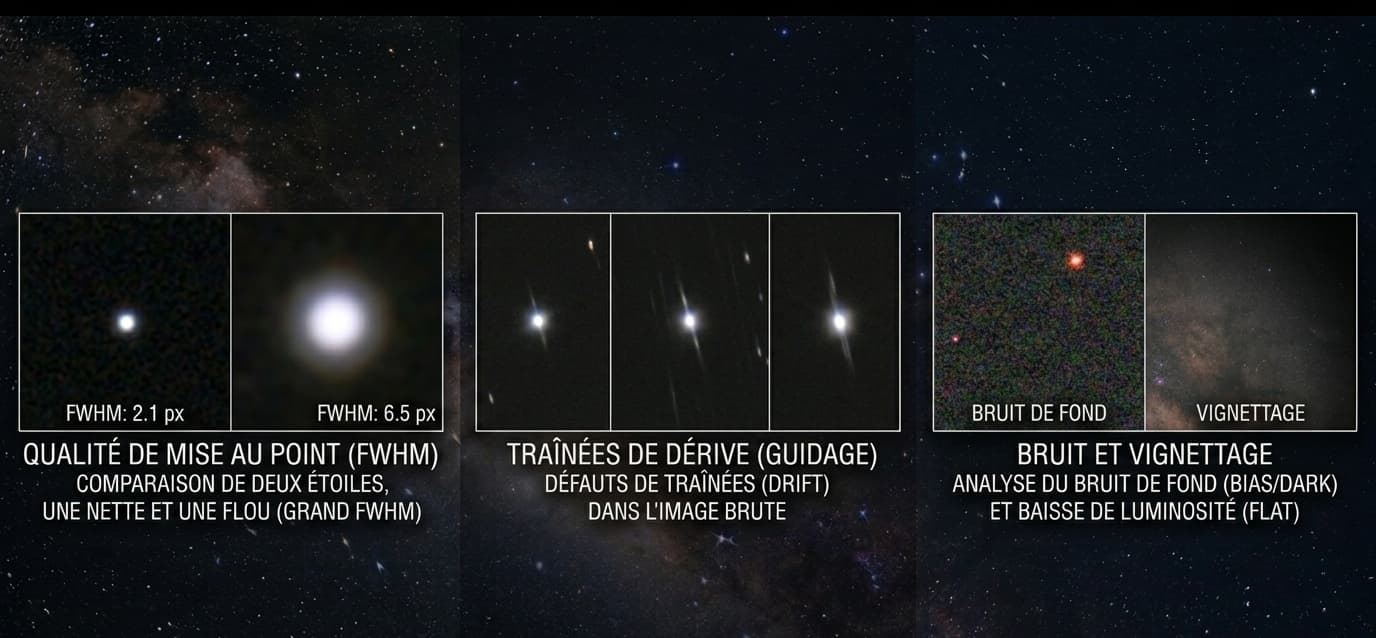
The PSF panel is reassuring on optics: FWHM varies little from center to corners (corner/center ratio 1.137, asymmetries H 0.032 / V 0.08), with no diagonal tilt signature, no symmetric radial backfocus spread, and no coma comet-tails. The cyan ellipses fit the stars well, so the measurement is reliable. The key discriminant is center C: it is itself elongated (elong 1.15 above the field floor 1.09), so the cause is not field optics but motion during the exposure.
The PA is very consistent across the nine zones (dispersion 6.4°) and the elongation is straight, pointing to tracking drift rather than periodic error (which would show curvature) or guiding oscillation (zigzag streaks). On a single 300s sub this reflects imperfect polar alignment or slightly weak guiding on one axis. The amplitude stays moderate (FWHM ~4 px), the image stacks perfectly well, but tighter stars are within reach by improving the mount.
On exposure, the background margin e_margin=2.8 with a slightly negative Bowley skew shows a background a bit short of the sky-limited regime, consistent with a very moonlit night; not a defect at this stage, just context to keep in mind for the final integration.
Priority actions
- Improve tracking: refine polar alignment and optimize autoguiding before continuing acquisition
- If guiding stays marginal, shorten sub length to 180-240s to limit drift
- Check mount balance on both axes