Astrophotography diagnosis of NGC784: Sensor tilt
MasterLuminance62×420s12 oct. 2026
The Doc examined this image of NGC784 (master, Luminance, 62×420s). Estimated overall technical quality: 8/10. 1 defect found: Sensor tilt (severity 2/5).

Info
- Cible
- NGC784
- Date
- 12 oct. 2026, 23:03
- Lune
- Gibbeuse décroissante 94.6% (sous l'horizon)
- Site
- Bortle 1 · ciel pristine (VIIRS)
- Position
- 2h01m17s · +28°50'08"
Near ideal conditions. Bortle 1 and the Moon below the horizon at 167° from target: no light pollution or lunar source can contaminate the background, which the background map confirms (plane amplitude just 3%, radial profile flat at +1%). That is exactly what a faint dwarf galaxy like NGC 784 needs in broadband luminance, where any urban gradient would drown the disk extensions. With 62x420s, over 7 hours under that sky, the SNR budget is comfortable: you can chase the outer halo and the faint field companions without worrying about the background. Nothing to fix on the conditions side.
Setup
- Type d'image
- Master
- Télescope
- Vinzoographe
- Caméra
- Moravian USB Camera 1 (64 bit)
- Filtre
- Luminance
- Exposition
- 62×420s
- Phase de lune
- Premier croissant (3 %)
- FOV
- 59.6'
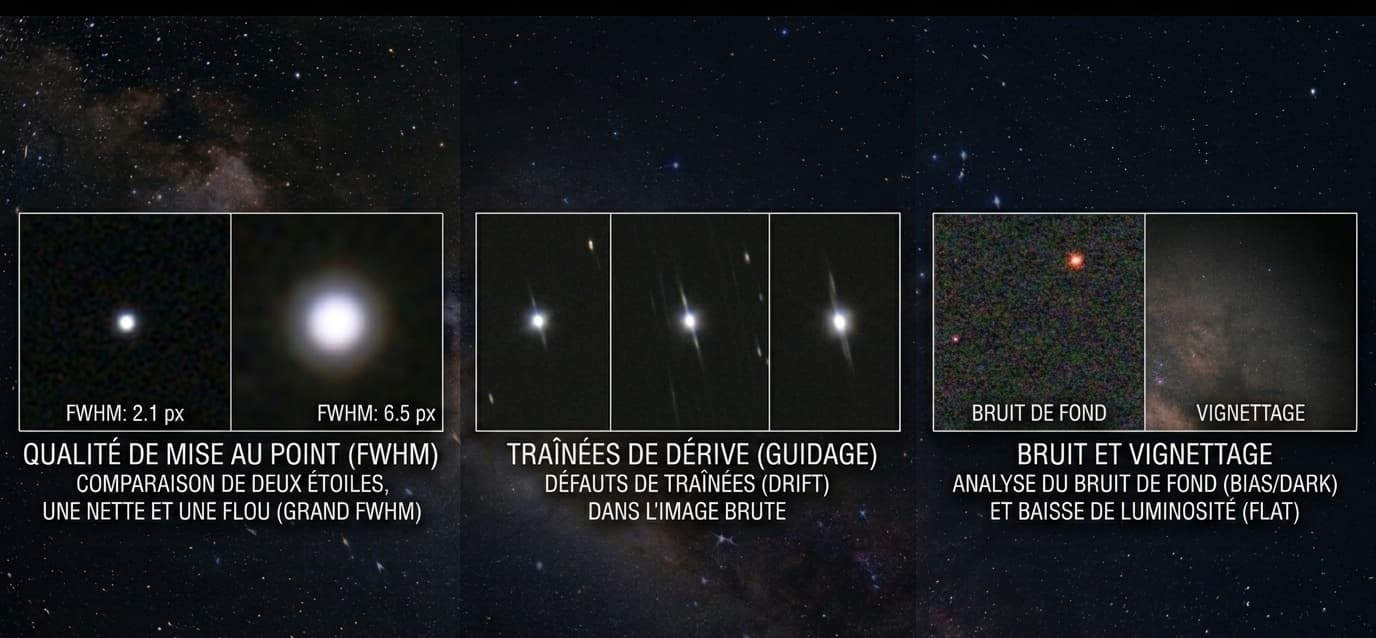
Setup is well matched to the target. At 876mm f/4.5 with 7.4um pixels, the 1.74"/px sampling suits the site seeing: the 2.14 px central FWHM stays above the Nyquist criterion, so you are neither oversampled nor losing detail. The 0.99° field leaves NGC 784 (about 7') fairly small at center, generous on margins but fine for a galaxy you want isolated with its companions. 420s luminance subs with background e_margin 5.35: you are sky-limited, read noise is swamped, no need to go longer. Cooling at -28°C is perfect for dark current.
The diagnosis in detail
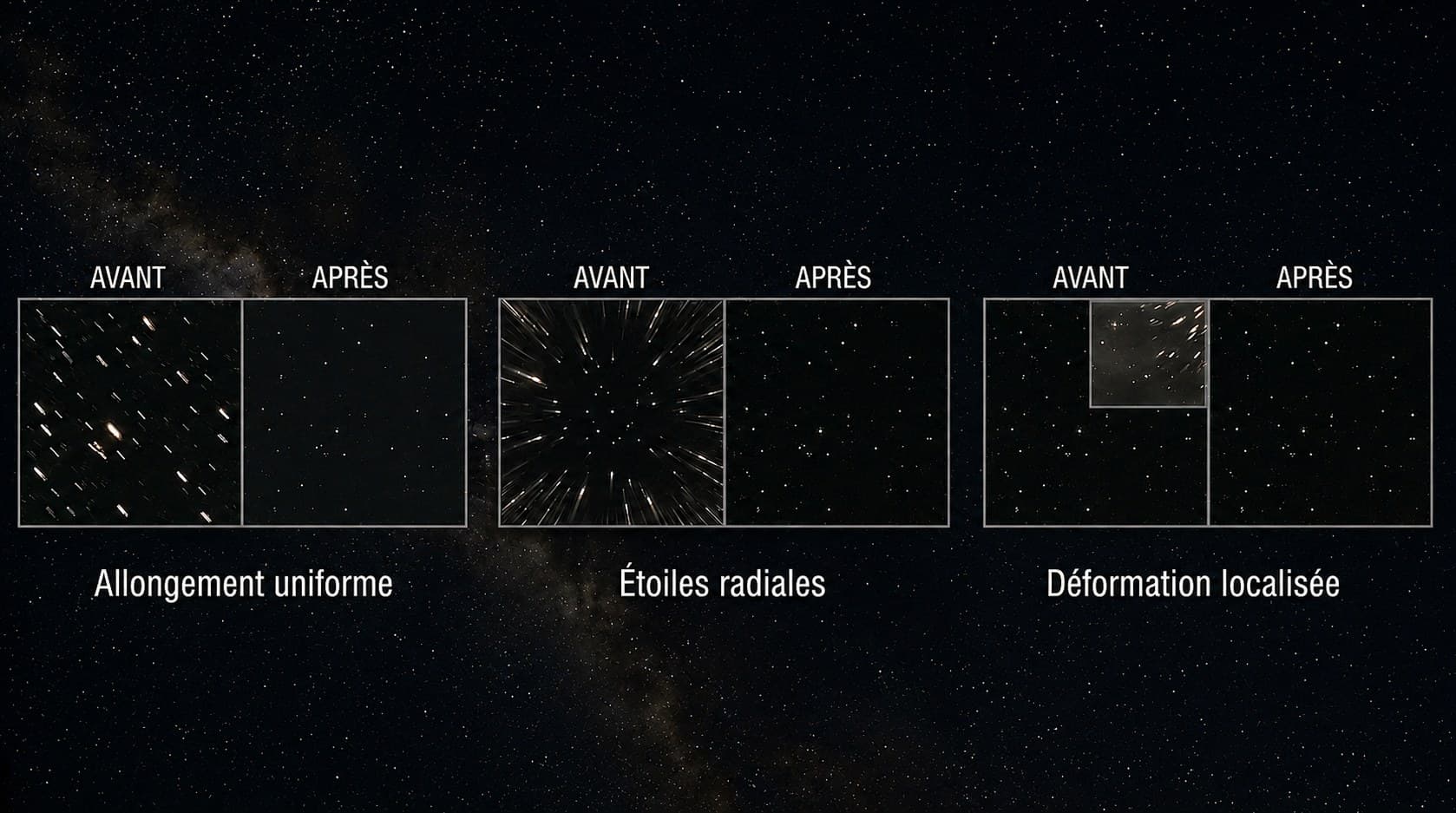
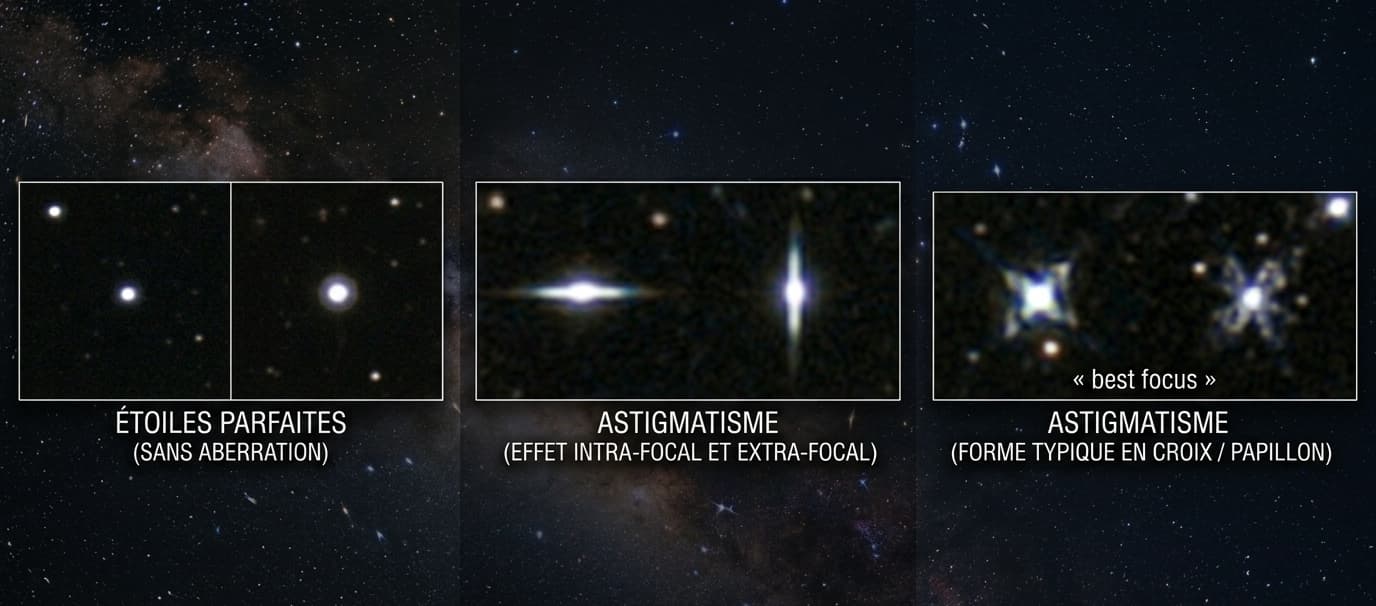
The verdict is simple: this integration is very well made, and the only complaint is mechanical. The Moffat measurements show a flawless center (FWHM 2.14/1.97 px, elong 1.09 equal to the field floor) and a degradation that appears only in two corners, TR and BL, with elongations of 1.37 and 1.32. The other two corners stay under 1.15. That diagonal asymmetry, visually confirmed on the PSF plate where the cyan ellipses in TR and BL are clearly ovalized while BR and B remain circular, is the signature of tilt rather than field curvature or a backfocus error, which would affect all four corners equally.
The amplitude stays modest: a corner/center ratio of 1.263 over a 1° field is far from gross tilt, and the image remains perfectly usable, especially on a centered target like NGC 784. This is a one-time comfort adjustment, not a reshoot.
Everything else holds up. The background is flat (plane/radial dominance of 10.41 for an amplitude of only 3%, so nothing instrumental to correct), tracking leaves no trace at the edges, and the DSS comparison validates the galaxy structure as well as the small companion in the left quarter: no artifact to mistake for signal.
Priority actions
- Correct the tilt on the TR/BL diagonal with an adjustable adapter, quarter-turn steps, revalidating with the aberration inspector
- First verify the exact corrector backfocus, so you do not compensate a spacing error with tilt
- Keep the current acquisition settings: 420s, -28°C and the Bortle 1 site already give an optimal sky-limited background