Astrophotography diagnosis of M 31_Lum: Sensor tilt and clipped stars
Raw300s16 sept. 2026
The Doc examined this image of M 31_Lum (raw, 300s). Estimated overall technical quality: 7/10. 2 defects found: Sensor tilt (severity 2/5), Clipped stars (severity 2/5).
&w=1920&q=75)
Info
- Cible
- M 31_Lum
- Date
- 16 sept. 2026, 20:42
- Lune
- Gibbeuse décroissante 68.9% (sous l'horizon)
- Site
- Bortle 2 · rural typique (VIIRS)
- Position
- 0h47m46s · +41°00'16"
Near ideal conditions for this target. The Bortle 2 sky gives a very dark background, which explains the measured background to black point margin of 1.97: on luminance under a sky this dark you stay close to the read-noise-limited regime rather than sky-limited, but 300 s at gain 160 remains a good compromise. The Moon, waning gibbous at 68.9 percent, is below the horizon and 139.7 degrees from the target: no lunar contribution is possible, and indeed no lunar gradient is measured. The measured plane gradient (29 percent amplitude, 155 degree orientation) is consistent with the real nebulosity of M31 and the galactic background visible in the DSS. Make the most of nights like this to pile up integration on the faint disk extensions.
Setup
- Type d'image
- Brut
- Télescope
- EQMod Mount
- Caméra
- ZWO ASI585MM Pro
- Exposition
- 300s
- Phase de lune
- Premier croissant (27 %)
- FOV
- 3.36°
A coherent setup, but clearly undersampled for M31. At 190 mm focal length and 2.9 micron pixels you sit at 3.148 arcsec/px: the measured 1.76 px FWHM at center corresponds to roughly 5.5 arcsec, so pixels are the limit, not seeing or optics. The arms and dust lanes stay readable but you lose fine detail. In exchange, the 3.36 degree field frames M31 perfectly with M110 and M32, and the composition leaves room for the disk extensions: the right choice for a wide view. On settings, gain 160, offset 15 and cooling at -20C are healthy, with no measured dark clipping (0 percent). If you want detail in the core, a longer focal length in a second session is the way.
The diagnosis in detail
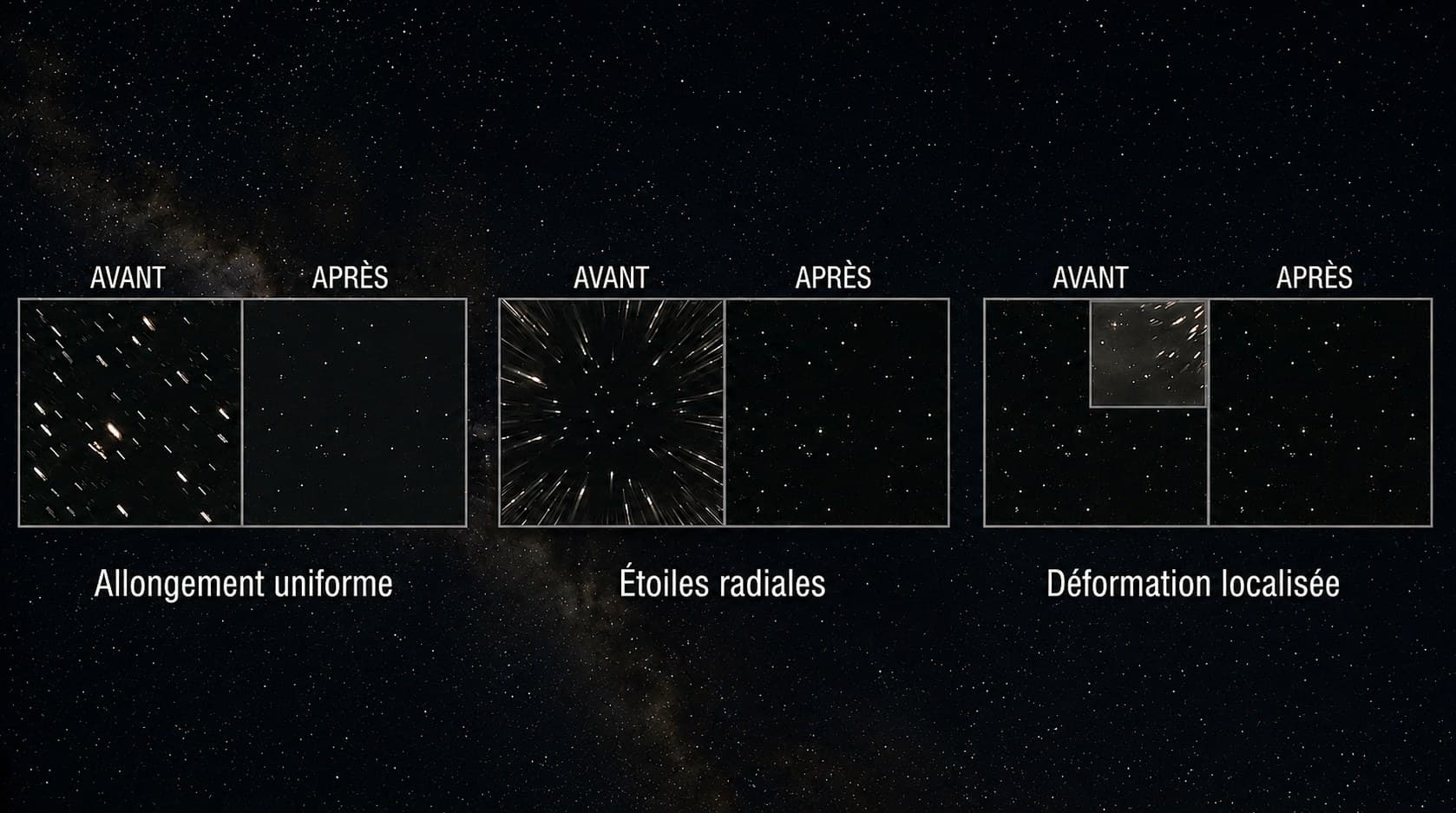
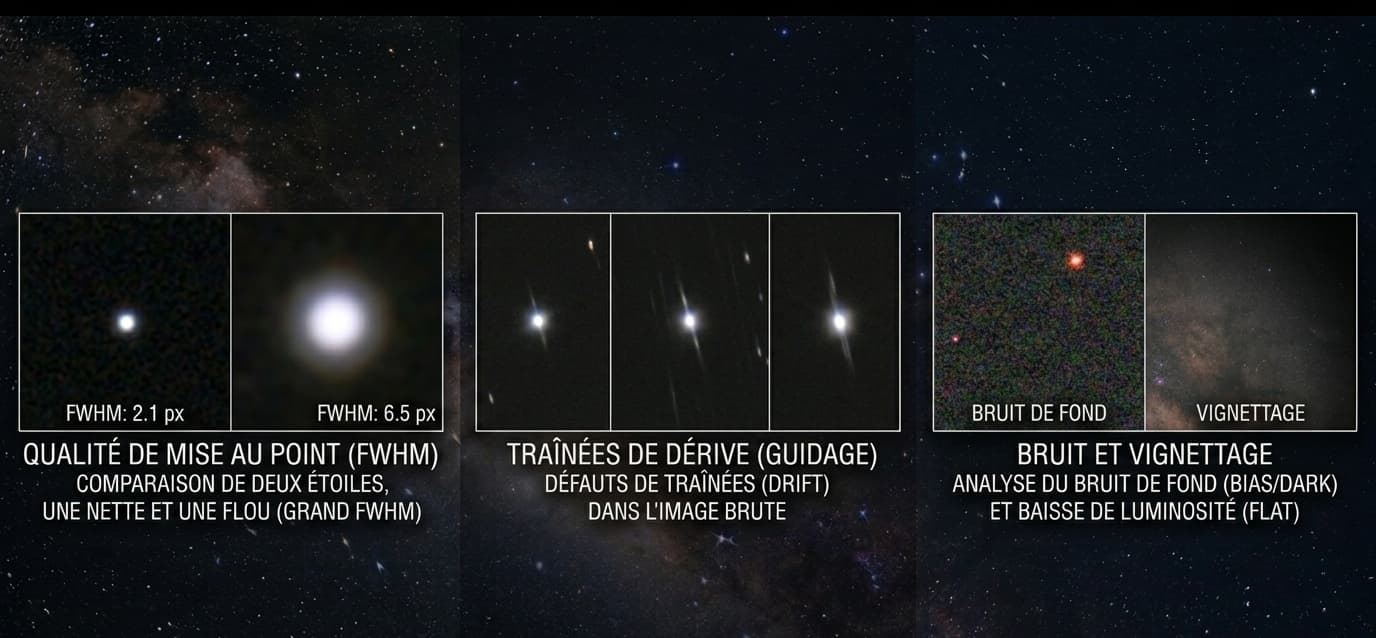
The overall picture is very favorable: the PSF measured at center (FWHM 1.76/1.66 px, elong 1.06 against a field floor of 1.03) shows round stars, and tracking holds perfectly over 300 s with no trace of drift, periodic error or guiding oscillation. On a single five minute sub, that is a solid base.
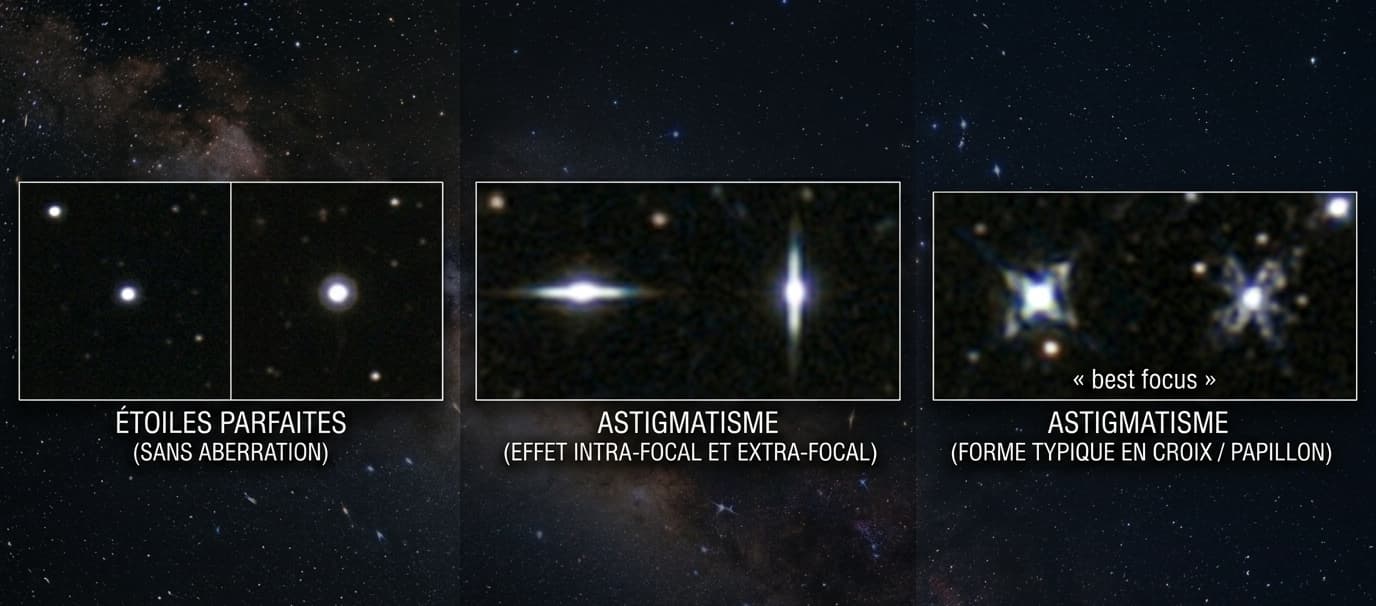
The only measured instrumental defect is mild tilt. Degradation is not symmetric across the four corners: the right side (TR at 2.32 px elong 1.12, R at 2.33 px) suffers more than the top left (2.09 px elong 1.05), with horizontal asymmetry of 0.047 against 0.018 vertically. The 1.287 corner/center ratio stays moderate, and at 3.15 arcsec/px this degradation is largely buried in the sampling: a mechanical point to watch, not an obstacle to the session.
The rest is normal acquisition traffic: a satellite trail in the left quarter, which sigma rejection will remove from about ten frames onward, and clipping of the M31 nucleus along with a few bright stars, the expected consequence of a 300 s exposure on such a high contrast target. Comparison with the DSS confirms the disk nebulosity and bulge are genuine signal, with no background artifact to correct.
Priority actions
- Check the tightness and play of the imaging train to reduce the tilt measured on the right side
- Stack with sigma rejection (Winsorized or Linear Fit Clipping) to remove the satellite trail
- Add a set of 30 to 60 s short exposures to recover the M31 core and saturated stars in HDR
- Accumulate more integration under this Bortle 2 sky to bring out the faint disk extensions