Astrophotography diagnosis of M 33: Sensor tilt and background chroma noise
ProcessedIRUV29×180s31 oct. 2026
The Doc examined this image of M 33 (processed, IRUV, 29×180s). Estimated overall technical quality: 8/10. 2 defects found: Sensor tilt (severity 2/5), Background chroma noise (severity 2/5).

Info
- Cible
- M 33
- Date
- 31 oct. 2026, 23:29
- Lune
- Croissant croissant 40.8% (15.9° d'alt., 84° de la cible)
- Site
- Bortle 4 · transition rural/banlieue (saisi)
- Position
- 1h33m52s · +30°39'41"
Decent conditions for a galaxy. Bortle 4 is the right ground for broadband work on M33, a low surface brightness target: the background stays manageable and gradients are nearly absent, which the image confirms. The Moon at 40.8% illumination, 15.9 degrees above the horizon and crucially 84 degrees from the target, is far enough away not to impose a lunar gradient, and none is measured. The reported seeing of 3 is consistent with the measured FWHM. That said, 1h27 of integration is short for an RGB galaxy: that is what limits background signal to noise more than the conditions themselves. A moonless night would let you push the stretch further on the faint outer extensions.
Setup
- Type d'image
- Traitée
- Télescope
- EQMod Mount
- Caméra
- ZWO ASI2600MC Pro
- Filtre
- IRUV
- Monture
- EQ6 pro
- Exposition
- 29×180s
- Phase de lune
- Gibbeuse décroissante (65 %)
- Seeing
- 3
- FOV
- 48.7'
Coherent but demanding setup. At 1482mm of focal length on the ASI2600MC, the 0.81 degree field frames M33 only just: the galaxy fills nearly the whole sensor and the outer extensions are cropped. A wider framing (reducer or shorter focal length) would give breathing room and make background extraction easier. Sampling at 0.52 arcsec/px is clearly oversampled for seeing of 3, and the 6 px FWHM confirms it: you could bin 2x without losing real detail and gain signal to noise. Gain 120 and offset 50 are healthy, with no dark clipping or saturation. Sensor at -10C, perfect. The 180s sub is short for getting clear of read noise under Bortle 4 on a faint target: 300s would be more efficient if guiding allows.
The diagnosis in detail
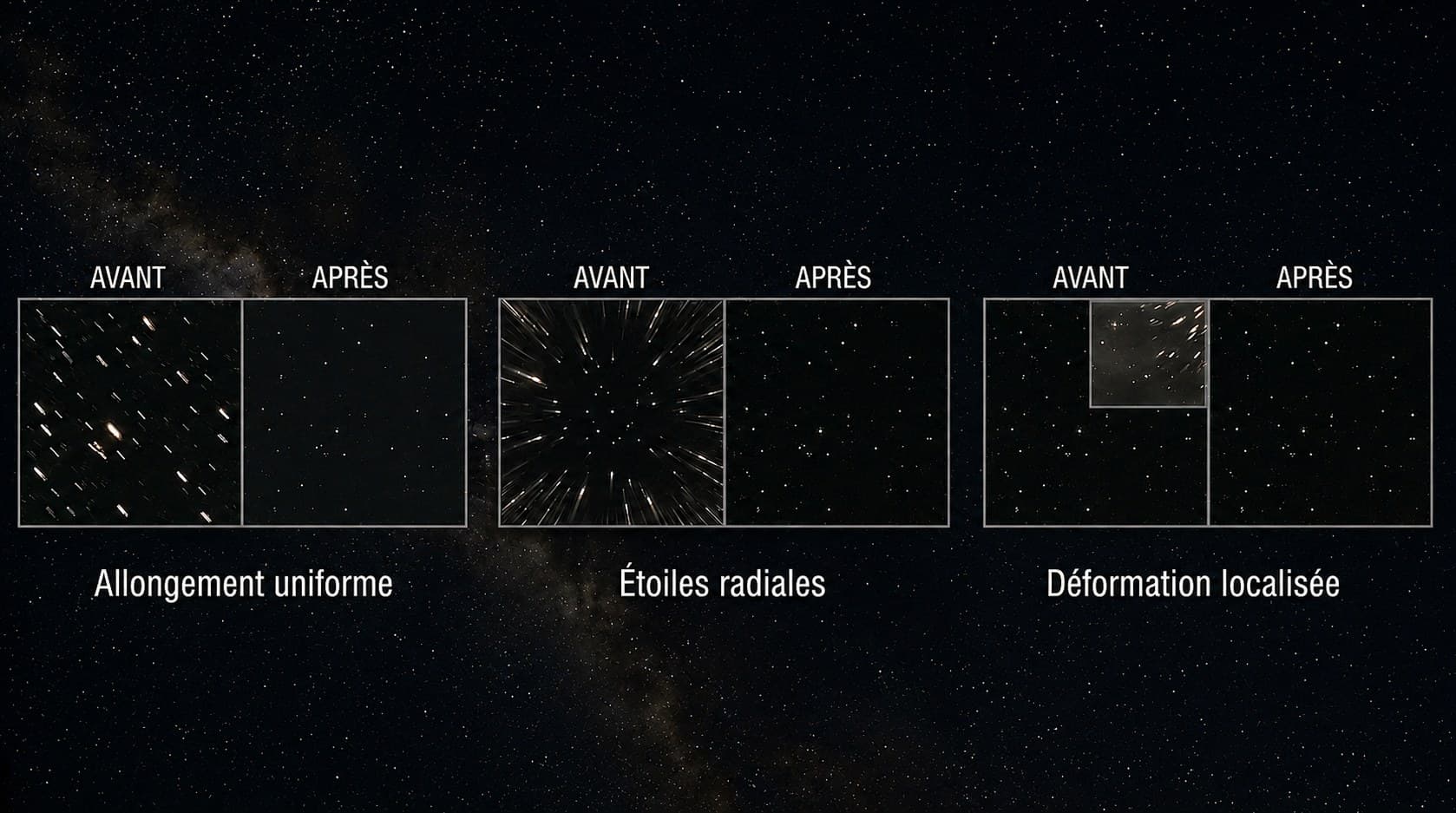
The image is well executed and the measurements confirm it. The PSF is remarkably homogeneous: 1.05 elongation at center against a field floor of 1.01, with 34 degrees of PA dispersion, meaning round stars and no tracking, guiding or field rotation signature. On a 180s sub at 1482mm, that is a good mark for the mount.
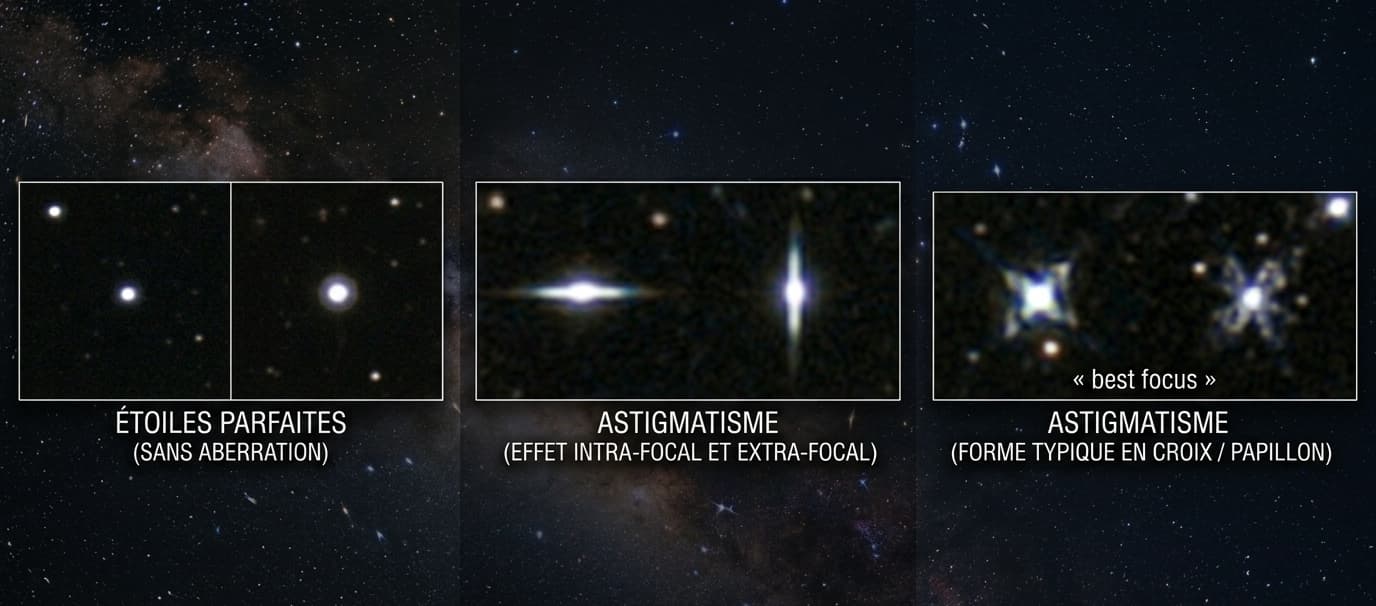
The only measurable deviation is an FWHM asymmetry along the horizontal axis: 0.109 versus 0.019 vertical, with the left side at 5.8 px and the right side at 6.7-6.8 px. Since the center stays tight and the degradation is not radially symmetric, the signature is that of mild tilt, not backfocus or coma. The amplitude stays low (corner/center ratio 1.114) and does not hurt readability, but it is the lever to pull for extra sharpness.
The second point is the sky background: at only 1h27 of integration, chroma noise remains perceptible in the dark areas, which caps the stretch headroom on M33's faint extensions and outer HII regions. That is an exposure time limit, not a processing one: the post-processing was in fact handled without excess, with no plastic smoothing and no dark halos around stars.
Priority actions
- Extend integration to 4-6 hours on M33 to drive down background chroma noise and open up stretch headroom
- Correct the residual tilt: even retorquing of the optical train, then a 90 degree camera rotation test to locate the source
- Bin 2x or consider a reducer: at 0.52 arcsec/px for a 6 px FWHM you are heavily oversampled and losing signal to noise
- Lengthen subs toward 300s if guiding allows, to better dominate read noise on this faint target
- Dither systematically between subs to decorrelate pattern and chroma noise