Astrophotography diagnosis of M42: Oversaturation, astigmatism and 2 others
Processed60s · ISO 20031 oct. 2026
The Doc examined this image of M42 (processed, 60s · ISO 200). Estimated overall technical quality: 7/10. 4 defects found: Oversaturation (severity 3/5), Astigmatism (severity 2/5), Sensor tilt (severity 2/5), Background chroma noise (severity 2/5).

Info
- Cible
- M42
- Date
- 31 oct. 2026, 23:54
- Site
- Bortle 5 · banlieue résidentielle (VIIRS)
- Position
- 5h35m32s · -5°18'56"
Average but workable conditions. Bortle 5 and a 64% waning gibbous moon push the sky background up noticeably: on M42, an extremely bright target, this is the most forgiving case, the nebula overwhelms the background and the impact stays confined to the faint extensions. The measured background-to-black-point margin (2.22, far from the 5-10 sky-limited regime) confirms the background is not swamped by light pollution. The outer wisps and the Running Man do suffer from the lunar background though. To improve, aim for a moonless window or early night while the moon is still low, and extend the integration: the gain on faint areas will be immediate.
Setup
- Type d'image
- Traitée
- Télescope
- 260mm
- Caméra
- Zwo Seestar S50 Pro
- Exposition
- 60s · ISO 200
- Phase de lune
- Waning gibbous (64 %)
- Notes
- EQ Mode
- FOV
- 1.27°
Setup well matched to the target. At 1.27 deg of field, M42 and the Running Man sit comfortably within the portrait frame with room to spare: framing is good. The 60s subs in EQ mode are plenty given M42's brightness, and tracking holds up (centre elongation 1.08, very close to the 1.03 field floor), EQ mode is clearly doing its job. The real shortfall is dynamic range: 60s subs saturate the Trapezium well before the end of the exposure, hence the clipped core. Always add a 5 to 10s set on M42, it is the target that most demands HDR treatment. The rest of the setup offers no accessible optical adjustment, which limits what can be done about the edge PSF.
The diagnosis in detail
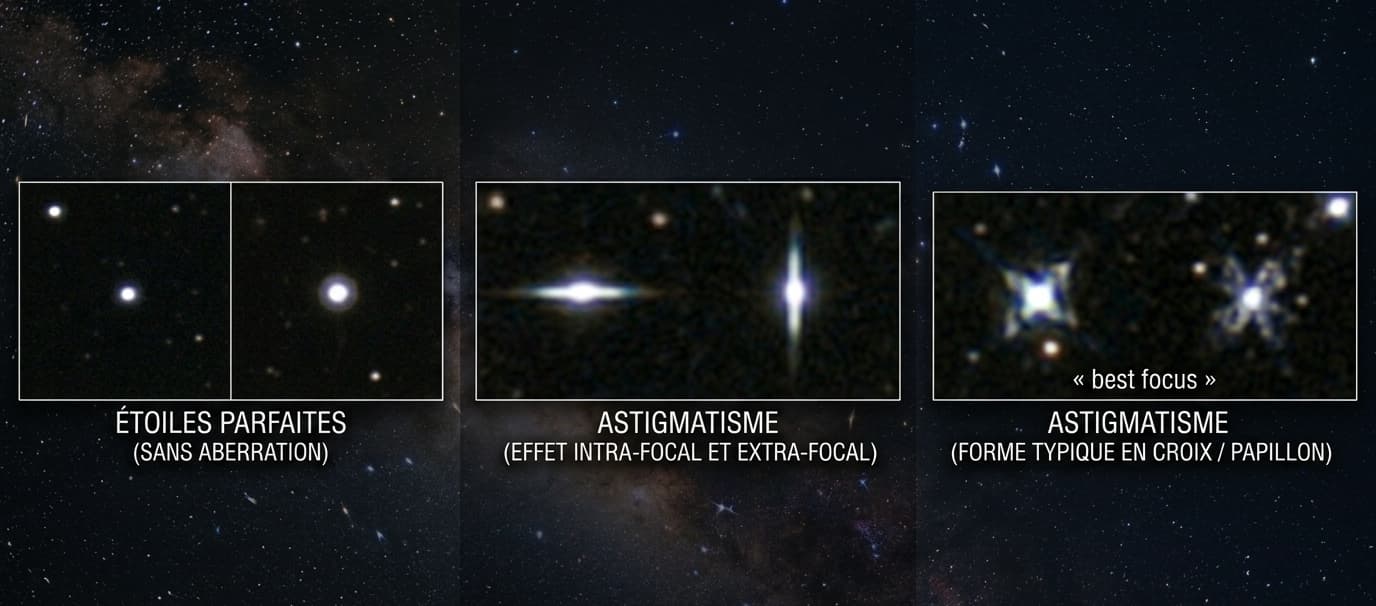
The diagnosis splits into two independent families. On the optical side the Moffat measurement is clear: the centre is clean (elong 1.08 against a 1.03 field floor, FWHM 4.67/4.31) and degradation appears at the periphery, with elongation rising to 1.33 on the top edge and 1.22 at the bottom, without a matching FWHM blow-up. That is the signature of field astigmatism. Superimposed on it is a single-axis asymmetry (0.098 horizontal versus 0.026 vertical, corner/centre ratio 1.19) pointing to a slight sensor plane tilt: the upper-right side is consistently softer than the mid-right edge. On a Seestar both defects fall within factory assembly tolerances and are not user-adjustable, hence a severity deliberately capped at 2: they are handled with an edge crop, not a mechanical intervention.
On the processing side the dominant problem is dynamic range. The Huygens core forms a flat white plateau with no hue at all, the Trapezium is entirely drowned in it, and more than a dozen bright field stars have lost their colour index. This is what costs the image the most, and it is also the easiest to fix: it is solved at acquisition with a short-exposure set merged in HDR, not by a curve tweak after the fact on already clipped data.
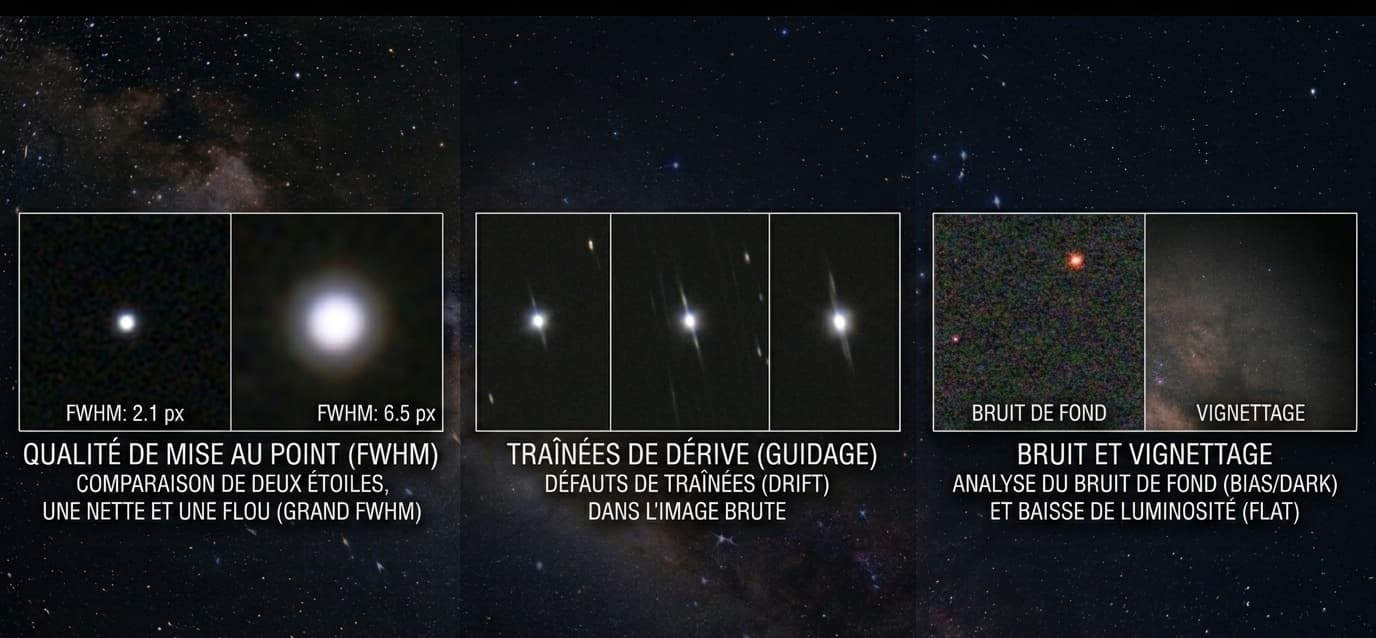
Finally the sky background still shows colour mottling in the lower half, consistent with short integration in 60s subs under a 64% moon. The background map shows no instrumental calibration defect, the Seestar's flats and darks are doing their job correctly.
Priority actions
- Shoot a short-exposure set (5-10s) on M42 and merge it in HDR to recover the Trapezium and the Huygens core
- Extend total integration (aim for several hours) to collapse the background chroma noise and bring out the faint extensions
- Process the stars separately (StarXTerminator) and stretch them with a gentle curve to restore their colour
- Crop 5 to 10% off the edges to remove stars ovalised by field astigmatism and residual tilt
- Schedule a session outside the lunar period to gain on the sky background and the outer wisps