Astrophotography diagnosis of M 31: Sensor tilt
RawL300s03 sept. 2026
The Doc examined this image of M 31 (raw, L, 300s). Estimated overall technical quality: 7/10. 1 defect found: Sensor tilt (severity 3/5).
&w=1920&q=75)
Info
- Cible
- M 31
- Date
- 03 sept. 2026, 21:16
- Lune
- Premier quartier 45.4% (1° d'alt., 45.6° de la cible)
- Site
- Bortle 2 · rural typique (VIIRS)
- Position
- 0h42m44s · +41°17'29"
Very favorable conditions. Bortle 2 on a galaxy in luminance is the ideal scenario: the sky background stays low and no instrumental or light pollution gradient is measurable. The Moon, at 45% and only 1° above the horizon at 45.6° from the target, has no usable impact: at that altitude its flux is absorbed by atmospheric extinction and it is setting anyway. In other words you have no excuse on the sky side, which the background measurement confirms. On M31 in L under such a sky you can safely extend total integration; the limiting factors will be seeing and tilt, not transparency or the Moon.
Setup
- Type d'image
- Brut
- Télescope
- Takahashi FSQ 530@F\5.0
- Caméra
- PlayerOne CCD Zeus 455M PRO
- Filtre
- L
- Exposition
- 300s
- Phase de lune
- Dernier quartier (55 %)
- FOV
- 3.89°
The FSQ 530mm f/5 and Zeus 455M pairing is coherent for M31: 3.89° of field, the galaxy and its satellites are comfortably contained with margin for the disk extension. Sampling at 1.46"/px is comfortable and well matched to typical seeing, as the 2.2 px central FWHM confirms. Two reservations on the settings: the background-to-black-point margin is thin (e_margin 1.82) with a Bowley skew of 0.47, so in luminance under Bortle 2 you are close to the read-noise-limited regime; on this sensor, raising the offset slightly or lengthening the exposure would secure the background. And a sensor temperature of 0°C is high for 300s subs: go down to -10°C to limit dark current.
The diagnosis in detail
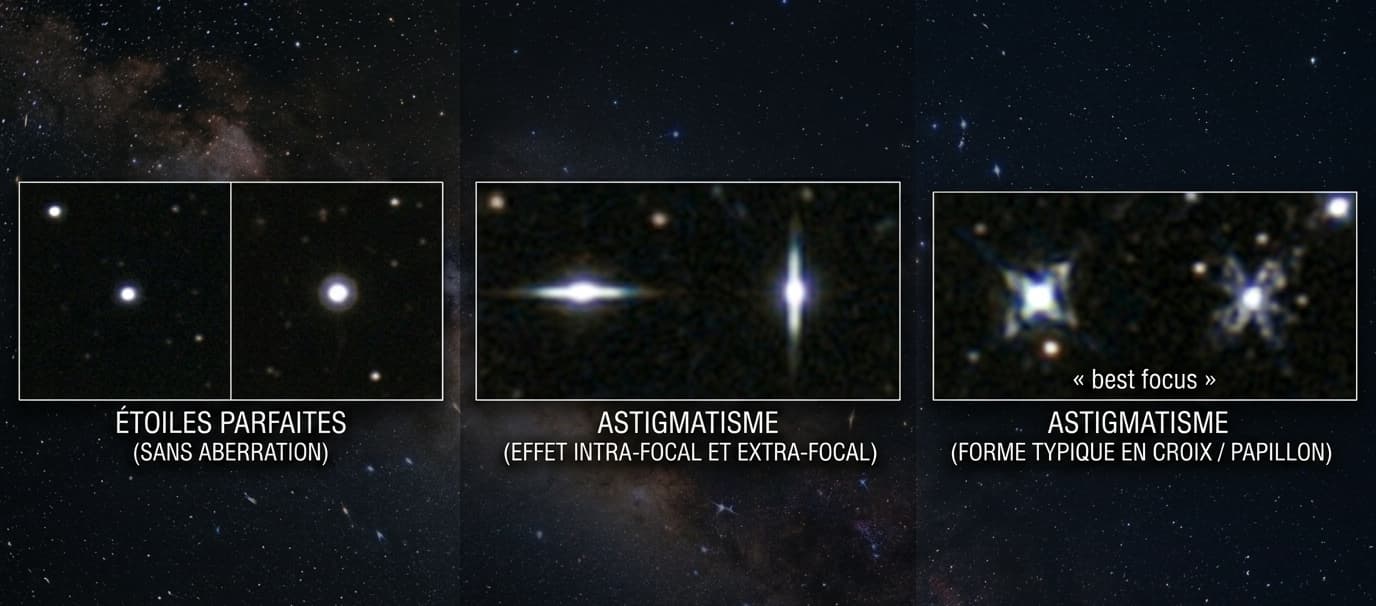
The diagnosis comes down to one point: star shape is excellent at the center and degrades only in the lower half of the field. The center measures 2.24/2.08 px with an elongation of 1.08, essentially at the field floor (1.07), so optics and focus are good, and so is tracking, since a mount issue would affect the center as much as the edges. The bottom-right corner, however, rises to 1.49 elongation and the bottom-left to 4.9 px FWHM, against 2.24 at top-left. This asymmetry between opposite corners with a healthy center is the classic signature of tilt, not a backfocus error, which would degrade all four corners symmetrically.
Everything else holds up: the sky background is clean, no usable gradient is measurable (the object fills the field, as the background map flags), and the DSS confirms that all the nebulosity around the bulge is genuinely the M31 disk and not an artifact. The 0.04% saturated pixels correspond to the bulge and a few bright stars, normal behavior in luminance at 300s.
Clear priority: fix the tilt before committing to the run. Then revisit cooling temperature and offset to secure calibration.
Priority actions
- Correct the imaging train tilt: the bottom of the field, especially the bottom-right corner, is clearly more degraded than the top-left
- Verify the exact FSQ corrector backfocus after re-setting tilt, then run a control aberration inspector
- Lower sensor temperature to -10°C instead of 0°C to limit dark current on 300s subs
- Slightly raise the offset or the exposure to lift the background-to-black-point margin (e_margin 1.82, currently tight)