Astrophotography diagnosis of M 31: Tracking drift
Raw300s07 sept. 2026
The Doc examined this image of M 31 (raw, 300s). Estimated overall technical quality: 7/10. 1 defect found: Tracking drift (severity 2/5).
&w=1920&q=75)
Info
- Cible
- M 31
- Date
- 07 sept. 2026, 20:24
- Lune
- Gibbeuse croissante 86.6% (sous l'horizon)
- Site
- Bortle 2 · rural typique (VIIRS)
- Position
- 0h43m03s · +40°19'11"
Very favorable conditions. The Bortle 2 sky is what explains the near neutral background and the lack of any significant light pollution gradient, and the Moon, although 86.6% illuminated, is below the horizon and 93 degrees from the target: its influence on this frame is nil. This is exactly the ideal context for broadband M31, a target that does not forgive a milky sky. The only measured gradient (4% amplitude, 32.6 degree orientation) is very weak and will come out easily with background extraction. In short, nothing in the conditions limits this session: the room for improvement is mechanical, not atmospheric.
Setup
- Type d'image
- Brut
- Télescope
- EQMod Mount
- Caméra
- ZWO ASI585MM Pro
- Exposition
- 300s
- Phase de lune
- Dernier croissant (16 %)
- FOV
- 3.36°
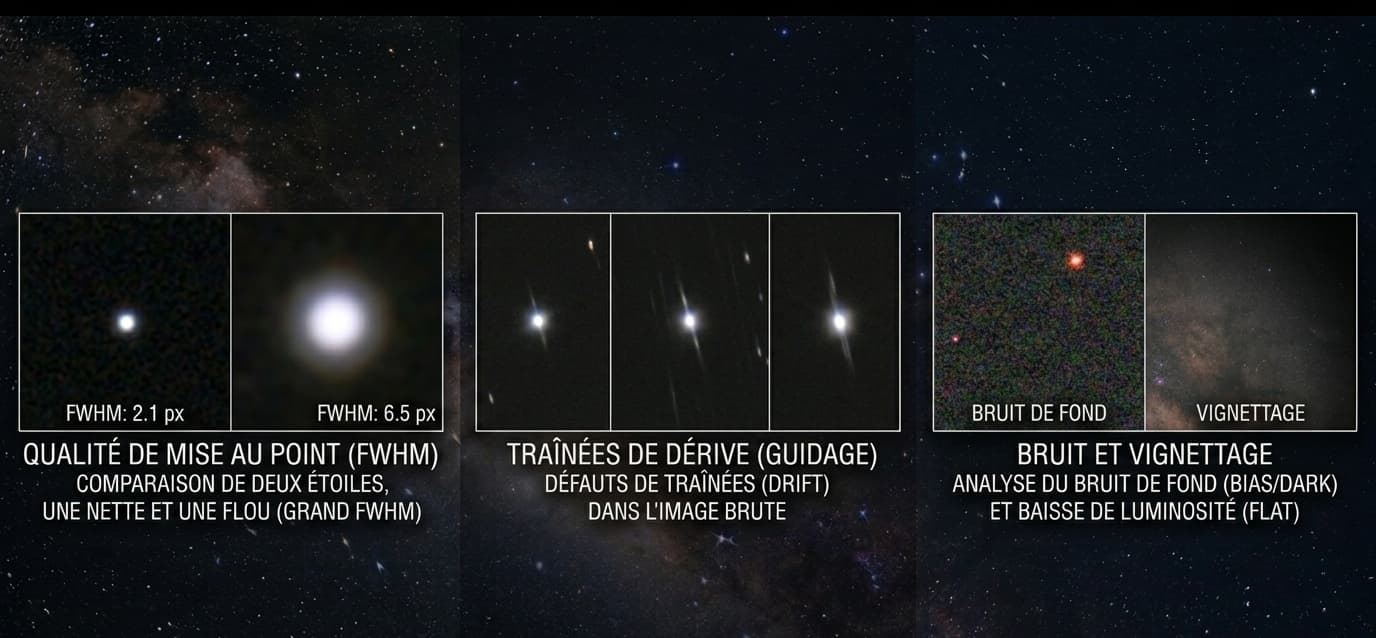
A coherent setup, but short on focal length for the target. At 190mm the 3.36 degree field takes in M31 and its companions very generously: the framing leaves the galaxy fairly small in the frame with a lot of empty sky around it, comfortable but not ambitious in resolution. The 3.15 arcsec/px sampling is clearly undersampled, consistent with measured FWHM of only 1.5-1.8 px: you lose detail, and it also makes star shape measurement more sensitive to noise. On settings, gain 130 and -15C are healthy, and the absence of dark clipping shows offset 15 is sufficient. The background-to-black-point margin (e_margin 2.36) stays low: under Bortle 2 with a 300s sub that is expected, you are limited by the very dark sky rather than by a faulty setting.
The diagnosis in detail
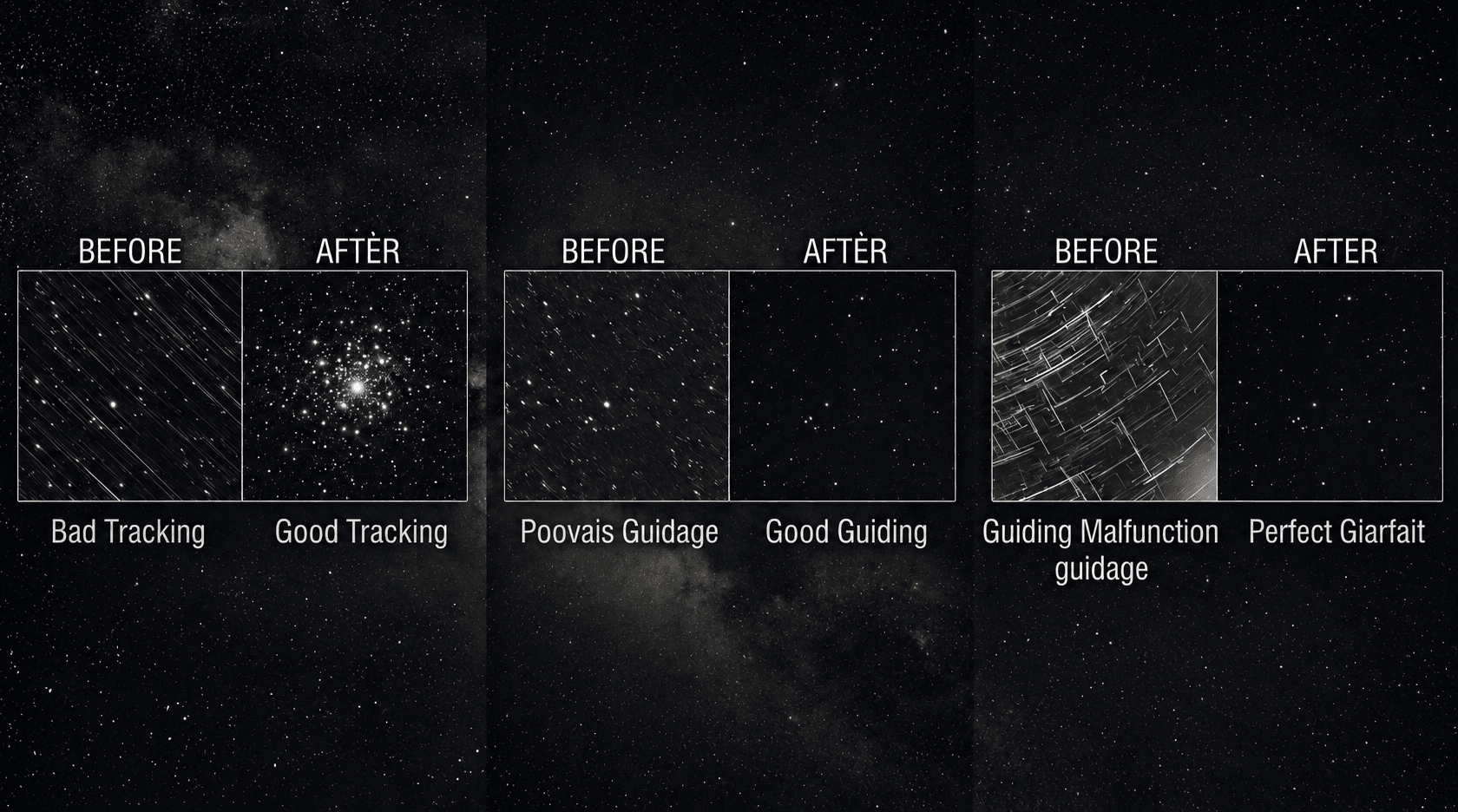
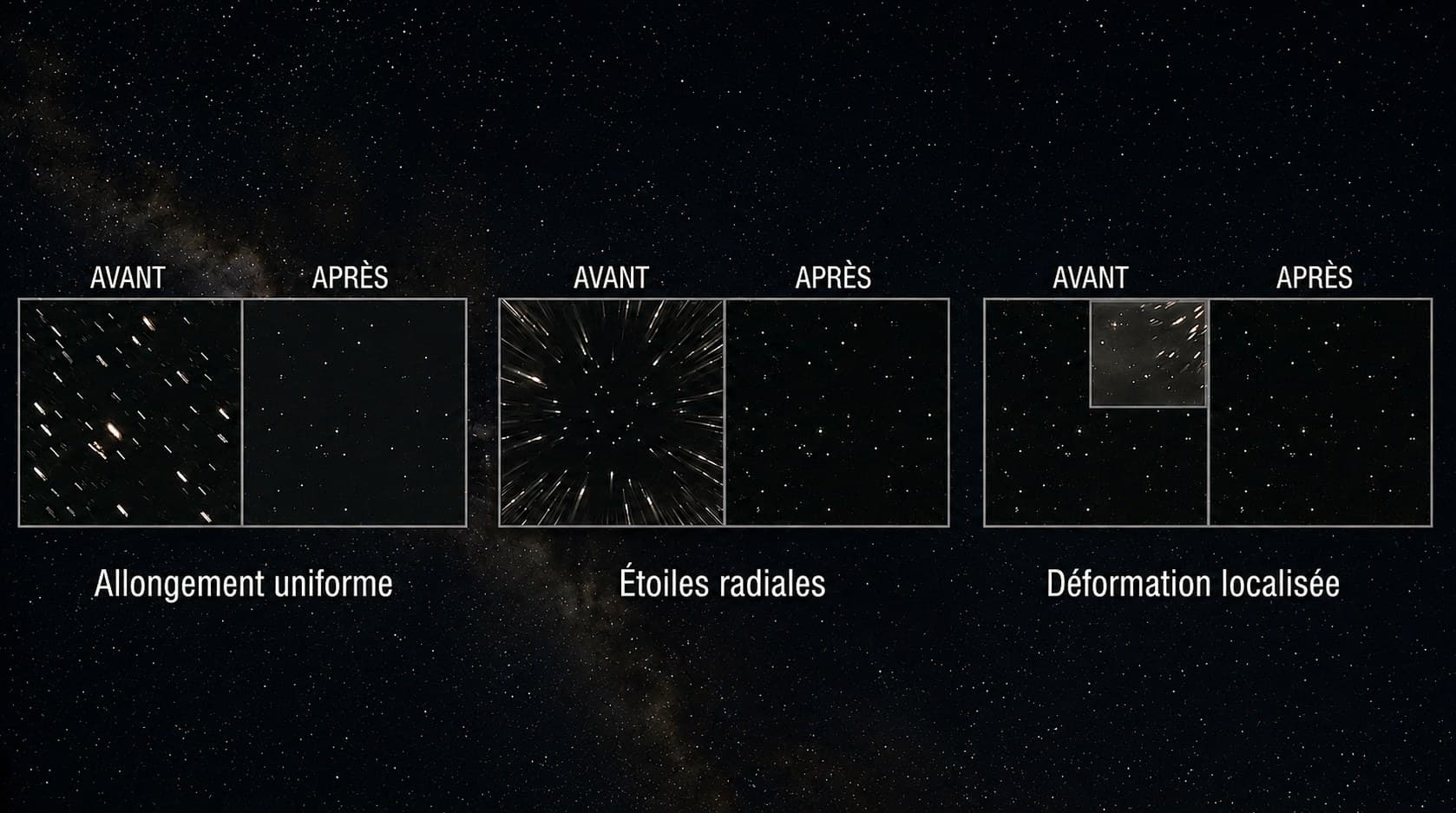
The diagnosis comes down to a single, well identified point. The aberration inspector shows an elongation of 1.30 at field center while the instrumental floor is 1.11, and above all a corner/center FWHM ratio of 0.88, so below 1. In other words the edges are not degraded relative to the center, which immediately rules out the classic optical causes (tilt, backfocus, coma, astigmatism). A deformation present at the center and uniform across the field can only come from relative motion between sky and sensor during the exposure.
The low PA scatter (14.2 degrees, with angles clustered around 70-77) confirms a stable elongation direction across the whole frame, the signature of a steady drift rather than guiding oscillation or periodic error, which would produce varying directions or curved streaks. On the PSF sheet the stars remain compact, slightly stretched cores, with no doubling.
The real impact is moderate: at 3.15 arcsec/px, an elongation of 1.30 on 1.5-1.8 px FWHM stays subtle on the preview, and stacking with rejection will not soften it since it is systematic. So it is a defect to fix at acquisition if you want to make full use of this Bortle 2 sky. The rest is clean: even background, negligible residual gradient, no sign of saturation or invasive hot pixels.
Priority actions
- Redo polar alignment with a drift align or the NINA polar assistant before the next session
- Enable or tighten PHD2 autoguiding to hold 300s subs without drift
- Check mount balance and imaging train tightness
- Consider a longer focal length if you want the resolution, since 3.15 arcsec/px sampling caps the detail on M31