Astrophotography diagnosis of M 33 - Triangulum Galaxy: Sensor tilt and light pollution gradient
MasterH300s04 sept. 2026
The Doc examined this image of M 33 - Triangulum Galaxy (master, H, 300s). Estimated overall technical quality: 7/10. 2 defects found: Sensor tilt (severity 3/5), Light pollution gradient (severity 2/5).
&w=1920&q=75)
Info
- Cible
- M 33 - Triangulum Galaxy
- Date
- 04 sept. 2026, 23:33
- Lune
- Gibbeuse croissante 58.1% (13.3° d'alt., 49.3° de la cible)
- Site
- Bortle 5 · banlieue résidentielle (saisi)
- Position
- 1h33m55s · +30°38'31"
Average but workable conditions. Bortle 5 with a 58% gibbous Moon peaking at 13 degrees and only 49 degrees from the target: that combination explains the 8% background ramp. The H-alpha filter saves you here, cutting most of the lunar continuum and urban glow, which keeps the session fully usable despite the context. That said, if you plan to add RGB for M 33's colors, save it for a moonless night: in broadband on a galaxy, these same conditions would ruin the outer halo SNR. H-alpha, on the other hand, can keep accumulating under this Moon.
Setup
- Type d'image
- Master
- Télescope
- Askar SQA70 Pro
- Caméra
- ATR2600M
- Filtre
- H
- Monture
- TeSeek HM-17 PE
- Exposition
- 300s
- Phase de lune
- Dernier quartier (44 %)
- FOV
- 3.83°
Well matched combination. At 338 mm focal length, the 3.83 degree field leaves M 33 (about 1.2 degrees) comfortably centered with room for the outer halo and peripheral HII regions: nothing is cut off. Sampling at 1.14 arcsec/px is consistent with the measured central FWHM (4.22 px, roughly 4.8 arcsec), so you are correctly sampled without pointless oversampling. H-alpha on M 33 is a sound choice: the galaxy is rich in HII regions (NGC 604 foremost) and that signal accumulates under moonlight. On the histogram side, e_margin=2.23 would flag underexposure in broadband, but in narrow narrowband at 300s this is normal and expected, it changes nothing.
The diagnosis in detail
The verdict is good: this master is usable as is, with two targeted corrections. On the PSF side the measurement is clear. A center at 4.22 px and elongations between 1.03 and 1.10 on a field floor of 1.03 mean the stars are round everywhere, so no tracking failure, no periodic error, no astigmatism. The mount holds 300s without complaint and the night's seeing was decent.
The only shape defect is a sensor plane tilt. It reads in the single-axis asymmetry: 0.059 vertical against 0.001 horizontal, with a top-left corner at 5.67 px while bottom-left stays at 4.28 px. A backfocus error would degrade all four corners symmetrically, which is not the case here. This is mechanical, so recoverable upstream without touching the data: rebuild the imaging train before the next session.
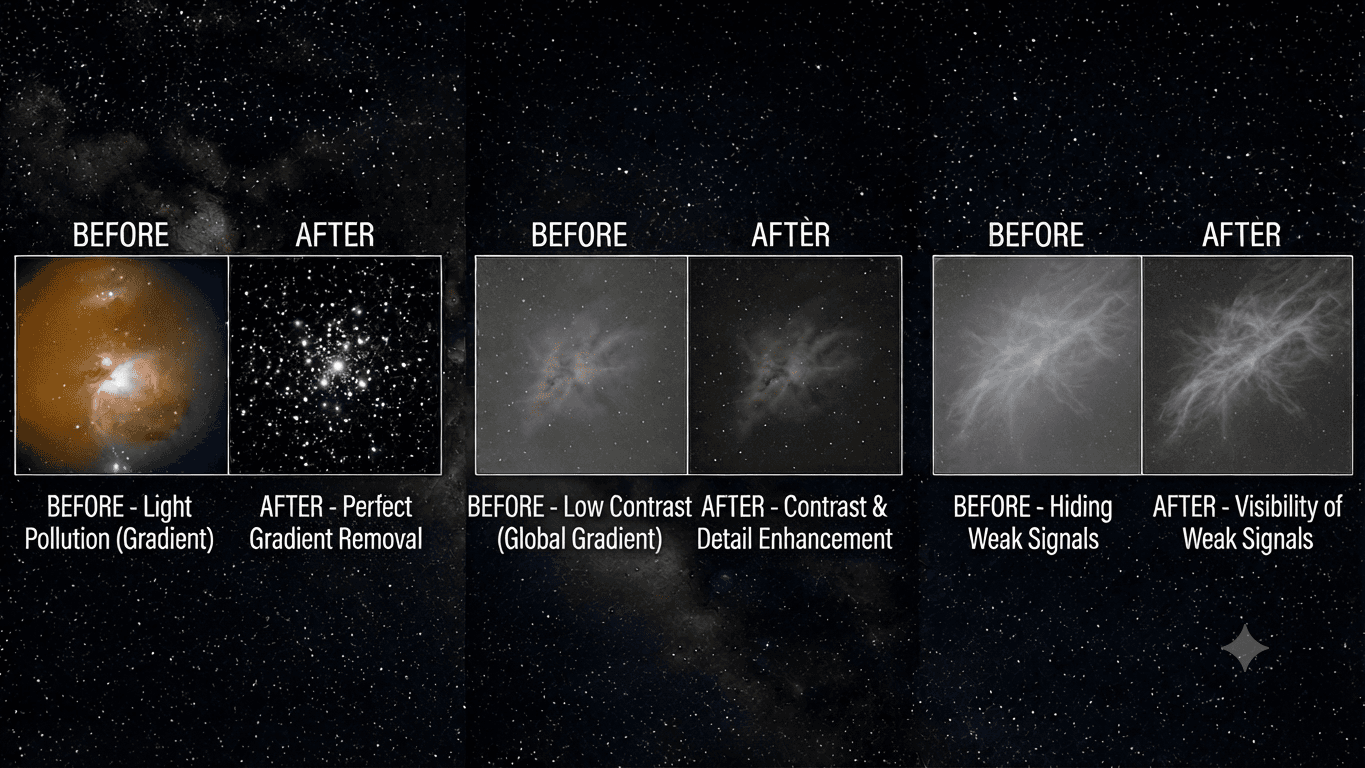
The second point is atmospheric, not instrumental. The background rises linearly by 8% toward 255 degrees, with a perfectly flat radial profile that rules out any residual vignetting: your flats are doing their job. This is the signature of light pollution combined with the low Moon, and gradient removal in processing erases it at no cost to the signal.
Priority actions
- Fix the sensor tilt before the next session: rebuild the imaging train clamping and adjust a tilt plate, re-measuring with the aberration inspector
- Apply gradient removal (GraXpert or DBE degree 1) on the master before any stretch
- Accumulate more H-alpha subs to strengthen the SNR of M 33's outer halo
- Plan future sessions with M 33 higher above the horizon and with no Moon present